THE CLASSIC COLLECTION✦Vanished Halls and Cathedrals of FranceCLASSIC FREE BOOKS
Vanished Halls and Cathedrals of France
George Wharton Edwards
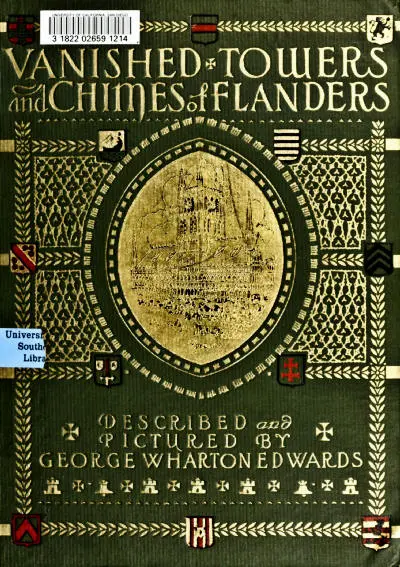
THE CLASSIC COLLECTION · 1916
"Vanished Towers and Chimes of Flanders" by George Wharton Edwards is a historical account written in the early 20th century. The focus of the text is on the once-vibrant region of Flanders, particularly its architectural marvels, the social landscape of its towns, and the melodious chimes from the bells that marked the lives of its people. The author reflects on the cultural significance of these towers and bells, especially in the light of the destruction they faced during the war. At the start of the work, Edwards provides a foreword that illustrates the plight of the Flemish people, their little-known heritage, and the beauty of their towns, especially the architectural grandeur of the belfries and cathedrals. He recounts his observations on the nature of the Flemish culture, characterized by their artistic achievements and deep-seated Catholic faith. The opening chapters not only highlight the historical richness of towns like Malines and Ypres but also introduce us to their iconic structures and the unique sounds of their bells, which poignantly resonate with the reader as symbols of a past now marred by war. The narrative sets a tone of nostalgia and loss, as the author laments the destruction of this exquisite heritage.
Introduction adapted from the source catalogue; source summaries may be automatically generated.
Free to read · English · 35,428 words · No account needed
MAKE TIME FOR A GOOD BOOK
On by default. Untick to stop anonymous reading totals. Each page counts after 10 seconds in view. How this works.
Anonymous counting is on unless you have switched it off.
Michael or Michel Coxie, le vieux, was a greatly esteemed painter who worked under the direction of Raphael. His real name was Van Coxcien, or Coxcyen, but he changed its form to Coxie.
His son, Michel Coxie le Jeune, surnamed the Flemish Raphael, was born in 1499, and first studied under his father. He was shortly placed with Bernard Van Orley, who sent him to Rome, where he might study the work of Raphael Sanzio. His work was of very unequal merit, although he painted hundreds of compositions in triptych form for the churches. Towards the end of his life he was commissioned to paint a decoration for the Hotel de Ville of Antwerp. He fell from the scaffolding during his work, receiving such injuries that he was incapacitated. Removed to his home in Malines, he died after some years of suffering, aged 93 years!
His second son, Raphael Coxie, born in 1540, was a painter of great merit, whose paintings were ordered for the Royal Spanish Cabinet. He lived at Antwerp, Ghent, and Brussels respectively, and died, full of honors, in 1616.
Michael, or Michel, Coxie, the third of the name, was received in the Gild of Painters the 28th day of September, 1598. He is the author of the triptych over the altar of the "Jardiniers" of Notre-Dame au dela de la Dyle. He died in 1618.
Michel Coxie, the Fourth, son of the above, born September, 1604, was elected to the Gild in 1623. He became Court Painter to the King.
Jean Coxie, son of Michel (above) excelled as a painter of landscape. He it was who decorated the two great salons of the "Parc" Abbey. The subjects were drawn from the life of Saint Norbert.
His son, Jean-Michel, though a member of the Gild of Malines, passed almost his whole life in Amsterdam, Dusseldorf, and Berlin. In the latter town he enjoyed the favor and patronage of Frederick I. He died in Milan in 1720.
Jean de Gruyter, gold worker and engraver, came in 1504 to Malines, where he enjoyed a certain renown. After his death in 1518, his sons Jean and Pierre continued the work which he began. Jean made seals of great beauty of detail, but Pierre was condemned to banishment in 1536 and confiscation of all his goods and chattels, for counterfeiting the state coinage.
Jean Hoogenbergh, born about 1500, was a successful painter of miniatures; he lived about fifty years.
Jean Van Ophem was appointed Civic Engraver of Seals and Gold Worker. He
died in 1553.
Francois Verbeek became master workman in 1531, and finally doyen of the craft. He abandoned oil painting for distemper, in which medium he excelled, producing masterpieces depicting the most fantastic subjects. He died in July, 1570.
Your reading position is saved on this browser. Take it to another device with a library code. Reading pages adapt to text, rather than matching a printed edition.
BEHIND THE BOOK
This eBook is for the use of anyone anywhere in the United States and most other parts of the world at no cost and with almost no restrictions whatsoever. You may copy it, give it away or re-use it under the terms of the Project Gutenberg License included with this eBook or online at www.gutenberg.org. If you are not located in the United States, you will have to check the laws of the country where you are located before using this eBook. Read the source licence.
The original source file, including credits and licence, is retained by this library. Request an original-format copy at no charge. Please include the book title and Project Gutenberg identifier #28288.
KEEP YOUR CURIOSITY GOING
Wilfrid Scawen Blunt
Wilfrid Scawen Blunt

E. W. (Edgar Watson) Howe

David Patterson (Spirit) Hatch

David Patterson (Spirit) Hatch

David Patterson (Spirit) Hatch