Captain Craig
Edwin Arlington Robinson
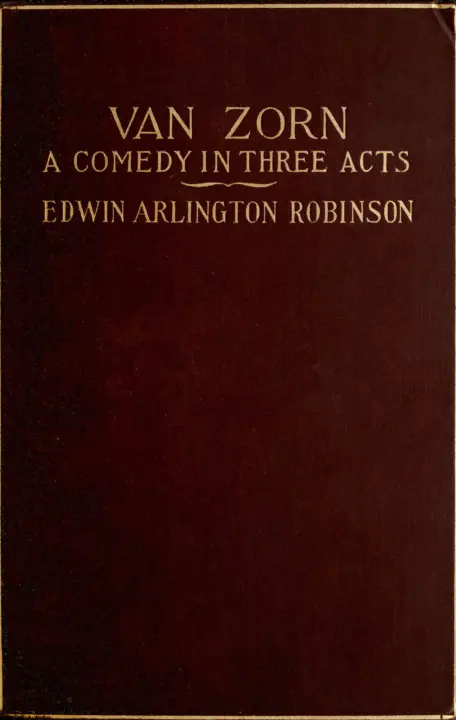
THE CLASSIC COLLECTION · 1914
Van Zorn is a comedy of New York City artist life written in 1914 by Edwin Arlington Robinson. It is one of Robinson's two published plays, published just before his volume of poems The Man Against the Sky. As of 1920, Van Zorn's only public performances was a 1917 run given in a Brooklyn hall by a semi-professional company. It has not fared so well in the hundred years since.
Van Zorn is about a fatalist who, attempting to play the part of destiny in a love affair, runs counter to a man with a destiny better than his own. (This summary is from Wikipedia.)
Introduction adapted from the source catalogue; source summaries may be automatically generated.
Free to read · English · 25,914 words · No account needed
MAKE TIME FOR A GOOD BOOK
On by default. Untick to stop anonymous reading totals. Each page counts after 10 seconds in view. How this works.
Anonymous counting is on unless you have switched it off.
So far as I count for anything, I suppose I’m as good a friend as you
have in the world.
[Pleased and embarrassed]
I’m glad to hear you say that, Otto.
[With more confidence]
You’d better wait till I’m done with you.
[Smiling]
Go on. I’m at your service.
[Clasping his knee and becoming very serious]
Very well. Tell me when to stop.
[Pause]
Phœbus, how much does Farnham know about you? Did he know anything
about you before he came to New York? Let me see, that was four years
ago.
[Surprised]
Probably not.
Well, then, did Farnham know Villa Vannevar before he came to New York?
[Surprised]
Not to my knowledge.
Am I getting too personal?
[Fighting with his curiosity]
You haven’t said anything injurious.
Good. Now does Farnham.... Oh, the devil! I suppose I ought not to ask you this, but I’m going to, all the same. Does Farnham know that Villa Vannevar cared more for you at one time than she cares now for any other man living?
[Rubbing his hands slowly]
I rather think, Otto, that you may as well stop.
Are you going to kick me?
No. Your motive is good, and I try to judge a fellow by his motive.
[Taking a cheap watch from his pocket, he looks at it and shakes it
at his ear]
What time is it?
[With much vigor]
Phœbus, you can’t put me off. I’ve got you now, and I’m going to tell you what I think of you.
[Shaking his watch at his ear]
What do you think of me?
[Nettled]
Well, I think you are going to the devil, for one thing.
[Grinning]
Only going? I was told the other day that I had arrived--with banners.
Did Farnham tell you that?
That was Farnham’s hidden meaning.
[After a pause]
Well, Phœbus, I can’t speak for Farnham. But there was a time when the rest of us would have said that you had empires up your sleeve.
[Impressively]
[Looking at his sleeve]
Then they must be there yet. I’ve never shaken them out.
[With more fervor]
They may be there, but all the devils in hell, with microscopes, couldn’t find them there this morning. As you are fond of reading, you may have gathered, from various authorities, that empires don’t run themselves, exactly. When they do, they run down.
Like my watch.
[He shakes it, and returns it to his pocket]
Your reading position is saved on this browser. Take it to another device with a library code. Reading pages adapt to text, rather than matching a printed edition.
Edwin Arlington Robinson
Edwin Arlington Robinson
Edwin Arlington Robinson
BEHIND THE BOOK
This eBook is for the use of anyone anywhere in the United States and most other parts of the world at no cost and with almost no restrictions whatsoever. You may copy it, give it away or re-use it under the terms of the Project Gutenberg License included with this eBook or online at www.gutenberg.org. If you are not located in the United States, you will have to check the laws of the country where you are located before using this eBook. Read the source licence.
The original source file, including credits and licence, is retained by this library. Request an original-format copy at no charge. Please include the book title and Project Gutenberg identifier #78762.
KEEP YOUR CURIOSITY GOING
Maurice Baring
W. B. (William Butler) Yeats
Edward Martyn

John Brougham & Charlotte Brontë
Marguerite Merington
Leonid Andreyev