Captain Craig
Edwin Arlington Robinson
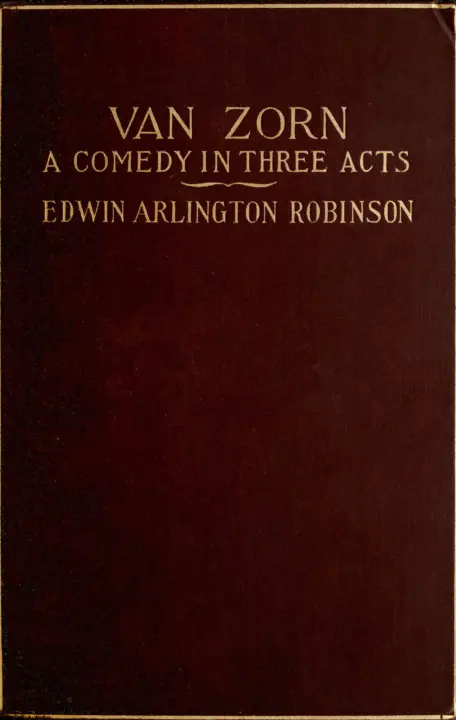
THE CLASSIC COLLECTION · 1914
Van Zorn is a comedy of New York City artist life written in 1914 by Edwin Arlington Robinson. It is one of Robinson's two published plays, published just before his volume of poems The Man Against the Sky. As of 1920, Van Zorn's only public performances was a 1917 run given in a Brooklyn hall by a semi-professional company. It has not fared so well in the hundred years since.
Van Zorn is about a fatalist who, attempting to play the part of destiny in a love affair, runs counter to a man with a destiny better than his own. (This summary is from Wikipedia.)
Introduction adapted from the source catalogue; source summaries may be automatically generated.
Free to read · English · 25,914 words · No account needed
MAKE TIME FOR A GOOD BOOK
On by default. Untick to stop anonymous reading totals. Each page counts after 10 seconds in view. How this works.
Anonymous counting is on unless you have switched it off.
You see, this friend of ours fills himself with fluid extract of early death for certain years, and then, all of a sudden, on Broadway, not far from Forty-second Street, he slaps a fellow kindly on the shoulder and tells a fellow that he, Phœbus, has been born again. That was it,--“born again.”
[To VILLA, who has risen to her feet in her excitement]
The man is illuminated, I tell you. There is something in his eyes.
[With tightening lips]
Let us hope it is not dust.
[Standing on his toes]
No, the dust is in our eyes, if anywhere. Or it was.
[To VAN ZORN, gratefully]
Not in yours, at any rate.... And you have been the cause of it all!
[OTTO looks at VAN ZORN in amazement]
[As before]
On the contrary, I don’t know that I have ever been the cause of anything. But I agree with you in saying that this was the only course for him to take, although I have never shared your fear that he would not take it.
[Still wondering]
But how did you know anything about him?
[Smiling faintly]
Oh, there are signs. Moreover, I permitted Farnham to tell me as much as he would about Lucas’s early life.
But he cannot possibly know much about it.
[Thoughtfully]
He spoke, I think, of an eccentric father.
[He glances at the portrait of LOVETT]
Weldon was not here in those days and perhaps it was as well that he was not,--for he might not have understood.
[As if to correct herself]
I mean that men like Weldon find it hard to measure the importance of things that happen in other people’s lives. They can’t do otherwise, I suppose.
All of which being granted, there still remains no room for doubt as to Farnham’s friendliness towards Lucas.
[Vexed]
I didn’t mean that. I don’t see how I came to speak as I did.
[Going to VILLA]
I’m very much afraid that you must put me down as the tender and innocent cause. Pardon my interruption, and--beware the book.
[After a somewhat bewildered pause]
Good afternoon.
[As he is going]
Is there very much about Nineveh in it?
[She laughs rather thinly]
[With a grimace]
Nineveh occurs but twice, and Babylon has disappeared entirely.
[He bows with exaggerated deference and disappears]
Your reading position is saved on this browser. Take it to another device with a library code. Reading pages adapt to text, rather than matching a printed edition.
Edwin Arlington Robinson
Edwin Arlington Robinson
Edwin Arlington Robinson
BEHIND THE BOOK
This eBook is for the use of anyone anywhere in the United States and most other parts of the world at no cost and with almost no restrictions whatsoever. You may copy it, give it away or re-use it under the terms of the Project Gutenberg License included with this eBook or online at www.gutenberg.org. If you are not located in the United States, you will have to check the laws of the country where you are located before using this eBook. Read the source licence.
The original source file, including credits and licence, is retained by this library. Request an original-format copy at no charge. Please include the book title and Project Gutenberg identifier #78762.
KEEP YOUR CURIOSITY GOING
Maurice Baring
W. B. (William Butler) Yeats
Edward Martyn

John Brougham & Charlotte Brontë
Marguerite Merington
Leonid Andreyev