Captain Craig
Edwin Arlington Robinson
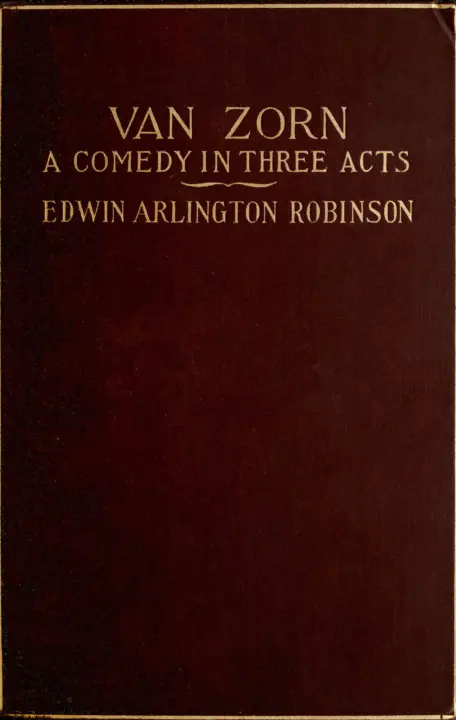
THE CLASSIC COLLECTION · 1914
Van Zorn is a comedy of New York City artist life written in 1914 by Edwin Arlington Robinson. It is one of Robinson's two published plays, published just before his volume of poems The Man Against the Sky. As of 1920, Van Zorn's only public performances was a 1917 run given in a Brooklyn hall by a semi-professional company. It has not fared so well in the hundred years since.
Van Zorn is about a fatalist who, attempting to play the part of destiny in a love affair, runs counter to a man with a destiny better than his own. (This summary is from Wikipedia.)
Introduction adapted from the source catalogue; source summaries may be automatically generated.
Free to read · English · 25,914 words · No account needed
MAKE TIME FOR A GOOD BOOK
On by default. Untick to stop anonymous reading totals. Each page counts after 10 seconds in view. How this works.
Anonymous counting is on unless you have switched it off.
[Rising with a sigh]
It may be so, poor fellow. If he were not so thoroughly impossible, he would be rather interesting.
[VILLA looks at her almost angrily]
May I venture to ask, Mrs. Lovett, if you are final in your judgment?
[With apologetic vivacity]
Dear me, no! I don’t judge anything--not even a fly.
[Smiling, as if with effort]
I am very glad, for I have begun to believe that Mr. Lucas and I may be of service to each other.
[VILLA looks at him eagerly]
[Puzzled and not wholly pleased]
I don’t understand what you mean, and I’m not going to try.
I am not always sure that I understand myself.
[With a nervous laugh]
I’m glad to know it, for I’m not either.
[To MRS. LOVETT]
Come along, Auntie, or Mrs. Dyce’s little dogs will eat up all the
luncheon.
[Laughing]
Pomeranian twins!
[Giving her hand to VAN ZORN]
Good-bye.... I’m glad you aren’t the Flying Dutchman.
[Holding her hand]
Nothing half so distinguished, I assure you.
[Not wholly at ease]
Or so unfortunate.
[Letting her hand go, slowly]
I am not so sure about that.
Weldon thinks you are the greatest man in the world
[To FARNHAM, laughing]
--except himself.
[Beaming]
And the most wonderful creature.
[Smiling]
Weldon has made a mistake.
You are too modest.
Do you think so?
[With the same constrained laugh]
Perhaps I don’t know you well enough to say.
We may come to know each other better in the future.
I feel sure of that. I should like to know you better.
[Smiling]
You may be disappointed in me.
[As before]
If I am, I’ll tell you so.
[Who has been watching the two with bewildered approval]
She means that she will say, on all occasions, the first thing that comes into her silly little head.--But we must go now. Good-bye.
[THEY shake hands. VAN ZORN and VILLA VANNEVAR look at each
other with a smile of half-fascinated intensity. The two women
go]
[Coming from the door and touching VAN ZORN on the shoulder,
laughing curiously]
Well, Childe Harold, for a sedate and rather melancholy Ancient Mariner, you seem to be getting on.
[Standing in thought]
Yes, I am getting on in years.
Oh, cheer up. We are only thirty two. “We are children still,” and we “grope in the dark for what the day will bring.”
Your reading position is saved on this browser. Take it to another device with a library code. Reading pages adapt to text, rather than matching a printed edition.
Edwin Arlington Robinson
Edwin Arlington Robinson
Edwin Arlington Robinson
BEHIND THE BOOK
This eBook is for the use of anyone anywhere in the United States and most other parts of the world at no cost and with almost no restrictions whatsoever. You may copy it, give it away or re-use it under the terms of the Project Gutenberg License included with this eBook or online at www.gutenberg.org. If you are not located in the United States, you will have to check the laws of the country where you are located before using this eBook. Read the source licence.
The original source file, including credits and licence, is retained by this library. Request an original-format copy at no charge. Please include the book title and Project Gutenberg identifier #78762.
KEEP YOUR CURIOSITY GOING
Maurice Baring
W. B. (William Butler) Yeats
Edward Martyn

John Brougham & Charlotte Brontë
Marguerite Merington
Leonid Andreyev