THE CLASSIC COLLECTION✦Nigeria and its tin fieldsCLASSIC FREE BOOKS
Nigeria and its tin fields
Albert Frederick Calvert
THE CLASSIC COLLECTION · 1908
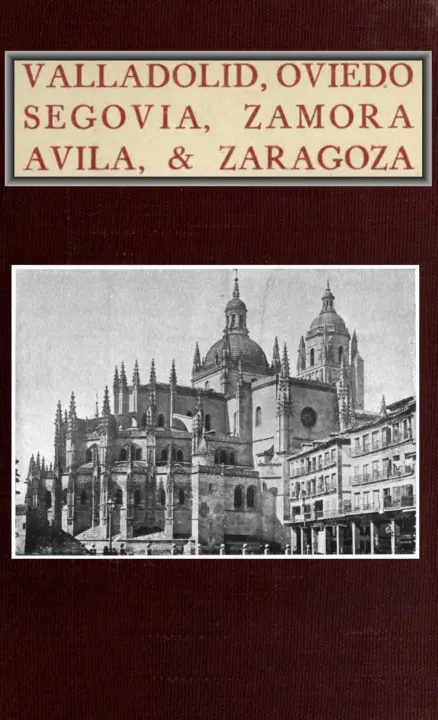
"Valladolid, Oviedo, Segovia, Zamora, Avila & Zaragoza" by Albert Frederick Calvert is a historical and descriptive account written in the early 20th century. The book covers six lesser-known cities in Spain, highlighting their architectural and cultural significance, as well as their historical importance. Calvert aims to shed light on these cities for English travelers, who may overlook their rich heritage in favor of more famous destinations. The opening of the book sets the stage by emphasizing the historical backdrop and contemporary relevance of Valladolid, the first city discussed. Calvert notes the city's once prominent role as a political capital and its connections to notable figures such as Cervantes and Columbus. He describes Valladolid as bustling and ingrained with history, with various anecdotes illustrating its turbulent past, including turbulent political events and notable historic figures. The author draws the reader’s attention to the city’s memories, architecture, and significance, priming the exploration of each city that follows.
Introduction adapted from the source catalogue; source summaries may be automatically generated.
Free to read · English · 40,655 words · No account needed
MAKE TIME FOR A GOOD BOOK
On by default. Untick to stop anonymous reading totals. Each page counts after 10 seconds in view. How this works.
Anonymous counting is on unless you have switched it off.
A city which was so long the capital of the monarchy--the city where Columbus died and Cervantes lived--whose streets are haunted by the immortal creature of Le Sage’s genius--can be no unworthy goal for a pilgrimage. It has memories far more stirring than Madrid, which in physiognomy it rather resembles. A cold, formal town it seems at first sight, with modern-looking squares, straight streets, and severe, imposing buildings; but behind these you find the old city of Juan II. and Enrique IV., a labyrinth of tortuous lanes, gloomy palaces, and ruinous monastic houses.
The handsome Accra de Recoletos, which looks across the spacious Campo Grande--the city’s principal park--leads from the triumphal Puerta del Carmen, commemorating the reign of Charles III., to the majestic Arch of Santiago. We pass through, and presently reach the Plaza Mayor, now called the Plaza de la Constitucion, the focus of the city’s life.
A minor Puerta del Sol, Ford calls this regular, symmetrically planned open space, designed after the great fire of 1561 by Francisco Salamanca. The houses enclosing it are of uniform architecture, with three tiers of balconies in the three Grecian orders, capable, it is said, of accommodating 24,000 spectators. The portico is supported by massive granite columns of a bluish tinge, each a monolith. On the north side is the ungraceful Ayuntamiento (Town Hall), with weather-vanes on its towers and martial trophies surmounting the town clock. The space is as lively and gay as any in Spain. The sun shines brightly, the birds fly as freely overhead as across the innocent plains; here there is no deeper shadow than elsewhere, no abiding gloom or ghostly chill. Yet if ever a spot deserved to be called accursed it is this. Let us project ourselves back into the past, to a bright morning in May in the year 1559. The balconies have not yet been built, but stands and tiers of seats have been constructed round the Plaza. There is a grand display of bunting, and the richest draperies are hung from the crowded windows--silks and cloth of gold and silver, damasks and brocades. On a daïs are seen the little prince, Don Carlos, and his aunt the Infanta Juana. The civic dignitaries of the town are here, the craftsmen in their liveries; but making the bravest show of all are the bishop and the clergy, arrayed in full canonicals, as befits the solemn Act of Faith at which they are about to assist. The square is packed with a vast multitude--men have come from far and near to see this thing--and people are pouring down the narrow streets, an unceasing stream. All eyes are fixed on the platform in the centre of the Plaza, whereon faggots and brushwood are neatly piled round fourteen pillars, and busy varlets are bestirring themselves. A subdued murmur betokens the approach of the procession. For the alguazils who clear the way, for the horribly clad familiars of the Holy Office who stalk before, the spectators have no eyes: the gaze of those thousands is levelled on the fourteen men and women walking slowly to their awful doom. Were ever creatures so shockingly grotesque? They wear a perfectly ridiculous headgear, like an elongated nightcap, or a hat such as our grenadiers wore in days gone by; a sort of smock covers their bodies, an ugly flame-coloured garment, painted with figures of dancing and grimacing devils. You can hardly restrain a smile. I’ll wager those gallants yonder are cracking some clever jokes at their expense, for the Latin is by nature a wag. We all know who they are, these wretches. Not long before Valladolid was thrilled by the rumour that a Lutheran conventicle had been discovered here in the heart of His Most Catholic Majesty’s capital. A holy woman, suspicious of her husband’s orthodoxy, had followed him one day, found him in the midst of this heretical assembly, and denounced him to the Holy Office. That is the man, Juan Garcia, a goldsmith whom all the townsmen have known and dealt with this many a year. Where’s his wife? somewhere in the crowd, doubtless, praying for his soul. Virtue like hers is worthy of heroines or devils. Most notable of the heretical crew is the Doctor Cazalla, one of the king’s most notable preachers; but the Holy Inquisitors are no respecters of persons. They would drag you from behind the throne. The priest with the Doctor is his brother Francisco. The woman is his sister, Doña Beatriz. Burn a woman? Ay, surely. There are four more, one of them a serving-wench. That black-avised fellow is a mere Jew from Lisbon--there is little sympathy for him. Then there are four gentlemen, and--hold!--one has a gag in his mouth. It is the Bachelor, Antonio Herrerruelo, an obstinate fellow, who will not recede one hair’s-breadth from his heretical opinions or concede one iota. The sixteen that follow interest us less. They have been reconciled with Mother Church, and for them no worse fate is reserved than the confiscation of all their goods and solitary confinement for life. Ha! one of them has fainted. It is the youthful daughter of the Marqués de Alcañias, Doña Ana Enriques. They say that one of this batch is an Englishman. Perhaps he has seen Catholics hanged, drawn, and quartered in his own land, and can forgive the Spaniard.
Your reading position is saved on this browser. Take it to another device with a library code. Reading pages adapt to text, rather than matching a printed edition.
Albert Frederick Calvert
Albert Frederick Calvert
Albert Frederick Calvert
Albert Frederick Calvert
BEHIND THE BOOK
This eBook is for the use of anyone anywhere in the United States and most other parts of the world at no cost and with almost no restrictions whatsoever. You may copy it, give it away or re-use it under the terms of the Project Gutenberg License included with this eBook or online at www.gutenberg.org. If you are not located in the United States, you will have to check the laws of the country where you are located before using this eBook. Read the source licence.
The original source file, including credits and licence, is retained by this library. Request an original-format copy at no charge. Please include the book title and Project Gutenberg identifier #64970.
KEEP YOUR CURIOSITY GOING
Wilfrid Scawen Blunt
Wilfrid Scawen Blunt

E. W. (Edgar Watson) Howe
Cécile Tormay

Moritz Busch
John L. Ransom