THE CLASSIC COLLECTION✦My diaries, being a personal narrative of events 1888-1914, Part 2 (1900-1914)CLASSIC FREE BOOKS
My diaries, being a personal narrative of events 1888-1914, Part 2 (1900-1914)
Wilfrid Scawen Blunt
THE CLASSIC COLLECTION · 1903
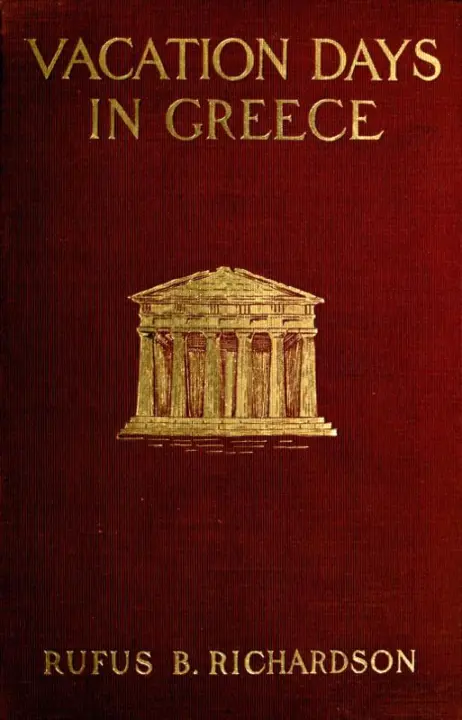
"Vacation Days in Greece" by Rufus B. Richardson is a travelogue written in the early 20th century. This book chronicles the author's personal experiences and explorations throughout Greece, highlighting regions that are often overlooked by conventional tourists. Richardson shares not just the beauty of the landscape and locales but also their historical relevance, providing readers with a rich tapestry of both personal narrative and cultural insight. The opening of the book details Richardson's initial impressions of Corfu, describing its natural beauty and vibrant local culture. He reflects on his journey through the island, noting the intoxicating scenery of olive groves and vineyards, the colorful traditional costumes of the locals, and the rich historical context that intertwines with the present day. Through evocative descriptions, he conveys a deep sense of appreciation for the land and its layered history, setting the tone for a narrative that promises a blend of travelogues and reflections on Greek history.
Introduction adapted from the source catalogue; source summaries may be automatically generated.
Free to read · English · 59,154 words · No account needed
MAKE TIME FOR A GOOD BOOK
On by default. Untick to stop anonymous reading totals. Each page counts after 10 seconds in view. How this works.
Anonymous counting is on unless you have switched it off.
The whole situation was changed at a single blow. The centre of interest shifts to the island, Sphacteria, where the Spartans were now imprisoned. The Athenians thought them sure game, and patrolled the island to cut off escape. The situation was so serious that the highest magistrates of Sparta appeared on the scene, and, after surveying the situation, decided that the only thing to do was to propose a truce. And a truce was immediately agreed upon, all the Spartan ships being given over to the Athenians as a pledge until Spartan envoys could be taken to Athens on an Athenian trireme and secure a permanent treaty of peace.
The envoys went and begged for peace, but the party in power at Athens made too great demands, and the envoys returned re infecta. The Athenians, claiming some slight infraction of the treaty, refused to deliver over the ships.
All interest was now centred on the fate of the Spartans shut up on Sphacteria. Instead of laying down their arms they waited for the Athenians to "come and take them." The starving process failed, because daring Spartans on shore were found who risked their lives to carry in provisions. Helots, especially, ran every risk, securing freedom as the price of success. The Athenians themselves suffered terribly, inasmuch as they controlled only the sea, and so were forced to take their meals in cramped quarters or in imminent fear of attack by the dreaded Spartan hoplite. More painful still was the lack of good drinking water. They were obliged to scratch away the sand with their hands and drink brackish sea water. The Spartans on the island had a well which afforded much better water. When this strain had lasted nearly two months the patience of the Athenians gave out. But just at this critical time a fire was accidentally started on the island by some Athenians who were cooking their dinner there, out of sight of the Spartans. Nearly the whole island, which was uninhabited and heavily wooded, was burned over. For the first time the Athenians were able to see how few the enemy were, and to watch their movements. Demosthenes, now the soul of every movement, resolved to attack them. But in the meantime tidings of the sad plight and sufferings of the besiegers had been carried to Athens, and a stormy and somewhat amusing scene had taken place in the Athenian Assembly, in which Cleon, the leader of the majority, who had been responsible for the failure of the peace negotiations, was compelled, much against his will, to go to Pylos, as commander, "to show how easy it was to take the Spartans by force." But he arrived in the nick of time, and, by trusting everything to Demosthenes, he went back to Athens with the captives within the few days in which he had boastfully said he would do it. It was, however, well understood at Athens that the planner and executer of the deed was Demosthenes. Aristophanes, in the Knights, makes Demosthenes say: "Out at Pylos I had kneaded up a Spartan cake, and Cleon, in a most rascally manner, snatched it away and served it up." Demosthenes landed on the island a force of about fifteen thousand men, mostly light armed, who could skip about over the rocks and burnt trees, inflicting injuries on the Spartan hoplites without suffering much in return. There were only 420 Spartans, and no note is taken of their attendant light armed. If we allow seven such attendants to each of them, which is a usual proportion, we should have a total force of 3,360; but as Thucydides says nothing of light armed troops on the Spartan side, but makes it an affair of hoplites against light armed, there was probably not a large body of auxiliaries present to the Spartans; but allowing the maximum, the opposing forces were in a proportion of five to one. If, however, the light armed attendants were lacking, the proportion was about fifty to one. Never in all Spartan history did their splendid fighting machine better show its superiority than in the slow march from the well at the centre of the island to the "old fort" at the north end. Demosthenes had distributed his light armed, in detachments of several hundred each, all along the line of march. His small force of hoplites, every time it was confronted by the Spartans, fell back at once and gave place to the light armed, who, with arrows and javelins, inflicted severe losses, easily keeping out of reach of the Spartan spears. There was, in fact, no serious loss to chronicle on the Athenian side. But that the little company led by Epitidas should move steadily toward its goal during the whole of a long summer day, half stifled with ashes and smoke, oppressed by raging thirst, surrounded by yelling thousands and pelted by every kind of missile, without the slightest thought of surrender, is perhaps the most brilliant page in the annals of Sparta. However much we may be inclined to throw up our cap at every success of Athens, we must here assign the honors to the vanquished. The movement of the Spartans over that mile and a half reminds us of a lion worried by a pack of yelping hounds.
Your reading position is saved on this browser. Take it to another device with a library code. Reading pages adapt to text, rather than matching a printed edition.
BEHIND THE BOOK
This eBook is for the use of anyone anywhere in the United States and most other parts of the world at no cost and with almost no restrictions whatsoever. You may copy it, give it away or re-use it under the terms of the Project Gutenberg License included with this eBook or online at www.gutenberg.org. If you are not located in the United States, you will have to check the laws of the country where you are located before using this eBook. Read the source licence.
The original source file, including credits and licence, is retained by this library. Request an original-format copy at no charge. Please include the book title and Project Gutenberg identifier #45175.
KEEP YOUR CURIOSITY GOING
Wilfrid Scawen Blunt
Wilfrid Scawen Blunt

E. W. (Edgar Watson) Howe
Cécile Tormay

Moritz Busch
John L. Ransom