THE CLASSIC COLLECTION✦My diaries, being a personal narrative of events 1888-1914, Part 2 (1900-1914)CLASSIC FREE BOOKS
My diaries, being a personal narrative of events 1888-1914, Part 2 (1900-1914)
Wilfrid Scawen Blunt
THE CLASSIC COLLECTION · 1903
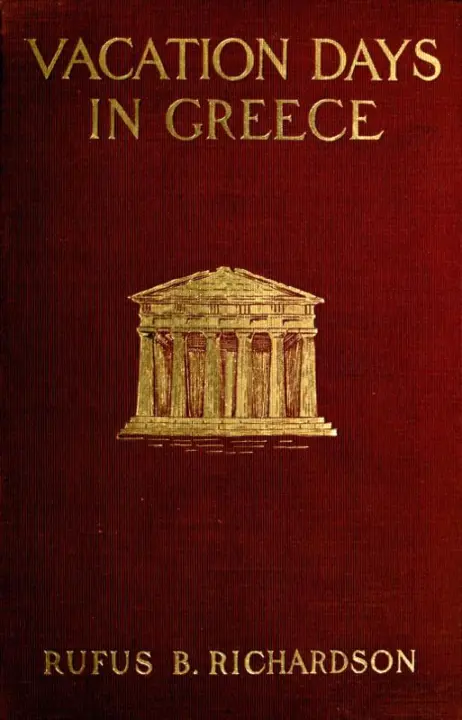
"Vacation Days in Greece" by Rufus B. Richardson is a travelogue written in the early 20th century. This book chronicles the author's personal experiences and explorations throughout Greece, highlighting regions that are often overlooked by conventional tourists. Richardson shares not just the beauty of the landscape and locales but also their historical relevance, providing readers with a rich tapestry of both personal narrative and cultural insight. The opening of the book details Richardson's initial impressions of Corfu, describing its natural beauty and vibrant local culture. He reflects on his journey through the island, noting the intoxicating scenery of olive groves and vineyards, the colorful traditional costumes of the locals, and the rich historical context that intertwines with the present day. Through evocative descriptions, he conveys a deep sense of appreciation for the land and its layered history, setting the tone for a narrative that promises a blend of travelogues and reflections on Greek history.
Introduction adapted from the source catalogue; source summaries may be automatically generated.
Free to read · English · 59,154 words · No account needed
MAKE TIME FOR A GOOD BOOK
On by default. Untick to stop anonymous reading totals. Each page counts after 10 seconds in view. How this works.
Anonymous counting is on unless you have switched it off.
In an exaltation of spirit we came to the Casa Politi, almost at the point of Ortygia, looking out upon the sea, where we found a German host and hostess. After our strenuous and partially successful wrestling with Italian, which had generally ended by our falling back on the member who had taken Italian at Harvard to straighten out for us the tangled web of the dialogue, how welcome it was when we asked the question, "Haben Sie vielleicht gutes Bier?" to get straight from the shoulder the honest answer, "Jawohl, gewiss," and the more tangible answer of three foaming mugs from a cool cellar. We had lived in the spirit a good deal that day, enjoying the beauty of Taormina, Ætna, and Syracuse, and holding converse with Alcibiades and Gorgias and Thucydides. Now we hobnobbed with Gambrinus, and enjoyed "the warmest welcome in an inn."
I have never had more full and exhilarating days than those four days in Syracuse, days full of revelation, recollection, reverie, or, to put it more prosaically, days devoted to study in history and topography. The ruins of Syracuse are not to the casual observer very imposing. One might almost say of them, "periere etiamque ruinæ." But even these ruins have great interest for the archæologist. There is, for example, an old temple near the northern end of Ortygia, for the most part embedded in the buildings of the modern city, yet with its east end cleared and showing several entire columns with a part of the architrave upon them. And what a surprise here awaits one who thinks of a Doric temple as built on a stereotyped plan! Instead of the thirteen columns on the long sides which one is apt to look for as going with a six-column front, here are eighteen or nineteen, it is not yet quite certain which. The columns stand less than their diameter apart, and the abaci are so broad that they nearly touch. So small is the intercolumnar space that archæologists incline to the belief that in this one Doric temple there were triglyphs only over the columns, and not also between them as in all other known cases. Everything about this temple stamps it as the oldest in Sicily. An inscription on the top step, in very archaic letters, much worn and difficult to read, contains the name of Apollo in the ancient form, Ἀπέλονι. The inscription may, of course, be later than the temple; but it is in itself old enough to warrant the supposition that the temple was erected soon after the first Corinthian colonists established themselves in the island. While the inscription makes it reasonably certain that the temple belonged to Apollo, the god under whose guiding hand all these Dorians went out into these western seas, tradition, with strange perversity, has given it the name of "Temple of Diana." But it is all in the family. Whether tradition has also erred in naming the temple on the highest part of the island, into which the cathedral has been so immured that the old temple columns protrude on each side of the church, the "Temple of Minerva," is a question to which archæologists have not yet returned a unanimous answer. Indications point rather to Zeus. This temple owes its preservation, such as it is, to this immuring of the cathedral in it. In fact, the temple is nearly all present, although one might almost pass it by in the daytime without seeing it. Another temple ruin on the edge of the plateau, which begins about two miles south of the city, across the Anapos, one might also easily overlook in a casual survey, because it consists only of two columns without capitals, and a broad extent of the foundations from which the accumulated earth has been only partially removed. This was the famous temple of Olympian Zeus, built probably in the days of Hiero I., soon after the Persian war, but on the site of a temple still more venerable. One seeks a reason for the location of this holy place at such a distance from the city. Holm, the German historian of Sicily, argues with some plausibility that this was no mere suburb of Syracuse, but the original Syracuse itself. In the first place, the list of the citizens of Syracuse was kept here down at least to the time of the Athenian invasion. In the second place, tradition, which, when rightly consulted, tells so much, says that Archias, the founder of Syracuse, had two daughters, Ortygia and Syracusa, which may point to two co-ordinate settlements, Ortygia and Syracuse; the latter, which was on this temple plateau, being subsequently merged in the former, but, as sometimes happens in such cases, giving its name to the combined result.
Your reading position is saved on this browser. Take it to another device with a library code. Reading pages adapt to text, rather than matching a printed edition.
BEHIND THE BOOK
This eBook is for the use of anyone anywhere in the United States and most other parts of the world at no cost and with almost no restrictions whatsoever. You may copy it, give it away or re-use it under the terms of the Project Gutenberg License included with this eBook or online at www.gutenberg.org. If you are not located in the United States, you will have to check the laws of the country where you are located before using this eBook. Read the source licence.
The original source file, including credits and licence, is retained by this library. Request an original-format copy at no charge. Please include the book title and Project Gutenberg identifier #45175.
KEEP YOUR CURIOSITY GOING
Wilfrid Scawen Blunt
Wilfrid Scawen Blunt

E. W. (Edgar Watson) Howe
Cécile Tormay

Moritz Busch
John L. Ransom