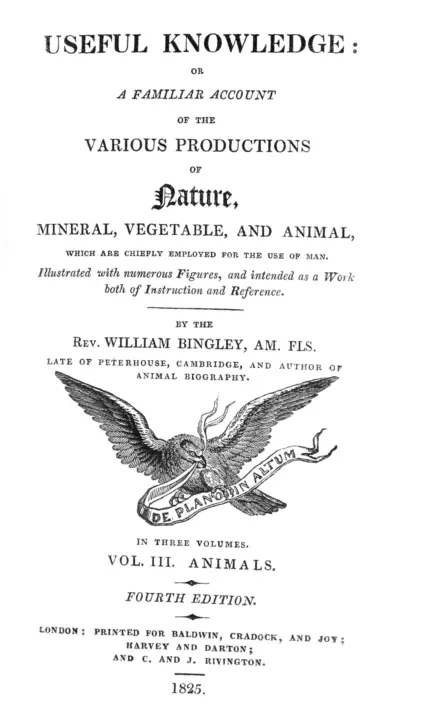
Useful Knowledge: Volume 3. Animals Or, a familiar account of the various productions of nature
William Bingley
THE CLASSIC COLLECTION · 1816
"Useful Knowledge: Volume 2. Vegetables" by William Bingley is a scientific publication written in the early 19th century. This volume serves as a detailed account of the various vegetable productions of nature, focusing on their structures, classifications, and uses for human benefit. It covers a wide range of plants, providing insights into their agricultural practices, medicinal applications, and culinary relevance. At the start of the work, the author introduces the concept of vegetables or plants, defining their characteristics and explaining the field of botany as it relates to plant study. He describes the main parts of plants, discusses the Linnæan classification system, and outlines the various classes based on reproductive structures. The opening sets the foundation for exploring specific plants, beginning with ginger, cardamoms, turmeric, and arrow root, detailing their cultivation, uses, and significance in both historical and contemporary contexts. This informative introduction establishes a clear thematic focus for the text, catering to readers interested in botany, agriculture, and the practical applications of plants.
Introduction adapted from the source catalogue; source summaries may be automatically generated.
Free to read · English · 94,509 words · No account needed
MAKE TIME FOR A GOOD BOOK
On by default. Untick to stop anonymous reading totals. Each page counts after 10 seconds in view. How this works.
Anonymous counting is on unless you have switched it off.
This plant is known by having arrow-shaped leaves, notched in a particular manner at the base, and each flower-stalk bearing two or three large and somewhat purplish white flowers.
The roots of the scammony plant are thick, black on the surface, white within, and full of an acrid milky juice, which, in a concrete state, is frequently used in medicine. To obtain it, the earth, at a certain season of the year, is removed from the upper part of the roots whilst they are growing, and the tops are cut obliquely. The juice flows from the wound into a small vessel sunk into the earth, at the lower end of the gash, to receive it. But, as each root furnishes only a very small quantity, the produce of several roots is usually mixed together for the greater convenience of being exposed to the sun and dried. Still, however, the quantity, thus obtained, is sometimes insufficient to supply the demand. In this case an addition is made to it by the pressure of juice from the leaves and stalks.
The best scammony is imported from Aleppo, in light, spongy, friable pieces, of shining blackish grey colour, which have a faint, unpleasant smell, and a bitterish, pungent taste. It is sometimes adulterated with flour, and sometimes even with sand or earth.
In its medical effects, scammony, when administered alone, is an efficacious, though violent purgative. But if triturated or ground down with sugar, almonds, or gum-arabic, its operation becomes sufficiently mild and safe.
61. JALAP is a dark-coloured root, which is usually imported, in transverse slices, from South America.
The plant that produces it (Convolvulus jalapa, Fig. 8) belongs to the convolvulus tribe, and has generally somewhat heart-shaped leaves, and flowers that are reddish on the outside, and dark purple or yellowish within.
The name of jalap is derived from Xalapa, a town in South America, situated betwixt Vera Cruz and Mexico, where the plant, of which it is the root, was originally discovered, and whence it has been imported, in great quantities, into Europe. The jalap plant is now cultivated in the botanical garden at Charlestown, and in several other parts of America. When recent, the root is large, whitish, and full of juice; but, when dried, the best pieces are compact, hard, weighty, and of dark colour, with black circular marks. Both in smell and taste it is very nauseous. It is frequently mixed with slices of bryony root; but these are easily distinguished by their paler colour and porous texture.
Your reading position is saved on this browser. Take it to another device with a library code. Reading pages adapt to text, rather than matching a printed edition.
William Bingley

William Bingley
William Bingley
BEHIND THE BOOK
This eBook is for the use of anyone anywhere in the United States and most other parts of the world at no cost and with almost no restrictions whatsoever. You may copy it, give it away or re-use it under the terms of the Project Gutenberg License included with this eBook or online at www.gutenberg.org. If you are not located in the United States, you will have to check the laws of the country where you are located before using this eBook. Read the source licence.
The original source file, including credits and licence, is retained by this library. Request an original-format copy at no charge. Please include the book title and Project Gutenberg identifier #57954.
KEEP YOUR CURIOSITY GOING
Cécile Tormay

Moritz Busch
John L. Ransom
Frances Wright
Cécile Tormay

Mabel Potter Daggett