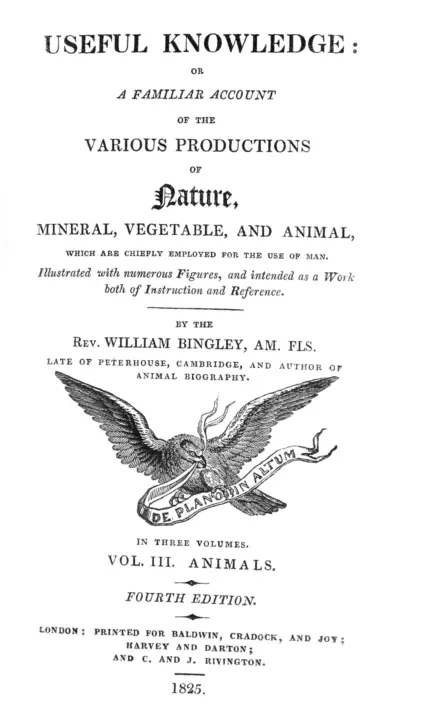
Useful Knowledge: Volume 3. Animals Or, a familiar account of the various productions of nature
William Bingley
THE CLASSIC COLLECTION · 1816
"Useful Knowledge: Volume 2. Vegetables" by William Bingley is a scientific publication written in the early 19th century. This volume serves as a detailed account of the various vegetable productions of nature, focusing on their structures, classifications, and uses for human benefit. It covers a wide range of plants, providing insights into their agricultural practices, medicinal applications, and culinary relevance. At the start of the work, the author introduces the concept of vegetables or plants, defining their characteristics and explaining the field of botany as it relates to plant study. He describes the main parts of plants, discusses the Linnæan classification system, and outlines the various classes based on reproductive structures. The opening sets the foundation for exploring specific plants, beginning with ginger, cardamoms, turmeric, and arrow root, detailing their cultivation, uses, and significance in both historical and contemporary contexts. This informative introduction establishes a clear thematic focus for the text, catering to readers interested in botany, agriculture, and the practical applications of plants.
Introduction adapted from the source catalogue; source summaries may be automatically generated.
Free to read · English · 94,509 words · No account needed
MAKE TIME FOR A GOOD BOOK
On by default. Untick to stop anonymous reading totals. Each page counts after 10 seconds in view. How this works.
Anonymous counting is on unless you have switched it off.
Abele. See Poplar, great white.
Acacia, 262
Acorns, uses of, 223
Alder, wood, bark, branches, and leaves, uses of, 211
Alkanet, description, properties, and uses of, 42
Alligator pear, description and uses of, 120
All-spice. See Pimento.
Almond, common or sweet, description of, 140
----, whence obtained, how imported, and uses of, 140
----, oil and milk of, how prepared, 141
----, bitter, description and uses of, 141
Aloe, American, description, culture, and uses of, 96, 97
Aloes, description of several kinds, 93, 94
----, leaves, stems, and juice, uses of, 93, 94
----, Socotrine, description, culture, preparation, and uses of, 94
----, Barbadoes, common, or hepatic, 95
----, Caballine, or horse, 96
Anise-seeds, description and uses of, 81
Apple, fruit and wood, uses of, 147, 148
Apricot, fruit, kernels, gum, and wood, uses of, 143
Archell, description and use of, 270
Areca, description and uses of, 231, 232
Arnatto, or annotta, description of, how prepared, and uses of, 157
Arrack, from what prepared, 106, 218
Arrow-root, what it is, how prepared, and uses of, 9, 10
----, how adulterated, 10
Artichoke, flowers, leaves, and stalks, uses of, 197
----, Jerusalem, description, culture, and uses of, 201
Arum, common, description and uses of, 218, 219
Asafoetida, description and uses of, 77
----, how obtained and exported, 77, 78
Ash-tree, wood, leaves, and bark, uses of, 264
Asparagus, description, cultivation, and uses of, 92, 93
Aspen. See Poplar, trembling.
B.
Balsam, Friar's, or Turlington's, from what made, 130
Bamboo canes, description and uses of, 100, 101
Banana, description and uses of, 269
Barberry, fruit, bark, and roots, uses of, 100
Barilla, description of, and how prepared for use, 73
Barley, cultivation and uses of, 27
----, pearl, how made, and uses of, 28
----, sugar, how made, 22
Bay, common sweet, description and uses of, 119, 120
Bay plum. See Guava.
Beans, culture and uses of, 184
Beech-tree, wood, fruit, and leaves, uses of, 220
Beet, description and uses of, 71, 72
Benjamin, gum. See Benzoin.
Bent-grass, 32
Benzoin, description of, how prepared, and uses of, 129, 131
Bergamot, how prepared, 195
Betel, what it is, and use of, 15
Betel-nut. See Areca.
Bilberries, uses of, 113
Birch-tree, wood, bark, twigs, leaves, and sap, uses of, 210
Bird-lime, how made, uses and properties of, 41
Blackberries, uses of, 152
Bleaberries. See Bilberries.
Blend-corn, 28
Boabab. See Sour gourd.
Bore cole, 176
Bottle gourd, description and uses of, 209
Box-tree, value and uses of, 215
Brake, description and uses of, 268
Bran, uses of, 26
Brandy, whence obtained, and how made, 69
----, distilled from potatoes and carrots, 55, 75
Brank. See Buck wheat.
Bread, prepared from turnips, arum roots, acorns, cassava, and sago, 175,
219, 224, 239, 256
Bread-fruit, description and uses of, 203, 204
----, tree, bark, juice, and flowers, uses of, 204, 205
Brocoli, 176
Broom, common, twigs, seeds, bark, &c., uses of, 181
----, Spanish, description and uses of, 181
Buck-bean, or bog-bean, description and uses of, 43
Buck-thorn, syrup, and bark, uses of, 56
Buck-wheat, description, cultivation, and uses of, 114
Bullace plums, description and uses of, 144
---- cheese, from what prepared, 144
Bull-rush, uses of, 31
Burgundy wine, 64
Burgundy pitch, of what made, and uses of, 236
Your reading position is saved on this browser. Take it to another device with a library code. Reading pages adapt to text, rather than matching a printed edition.
William Bingley
William Bingley
William Bingley
BEHIND THE BOOK
This eBook is for the use of anyone anywhere in the United States and most other parts of the world at no cost and with almost no restrictions whatsoever. You may copy it, give it away or re-use it under the terms of the Project Gutenberg License included with this eBook or online at www.gutenberg.org. If you are not located in the United States, you will have to check the laws of the country where you are located before using this eBook. Read the source licence.
The original source file, including credits and licence, is retained by this library. Request an original-format copy at no charge. Please include the book title and Project Gutenberg identifier #57954.
KEEP YOUR CURIOSITY GOING
Cécile Tormay

Moritz Busch
John L. Ransom
Frances Wright
Cécile Tormay

Mabel Potter Daggett