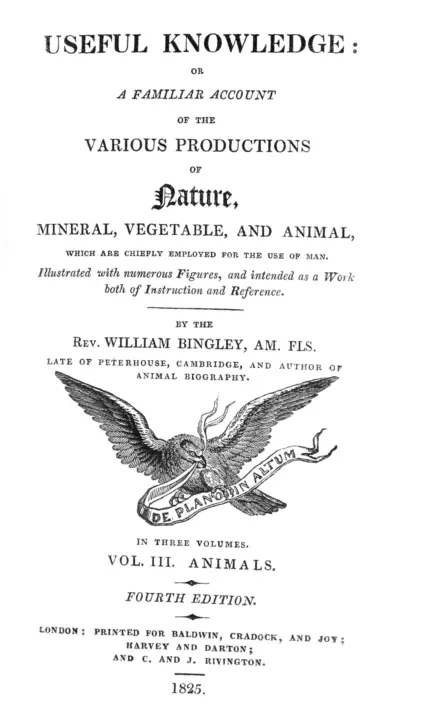
Useful Knowledge: Volume 3. Animals Or, a familiar account of the various productions of nature
William Bingley
THE CLASSIC COLLECTION · 1816
"Useful Knowledge: Volume 2. Vegetables" by William Bingley is a scientific publication written in the early 19th century. This volume serves as a detailed account of the various vegetable productions of nature, focusing on their structures, classifications, and uses for human benefit. It covers a wide range of plants, providing insights into their agricultural practices, medicinal applications, and culinary relevance. At the start of the work, the author introduces the concept of vegetables or plants, defining their characteristics and explaining the field of botany as it relates to plant study. He describes the main parts of plants, discusses the Linnæan classification system, and outlines the various classes based on reproductive structures. The opening sets the foundation for exploring specific plants, beginning with ginger, cardamoms, turmeric, and arrow root, detailing their cultivation, uses, and significance in both historical and contemporary contexts. This informative introduction establishes a clear thematic focus for the text, catering to readers interested in botany, agriculture, and the practical applications of plants.
Introduction adapted from the source catalogue; source summaries may be automatically generated.
Free to read · English · 94,509 words · No account needed
MAKE TIME FOR A GOOD BOOK
On by default. Untick to stop anonymous reading totals. Each page counts after 10 seconds in view. How this works.
Anonymous counting is on unless you have switched it off.
Though this plant is an extremely troublesome weed to the farmer, from the roots penetrating deep into the ground, it is applied to various uses in rural oeconomy. When cut and properly dried, it serves as litter for horses and cattle; and it supplies the place of thatch for covering the roofs of cottages and stacks. Where coal is scarce, it is used for the heating of ovens and burning of lime-stone.
The ashes of fern, from their yielding a tolerably pure alkali, are frequently used by manufacturers of glass, particularly in France. And, in some parts of our own country, the poor people mix these ashes with water, and form them into round masses which they call fern balls. These are afterwards heated in a fire, and then, with water, are made into a ley for the scouring of linen. They thus furnish a cheap substitute for soap.
Swine are fond of the roots of fern, and will feed freely upon them. We are even informed that, with the inhabitants of Palma, one of the Canary islands, they are sometimes made to supply the place of bread.
It is deserving of remark that, when the root of the fern is cut obliquely across, it presents a kind of figure of the Imperial or Russian eagle; from which circumstance Linnæus was induced to name it Pteris aquilina, or "Eagle brake."
281. The LICHENS constitute a very numerous family of plants, which grow on the bark of trees, on rocks, stones, and other substances; and have an indistinct fructification, in scattered wart-like tubercles, or excrescences, and smooth saucers or shields, in which the seeds are imbedded.
Some of them have a powdery appearance, and others are crustaceous, leaf-like, shrub-like, herbaceous, or gelatinous.
282. The CALCAREOUS LICHEN (Lichen calcareus) consists of a white crust with black tubercles.
This plant, which is found on lime-stone rocks in Wales, and the north of England, is used in dyeing woollen and other cloths a scarlet colour.
283. CRAB'S-EYE LICHEN (Lichen parellus) is a crustaceous, whitish, and granulated vegetable substance, with cups of the same colour, which have a thick and blunt border.
From this lichen, which is found on rocks and stones in mountainous countries, and sometimes on stones near the sea-shore, is prepared the bluish pigment called litmus. It is chiefly collected from rocks in the north of England, packed in casks, and sent to London for sale.
284. TARTAREOUS LICHEN (Lichen tartareus) is a whitish, crustaceous, vegetable production, with yellow cups or shields, which have a whitish border.
Your reading position is saved on this browser. Take it to another device with a library code. Reading pages adapt to text, rather than matching a printed edition.
William Bingley
William Bingley
William Bingley
BEHIND THE BOOK
This eBook is for the use of anyone anywhere in the United States and most other parts of the world at no cost and with almost no restrictions whatsoever. You may copy it, give it away or re-use it under the terms of the Project Gutenberg License included with this eBook or online at www.gutenberg.org. If you are not located in the United States, you will have to check the laws of the country where you are located before using this eBook. Read the source licence.
The original source file, including credits and licence, is retained by this library. Request an original-format copy at no charge. Please include the book title and Project Gutenberg identifier #57954.
KEEP YOUR CURIOSITY GOING
Cécile Tormay

Moritz Busch
John L. Ransom
Frances Wright
Cécile Tormay

Mabel Potter Daggett