
The Philosophy of Health; Volume 2 (of 2) or, an exposition of the physical and mental constitution of man
Southwood Smith
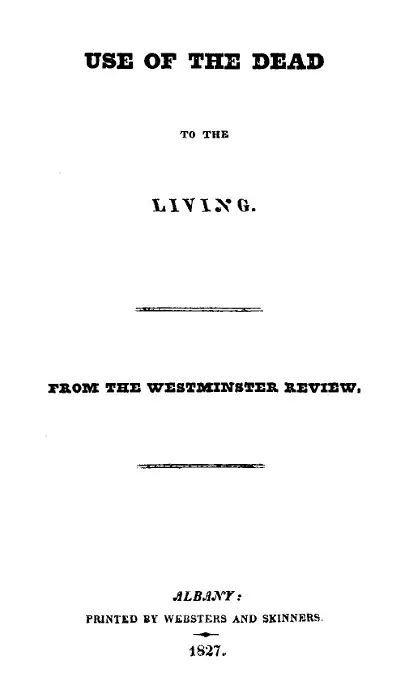
THE CLASSIC COLLECTION · 1827
"Use of the Dead to the Living" by Southwood Smith is a scientific publication written in the early 19th century. This work, derived from an article in the Westminster Review, addresses the ethical and educational necessity of using human cadavers for anatomical study in medical education. It highlights the importance of anatomical knowledge as foundational for effective medical and surgical practice. In this treatise, Smith argues that a comprehensive understanding of anatomy is crucial for diagnosing and treating diseases effectively. He provides a historical context of the prejudices against dissection, noting that many medical advancements were stunted due to societal fears surrounding mortality and bodily desecration. The text urges legislative change to facilitate the ethical acquisition of bodies for dissection, thereby enhancing the education of future physicians and ultimately improving public health outcomes. Smith effectively combines appeals to reason with detailed medical and historical analysis, advocating for both respect for the dead and the critical need to educate the living to minimize suffering and save lives.
Introduction adapted from the source catalogue; source summaries may be automatically generated.
Free to read · English · 17,960 words · No account needed
MAKE TIME FOR A GOOD BOOK
On by default. Untick to stop anonymous reading totals. Each page counts after 10 seconds in view. How this works.
Anonymous counting is on unless you have switched it off.
But it is possible that inflammation may attack the parts included in the hernial sac, without arising from the hernia itself. The inflammation may be produced by the common causes of inflammation; there may be no pressure: there may be no strangulation: the swelling may be the seat, not the cause of the disease. In this case, too, the operation would be both useless and pernicious. Now all these are diversities which it is of the highest importance to discriminate. In some of them, life depends on the clearness, accuracy, and promptitude, with which the discrimination is made. Promptitude is of no less consequence than accuracy. If the decision be not formed and acted on at once, it will be of no avail. The rapidity of the progress of this disease is often frightful. We have mentioned a case in which it was fatal in three days, but it not unfrequently terminates fatally in less than twenty four hours. Sir Astley Cooper mentions a case in which the patient was dead in eight hours after the commencement of the disease. Larrey has recorded the case of a soldier in whom a hernia took place, which was strangulated immediately. He was brought to the "ambulance" instantly, and perished in two hours with gangrene of the part, and of the abdominal viscera. This was the second instance which had occurred to this surgeon of a rapidity thus appalling. What clearness of judgment, what accuracy of knowledge, what promptitude of decision, are necessary to treat such a disease with any chance of success!
The moment that a case is ascertained to be strangulated hernia, an attempt must be made to liberate the parts from the stricture, and to replace them in their natural situation. This is first attempted by the hand, and the operation is technically termed the taxis. The patient must be placed in a particular position; pressure must be made in a particular direction; it is impossible to ascertain either, without an accurate knowledge of the parts. If pressure be made in a wrong direction, and in a rough and unscientific manner, the organs protruded instead of being urged through a proper opening, are bruised against the parts which oppose their return. Many cases are on record, in which gangrene and even rupture of the intestine, have been occasioned in this manner. When the parts cannot be returned by the hand, assisted by those remedies which experience has proved to be beneficial, the operation must be performed without the delay of a moment. To its proper performance two things are necessary. First, a minute anatomical knowledge of the various and complicated parts which are implicated in it; and secondly, a steady, firm, and delicate command of the knife. In the first place, the integuments must be divided; the cellular substance which intervenes between the skin and the hernial sac must be removed layer by layer with the knife and the dissecting forceps; the sac itself must be opened: this part of the operation must be performed with the most extreme caution: the sac being laid open, the protruded organs are now exposed to view. The operator must next ascertain the exact point where the stricture exists; having discovered its seat, he must make his incision with a particular instrument--in a certain direction--to a definite extent. On account of the nature of the parts implicated in the operation, and the proximity of vessels, life depends on an exact knowledge and a precise and delicate attention to all these circumstances. How can this knowledge be obtained, how can this dexterity be acquired, without a profound acquaintance with anatomy, and how can this be acquired without frequent and laborious dissection? The eye must become familiar with the appearance of the integuments, with the appearance of the cellular substance beneath it, with the appearance of the hernial sac, and of the changes which it undergoes by disease; with the appearance of the various viscera contained in it, and of their changes: and the hand must pay that steady and prompt obedience to the judgment, which nothing but knowledge, and the consciousness of knowledge, can command. Even this is not all. When the operation has been performed thus far with perfect skill and success, the most opposite measures are required according to the actual state of the organs contained in the sac. If they are agglutinated together--if portions of them are in a state of mortification, to return them into the cavity of the abdomen in that condition, would, in general, be certain death. Preternatural adhesion must be removed; mortified portions must be cut away: but how can this possibly be done without an acquaintance with healthy and diseased structure, and how can this be obtained without dissecting the organs in a state of health and of disease?
Your reading position is saved on this browser. Take it to another device with a library code. Reading pages adapt to text, rather than matching a printed edition.
Southwood Smith
Southwood Smith
Southwood Smith
BEHIND THE BOOK
This eBook is for the use of anyone anywhere in the United States and most other parts of the world at no cost and with almost no restrictions whatsoever. You may copy it, give it away or re-use it under the terms of the Project Gutenberg License included with this eBook or online at www.gutenberg.org. If you are not located in the United States, you will have to check the laws of the country where you are located before using this eBook. Read the source licence.
The original source file, including credits and licence, is retained by this library. Request an original-format copy at no charge. Please include the book title and Project Gutenberg identifier #58460.
KEEP YOUR CURIOSITY GOING

David Patterson (Spirit) Hatch
Cécile Tormay

Moritz Busch
Coulson Kernahan
John L. Ransom

Ralph Waldo Emerson