The Philosophy of Health; Volume 2 (of 2) or, an exposition of the physical and mental constitution of man
Southwood Smith
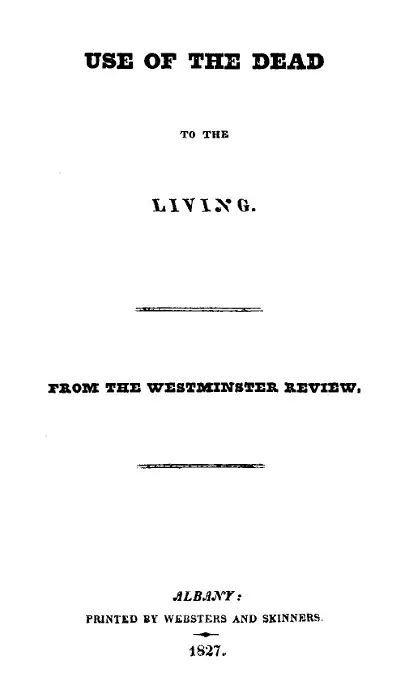
THE CLASSIC COLLECTION · 1827
"Use of the Dead to the Living" by Southwood Smith is a scientific publication written in the early 19th century. This work, derived from an article in the Westminster Review, addresses the ethical and educational necessity of using human cadavers for anatomical study in medical education. It highlights the importance of anatomical knowledge as foundational for effective medical and surgical practice. In this treatise, Smith argues that a comprehensive understanding of anatomy is crucial for diagnosing and treating diseases effectively. He provides a historical context of the prejudices against dissection, noting that many medical advancements were stunted due to societal fears surrounding mortality and bodily desecration. The text urges legislative change to facilitate the ethical acquisition of bodies for dissection, thereby enhancing the education of future physicians and ultimately improving public health outcomes. Smith effectively combines appeals to reason with detailed medical and historical analysis, advocating for both respect for the dead and the critical need to educate the living to minimize suffering and save lives.
Introduction adapted from the source catalogue; source summaries may be automatically generated.
Free to read · English · 17,960 words · No account needed
MAKE TIME FOR A GOOD BOOK
On by default. Untick to stop anonymous reading totals. Each page counts after 10 seconds in view. How this works.
Anonymous counting is on unless you have switched it off.
It is an odious thing that the teachers of anatomy should be brought into contact with such men: that they should be obliged to employ them, and that they should even be in their power; which they are to such a degree, that they are obliged to bear with the wantonness of their tyranny and insult. All the clamour against these men, all the punishment inflicted on them, only operate to raise the premium on the repetition of their offence. This premium the teachers of anatomy are obliged to pay, which these men perfectly understand, who do not at all dislike the opposition which is made to their vocation. It gives them no unreasonable pretext for exorbitancy in their demands. In general, they are men of infamous character; some of them are thieves, others are the companions and abettors of thieves. Almost all of them are extremely destitute. When apprehended for the offence in question, the teachers of anatomy are obliged to pay the expenses of the trial, and to support their families while they are in prison: whence the idea of immunity is associated, in these men's minds, with the violation of the law, and when they do happen to incur its penalties, they practically find that they and their families are provided for, and this provision comes to them in the shape of a reward for the commission of their offence. The operation of such a system on the minds of the individuals themselves is exceedingly pernicious, and is not a little dangerous to the community.
Moreover, by the method of exhumation, the supply after all is scanty; it is never adequate to the wants of the schools; it is of necessity precarious, and it sometimes fails altogether for several months. But it is of the utmost importance that it should be abundant, regular, and cheap.--The number of young men who come annually to London for the purpose of studying medicine and surgery, may be about a thousand. Their expenses are necessarily very considerable while in town; they have already paid a large sum for their apprenticeship in the country; the circumstances of country practitioners, in general, can but ill afford protracted expenses for their sons in London; few of them stay a month longer than the time prescribed by the College of Surgeons. But the short period they spend in London, is the only time they have for acquiring the knowledge of their profession. If they mispend these precious hours, or if the means of employing them properly be denied them, they must necessarily remain ignorant for life. After they leave London they have no means of dissecting. We have seen that it is by dissecting alone, that they can make themselves acquainted even with the principles of their art; that without it they cannot so much as avail themselves of the opportunities of improvement, which experience itself may offer, nor, without the highest temerity, perform a single operation. We have seen that occasions suddenly occur, which require the prompt performance of important and difficult operations; we have seen that unless such operations are performed immediately, and with the utmost skill, life is inevitably lost. In many such cases, there is no time to send for other assistance. If a country practitioner (and most of these young men go to the country) be not himself capable of doing what is proper to be done, the death of the patient is certain. We put it to the reader to imagine what the feelings of an ingenuous young man must be, who is aware of what he ought to do, but who is conscious that his knowledge is not sufficient to authorise him to attempt to perform it, and who sees his patient die before him, when he knows that he might be saved, and that it would have been in his own power to save him, had he been properly educated. We put it to the reader to conceive what his own sensations would be, were an ignorant surgeon, with a rashness more fatal than the criminal modesty of the former, to undertake an important operation--Suppose it were a tumor, which turned out to be an aneurism; suppose it were a hernia, in operating on which the epigastric artery were divided, or the intestine itself wounded: suppose it were his mother, his wife, his sister, his child, whom he thus saw perish before his eyes, what would the reader then think of the prejudice which withholds from the surgeon that information, without which the practice of his profession is murder?
Your reading position is saved on this browser. Take it to another device with a library code. Reading pages adapt to text, rather than matching a printed edition.
Southwood Smith
Southwood Smith
Southwood Smith
BEHIND THE BOOK
This eBook is for the use of anyone anywhere in the United States and most other parts of the world at no cost and with almost no restrictions whatsoever. You may copy it, give it away or re-use it under the terms of the Project Gutenberg License included with this eBook or online at www.gutenberg.org. If you are not located in the United States, you will have to check the laws of the country where you are located before using this eBook. Read the source licence.
The original source file, including credits and licence, is retained by this library. Request an original-format copy at no charge. Please include the book title and Project Gutenberg identifier #58460.
KEEP YOUR CURIOSITY GOING

David Patterson (Spirit) Hatch
Cécile Tormay

Moritz Busch
Coulson Kernahan
John L. Ransom

Ralph Waldo Emerson