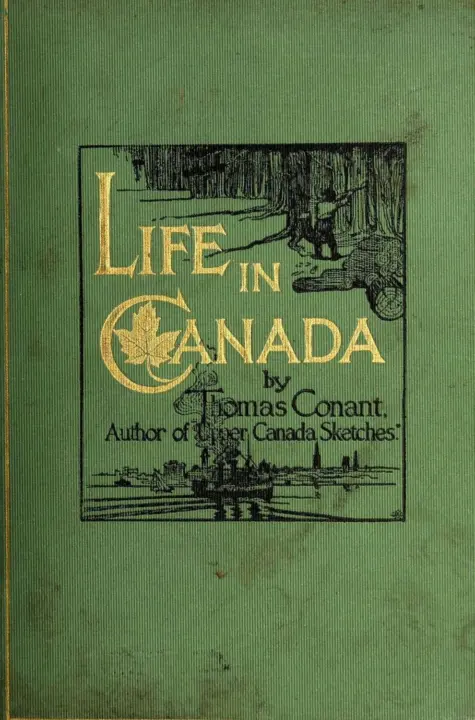
Life in Canada
Thomas Conant
THE CLASSIC COLLECTION · 1898
"Upper Canada Sketches" by Thomas Conant is a collection of historical accounts written in the late 19th century. The work explores the heritage and experiences of early settlers in Upper Canada, specifically focusing on the Conant family, with ties to notable historical figures such as Roger Conant, the first governor of Massachusetts. The narratives within this volume delve into the challenges, triumphs, and everyday life of these pioneers as they navigated the frontier while contributing to the formation of Canadian society. The opening of "Upper Canada Sketches" introduces the reader to the origins of the Conant family, tracing their lineage from Normandy following William the Conqueror in 1066 through to their settlement in England and eventual migration to the American colonies. The text emphasizes the importance of Roger Conant's character and his foundational role in the New World, setting the stage for a rich tapestry of stories about early American and Canadian life. In this opening portion, the author also establishes a backdrop of historical context, noting significant events and figures that shaped the trajectory of the Conants and their contributions to the burgeoning settlements in Upper Canada.
Introduction adapted from the source catalogue; source summaries may be automatically generated.
Free to read · English · 53,659 words · No account needed
MAKE TIME FOR A GOOD BOOK
On by default. Untick to stop anonymous reading totals. Each page counts after 10 seconds in view. How this works.
Anonymous counting is on unless you have switched it off.
William Lyon Mackenzie, the hard-headed little Scotch reformer, who was several times elected and expelled the House, exposed these acts in his paper and some of the sons of the Compact threw his type into York (Toronto) bay. The destruction of his type and the consequent revulsion of feeling secured justice, and damages assessed for the loss being paid to Mackenzie from the fines exacted of the lads who committed the depredation enabled him to continue the publication of his paper, and through it rouse his sympathizers into open rebellion. No government over English-speaking subjects has yet succeeded long in curtailing the liberty of the press. In Canada this remark was as true as elsewhere.
My father at this time was captain of one of his fleet of ships, and was not on shore to participate in the excitement. Freights that fall (1837) were exceedingly high on Lake Ontario. Salt, for instance was one dollar a barrel from Sodus, New York, to Whitby, Upper Canada, that being the nearest port to Oshawa, his home, four miles away. Flour was one dollar a barrel from Oshawa and Whitby to Kingston. It was an exceedingly mild winter, and succeeding so well, he did not put his ship into winter quarters in November, as is the custom on the Great Lakes, but continued his trips until the day after Christmas, when he reached Whitby, unbent his sails and stowed everything for the winter.
Many persons who occupied good positions in Upper Canada, even if not in actual rebellion, were mistrusted as sympathizers with the patriots; they were hunted by the Compact’s forces, and driven from their homes, being forced to find shelter in the forests and in barns. Life to them finally became unbearable, and they sought some means of leaving the Province. A small schooner, the Industry, happened to be laid up for the winter in one of the ports on the north shore of Lake Ontario. The owner was besought to bend his sails to the masts and take the patriots across the lake to Oswego, N.Y. Such a trip as crossing Lake Ontario in midwinter by a sailing craft is a most perilous thing to do, and naturally the owner of the vessel hesitated to take the great risk to his vessel, and to his own life as well. It was thought that the vessel might make the outlet of the Oswego River at Oswego, N.Y., and therefore effect a landing. Recollect that there were no tugs in those days to tow a vessel as soon as she hove in sight, but the wind alone must be depended upon. However, the owner, besought by the tears and entreaties of the wives and friends of the patriots in hiding, finally concluded to make the attempt. On the night of the 27th day of December, 1837, the little vessel of 100 feet in length quietly slipped from her moorings, and sailed close along the shore of Lake Ontario. It was a bright moonlight night, still, but very cold. Every mile or so she would back her mainsail, and lay to at a signal of a light upon shore, that a canoe might put off to the vessel, bearing a patriot from his hiding in the forest to the side of the boat. As yet no storm had come on to form the ice-banks since the cold set in, but there was no knowing what a day might produce in the way of a storm and the formation of ice-banks. Some forty stops, however, and forty different canoes were paddled out to the vessel, and forty patriots transferred, panting for the land of liberty across Lake Ontario, to the south of them sixty miles or so. A fine sailing breeze blew off shore, and hoisting sail and winging out mainsail and foresail, nothing could bid fairer for a quick and prosperous voyage; and the land of liberty seemed almost gained. Lying upon blankets in the bottom of the vessel were the patriots, with the hatches closed down tight on account of the intense cold. Quickly and gaily the little vessel sped on, with anxious hearts beating below. Morning revealed to their gaze the mouth of the river at Oswego, and the Stars and Stripes floating from the old fort near the river’s outlet. And a glorious sight indeed it was to the heavy-hearted patriots, liberty at hand just before them, where no one dare pursue. Then “Get up, boys, and let’s get into port!” But the north wind, which bore them so gaily and swiftly over the broad lake, had driven all the floating, drifting ice before it, and wedged it firmly along the south shore. For three miles between them and the land was this mass of floating ice, and the little vessel refused to be driven through it.
Your reading position is saved on this browser. Take it to another device with a library code. Reading pages adapt to text, rather than matching a printed edition.
Thomas Conant
BEHIND THE BOOK
This eBook is for the use of anyone anywhere in the United States and most other parts of the world at no cost and with almost no restrictions whatsoever. You may copy it, give it away or re-use it under the terms of the Project Gutenberg License included with this eBook or online at www.gutenberg.org. If you are not located in the United States, you will have to check the laws of the country where you are located before using this eBook. Read the source licence.
The original source file, including credits and licence, is retained by this library. Request an original-format copy at no charge. Please include the book title and Project Gutenberg identifier #64749.
KEEP YOUR CURIOSITY GOING
Wilfrid Scawen Blunt
Wilfrid Scawen Blunt

E. W. (Edgar Watson) Howe
Cécile Tormay

Moritz Busch
John L. Ransom