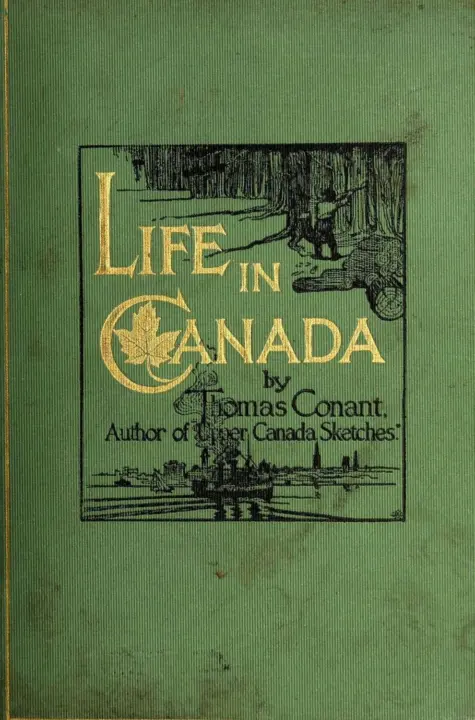
Life in Canada
Thomas Conant
THE CLASSIC COLLECTION · 1898
"Upper Canada Sketches" by Thomas Conant is a collection of historical accounts written in the late 19th century. The work explores the heritage and experiences of early settlers in Upper Canada, specifically focusing on the Conant family, with ties to notable historical figures such as Roger Conant, the first governor of Massachusetts. The narratives within this volume delve into the challenges, triumphs, and everyday life of these pioneers as they navigated the frontier while contributing to the formation of Canadian society. The opening of "Upper Canada Sketches" introduces the reader to the origins of the Conant family, tracing their lineage from Normandy following William the Conqueror in 1066 through to their settlement in England and eventual migration to the American colonies. The text emphasizes the importance of Roger Conant's character and his foundational role in the New World, setting the stage for a rich tapestry of stories about early American and Canadian life. In this opening portion, the author also establishes a backdrop of historical context, noting significant events and figures that shaped the trajectory of the Conants and their contributions to the burgeoning settlements in Upper Canada.
Introduction adapted from the source catalogue; source summaries may be automatically generated.
Free to read · English · 53,659 words · No account needed
MAKE TIME FOR A GOOD BOOK
On by default. Untick to stop anonymous reading totals. Each page counts after 10 seconds in view. How this works.
Anonymous counting is on unless you have switched it off.
I submit that the people of Ontario are the most generous in the world, and give most voluntarily, for, as I remarked at the outset, I am not claiming more nor less for Oshawa, and think I must be safe in coming to the conclusion that other towns of a similar population do likewise.
Very few of us, I am sure, ever stopped before to think of what we do voluntarily in this our banner Province. It is only because we are a frugal and industrious and prosperous people that we can make this annual contribution for religious purposes. It is far greater than that for educational purposes, and yet we feel sure we are doing as much for education as any people under the sun.
There is one more tax which our people voluntarily subject themselves to, which I think might well be referred to. So far as I know, no one has ever touched upon the subject, and since it is becoming so general, it ought, I think, to be spoken of, to give us some idea of what we are voluntarily doing in another direction. Life insurance has become so common, and is so fast increasing, that it bids fair to be one of the great questions among us. I have been at considerable pains to get as near the truth as I can, but insurance men, however, do not care to give too many figures, and I must get all I can from policyholders and then draw an approximate estimate. Take Oshawa again for a comparison, with its 5,000 people. For the same reason as in the former case, I use Oshawa for comparison solely because I know it best, and not for any particular merit or demerit so far as it is concerned. There are three hundred policies of life insurance in Oshawa among 5,000 people. This number is certainly within the mark, as insurance men reluctantly admit. Pursuing the inquiry further, I find, as near as may be, these policies will average $2,000 each, making thereby a total of $600,000 life insurance now carried by this people. With the gross amount I am not particularly concerned, but it is the sum they yearly voluntarily tax themselves to pay to keep these three hundred policies in force that I want to discover. It is difficult to get at the sum the people pay annually, for there are so many kinds of life insurance that they vary, some policies being on the plan of annual payments for life, while others are only for a stated term of years, so that it is difficult to get at the average amount. Five thousand dollars per month one insurance company has been known to receive from here. But I take it that this was a special month, and that more policies were renewed that month than usual, so it will not be safe to take those figures for any average. It is certain, however, that these three hundred policies average a cost of $30 per annum. Now, this $30 per annum is well within the mark, and I feel quite warranted in using that as a basis for comparison. This will give us $24,000 per year which the people here pay for life insurance, and I am quite right in classing these payments as among the generous acts and givings of the people, because the persons assured by these policies cannot ordinarily be expected to be benefited themselves, but are doing it and making these annual sacrifices for those who remain after their decease. Hence, these payments are charitable donations. If 5,000 people pay $24,000 per annum, that means very nearly $5 per head for every man, woman and child yearly paid in this town for life insurance to benefit those of our friends who succeed us. Now, add this $5 per head for life insurance to the $3 per head, as before instanced, annually raised for religious purposes, and we have $8 per head annually paid by the people of Oshawa, voluntarily and spontaneously. Again I say, taking Oshawa as an index of the Province, one can begin to form some idea of the vast sum annually contributed for these purposes. Verily, there are no more generous people on this globe, This $8 per head is almost equal to the annual drink bill of the greatest drinking nations of the world. But then, of course, one must expect, unfortunately, that men will pay more for vices, taking the world at large, than they will for commendable objects. Ontario comes perhaps quite as near paying as much per head for commendable objects as for vicious ones as any people existing to-day. Hence, one can form no other opinion than that Ontarioans are really as moral, as well educated and thrifty, and as generous a people as there are anywhere to be found.
Your reading position is saved on this browser. Take it to another device with a library code. Reading pages adapt to text, rather than matching a printed edition.
Thomas Conant
BEHIND THE BOOK
This eBook is for the use of anyone anywhere in the United States and most other parts of the world at no cost and with almost no restrictions whatsoever. You may copy it, give it away or re-use it under the terms of the Project Gutenberg License included with this eBook or online at www.gutenberg.org. If you are not located in the United States, you will have to check the laws of the country where you are located before using this eBook. Read the source licence.
The original source file, including credits and licence, is retained by this library. Request an original-format copy at no charge. Please include the book title and Project Gutenberg identifier #64749.
KEEP YOUR CURIOSITY GOING
Wilfrid Scawen Blunt
Wilfrid Scawen Blunt

E. W. (Edgar Watson) Howe
Cécile Tormay

Moritz Busch
John L. Ransom