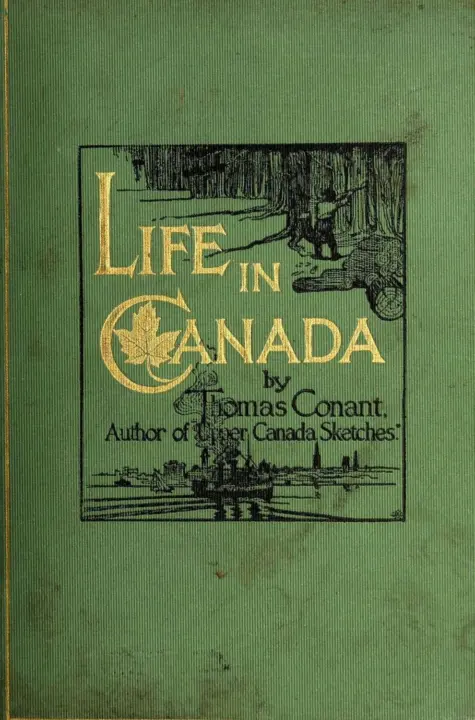
Life in Canada
Thomas Conant
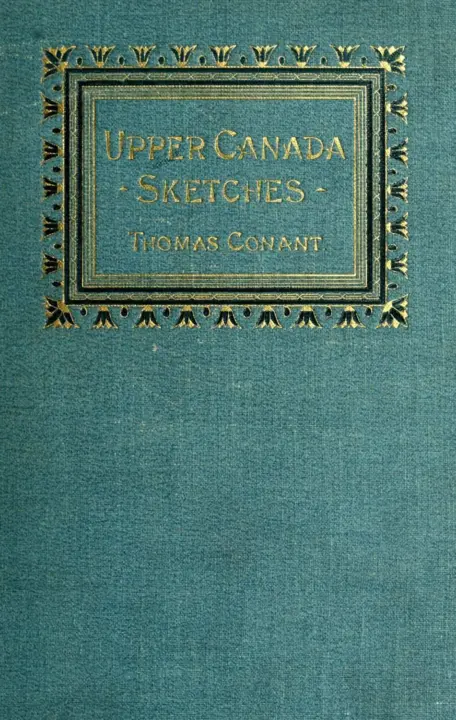
THE CLASSIC COLLECTION · 1898
"Upper Canada Sketches" by Thomas Conant is a collection of historical accounts written in the late 19th century. The work explores the heritage and experiences of early settlers in Upper Canada, specifically focusing on the Conant family, with ties to notable historical figures such as Roger Conant, the first governor of Massachusetts. The narratives within this volume delve into the challenges, triumphs, and everyday life of these pioneers as they navigated the frontier while contributing to the formation of Canadian society. The opening of "Upper Canada Sketches" introduces the reader to the origins of the Conant family, tracing their lineage from Normandy following William the Conqueror in 1066 through to their settlement in England and eventual migration to the American colonies. The text emphasizes the importance of Roger Conant's character and his foundational role in the New World, setting the stage for a rich tapestry of stories about early American and Canadian life. In this opening portion, the author also establishes a backdrop of historical context, noting significant events and figures that shaped the trajectory of the Conants and their contributions to the burgeoning settlements in Upper Canada.
Introduction adapted from the source catalogue; source summaries may be automatically generated.
Free to read · English · 53,659 words · No account needed
MAKE TIME FOR A GOOD BOOK
On by default. Untick to stop anonymous reading totals. Each page counts after 10 seconds in view. How this works.
Anonymous counting is on unless you have switched it off.
Last winter a clergyman wrote me from the neighborhood of Peterboro’, saying that a colored man who was begging about the country from door to door had exhibited a paper declaring him to be a worthy object of charity, and purporting to have my name attached as a guarantee of good faith. This generous and gentlemanly clergyman wrote me that he had his doubts about the genuineness of the man’s need, for he found he had been drunk. By telegram I repudiated the man and his paper, and asked for his arrest. Persons who gave to that man committed an injury to our country, and not an act of charity. I am only mentioning this case as an illustration. Perhaps a good many of us may not yet know or realize the fact that many tramps in our Province are using the names of prominent or well-known citizens to help them to defraud the public. It is just as well for gentlemen to know, if their names have been brought considerably before the public, that in many instances these are used without their knowledge by tramps to further their impostures. Tramps have indeed called upon me, exhibiting what purported to be “a recommend” signed by one or more of Toronto’s prominent citizens, when I knew at a glance that such signatures were forgeries. The proper plan would be to have them arrested, but no one individual wants to fight the battles for the general public, and usually these fellows get off.
From the last tramp who honored me with a call I wormed out his story. He was a strong, hearty, broad-shouldered young man of twenty-eight or so, born in Ontario, the son of assisted immigrants. During the past summer he had worked for a couple of months in a brickyard near Toronto. His wages were $1.50 per day, but the proprietor, according to his rules, kept back one-third until the end of the season, when this, too, would be paid in a lump sum along with the last week’s pay. “But I could not stand that, you know,” the tramp said. He must have his money, all of it weekly, or quit. And quit he did, for he could not subsist on the single dollar a day and buy his whiskey! Until the following winter he simply “bummed” around the city, spending the balance of his brickyard money. As winter came on he made his way to Ottawa and Pembroke--just how did not appear quite clear. He worked about Pembroke in the lumber woods for a couple of months; was discharged because he would not be driven by the gang boss nor be ordered to keep up; bought a C.P.R. ticket for Toronto, but before setting out must have a few drinks. Took a few glasses, and then a few more, and fell into oblivion. Next morning he awoke in a hotel stable, minus his railway ticket and $25 which he had in his pocket, and then he had no resource but to tramp it back to Toronto. He had no difficulty, for any of the farmers would feed him and keep him overnight, so that it was just a question of slow marching with him from house to house, with a full stomach and a stop whenever cold. But as he got nearer Toronto he found the farmers not so hospitable; they refused generally to feed him, and invariably declined to lodge him. He said those near Toronto had been called upon by so many tramps that they had become wise, and no longer considered it charity to give to tramps. In a small village near Toronto, overtaken by night, he could find no refuge, and had to apply to the village constable to be confined in the ordinary lock-up. In this he was accommodated. But the constable did not relish the idea of sitting up all night for any such specimen of humanity, and so left him alone in the lock-up, where there was a stove and supply of wood. The night was cold, and the tramp fired up himself. On leaving him the constable had cautioned him to be careful of fire, and the tramp said that he was only careful for fear that he might get burnt himself. The lock-up stood beside other buildings, and had he set it on fire a good part of the village must have been consumed. Thus was this village placed in great jeopardy on account of this worthless fellow who became a charge upon them for the night, and the whole community thereabout was in great danger of losing many thousands of dollars worth of property, and possibly precious human life, by this wretched scamp, who was too lazy to work in summer and too fond of whiskey to keep him off the road in winter. Now if there be any charity in giving to such persons, I fail to see it. If we construct county poor-houses just such fellows will want to get into them. There is no excuse for any such persons. In the summer they can easily earn sufficient money to keep them during the winter if they will. In this tramp’s case he could have earned good money in the winter if he chose. He said he would get on to Toronto, and if nothing turned up he would go on west towards Woodstock and about Berlin, for the tramping fraternity told him that the German farmers thereabout have big barns and cellars and great abundance, and feed all tramps. In case they would not feed or lodge him readily, he said most of those about Berlin possessed stone base stables, which were always warm, and that he could sleep as warm in them as he could in the house.
Your reading position is saved on this browser. Take it to another device with a library code. Reading pages adapt to text, rather than matching a printed edition.
Thomas Conant
BEHIND THE BOOK
This eBook is for the use of anyone anywhere in the United States and most other parts of the world at no cost and with almost no restrictions whatsoever. You may copy it, give it away or re-use it under the terms of the Project Gutenberg License included with this eBook or online at www.gutenberg.org. If you are not located in the United States, you will have to check the laws of the country where you are located before using this eBook. Read the source licence.
The original source file, including credits and licence, is retained by this library. Request an original-format copy at no charge. Please include the book title and Project Gutenberg identifier #64749.
KEEP YOUR CURIOSITY GOING
Wilfrid Scawen Blunt
Wilfrid Scawen Blunt

E. W. (Edgar Watson) Howe
Cécile Tormay

Moritz Busch
John L. Ransom