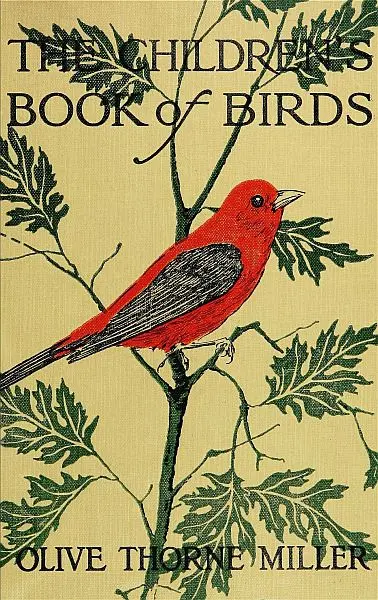
The Children’s Book of Birds
Olive Thorne Miller
THE CLASSIC COLLECTION · 1897
"Upon The Tree-Tops" by Olive Thorne Miller is a nature-themed account written in the late 19th century. The book explores the intricacies of bird life, expressing the author's admiration for their individual traits and songs through a series of observations. The narrative serves as a blend of memoir and field observations, presenting a rich tapestry of the relationships between birds and their surroundings. At the start of the book, the author shares her desire to immerse herself in the tranquility of nature following a hectic city life. She finds herself in a solitary farmhouse in the Green Mountains, where she watches birds from her window, reflecting on their beauty and individuality. Soon, she is joined by a friend, an "Enthusiast" of birdwatching, and together they embark on forest explorations in search of specific birds, notably the hermit thrush and the oven-bird. Their excursions are filled with lyrical descriptions of the flora and fauna around them as they eagerly listen for the captivating songs of their feathered companions, setting the tone for an intimate journey into the world of birds.
Introduction adapted from the source catalogue; source summaries may be automatically generated.
Free to read · English · 56,767 words · No account needed
MAKE TIME FOR A GOOD BOOK
On by default. Untick to stop anonymous reading totals. Each page counts after 10 seconds in view. How this works.
Anonymous counting is on unless you have switched it off.
Shortly following the beginning of the second and more familiar song, a change appeared in the relations of the pair. The male assumed the aggressive, and became rather violent in his attentions. He drove his mate around the room, and when he cornered her they indulged in what must be called a "clawing match," upon which he flew away with a loud song, as though he had won a victory. When this performance had gone on a few days, she began to show a disinclination to go home, took possession of another cage whose owner was amiable, and finally turned upon her rough wooer, as I suppose he must be named; though if I had not seen a similar style of courtship among the orchard orioles I should hesitate to give it that name. One morning she rose in her might to put an end to all this persecution, and I saw her on the war-path, pursuing him with open beak; but after fleeing a moment, he turned and flung himself upon her so savagely that both flew violently against the window, which they had not touched for months, being perfectly aware of the obstacle there. However, he changed his manners, and I heard much low, sweet talk in the cage, such as he had used to coax me for currants. She listened, but said nothing. I neglected to say that meanwhile she had replaced her scraggy feathers and grown a fine tail.
[Sidenote: FREE AT LAST.]
Another time I saw the two orioles on top of a cage, six or eight inches apart. First she stretched up and faced him, uttering a peculiar cry, a single note of rich but mournful tone, and then she bowed again and again, constantly repeating the call. He posed, turned this way and that, evidently aching to fly at her. At last she flew, and he followed to another cage, where the performance was repeated. Then came a mad chase around the room, which she ended by slipping behind a large cage.
For some days these scenes were frequent, and I began to feel myself a jailer; so one morning they were carried to the country, where sparrows would not mob them, and set at liberty to pursue their wooing, if such it were, in freedom.
Arkansas goldfinch, 185.
Black-throated green warbler, 26, 28, 29.
Bluebird, 173.
Blue jay, 216.
Bobolink, 30.
Brazilian cardinal, 214.
Catbird, 153, 158.
Cats, 197.
Chebec, 6, 621.
Chewink, 159, 180-184.
Chipmunk, 13.
Chipping sparrow, 86.
Clarin, 205-220, 226.
Cowbird, 22.
Crow, 6, 156, 166.
Cuckoo, 62, 64, 65.
Eave swallow, 32, 175.
English sparrow, 200.
Fox barking, 16.
Golden-winged woodpecker, 18, 49, 164.
Hermit thrush, 6, 8, 9, 10, 21, 22, 202.
House wren, 30, 49, 189.
Junco, 201.
Least flycatcher, 61, 62.
Maryland yellow-throat, 142-147.
Meadow lark, 31, 34.
Meadow lark, western, 191.
Mountain whistler, 220-226.
Night hawk, 200.
Olive-aided flycatcher, 7, 11, 14-18.
Oriole, Baltimore, 50, 150-153, 229-245.
Oriole, orchard, 227-239.
Oven-bird, 7.
Ph[oe]be, 33, 34, 174.
Your reading position is saved on this browser. Take it to another device with a library code. Reading pages adapt to text, rather than matching a printed edition.
Olive Thorne Miller
Olive Thorne Miller
Olive Thorne Miller
Olive Thorne Miller
BEHIND THE BOOK
This eBook is for the use of anyone anywhere in the United States and most other parts of the world at no cost and with almost no restrictions whatsoever. You may copy it, give it away or re-use it under the terms of the Project Gutenberg License included with this eBook or online at www.gutenberg.org. If you are not located in the United States, you will have to check the laws of the country where you are located before using this eBook. Read the source licence.
The original source file, including credits and licence, is retained by this library. Request an original-format copy at no charge. Please include the book title and Project Gutenberg identifier #31269.
KEEP YOUR CURIOSITY GOING

Charles G. (Charles Griffith) Ross
Hannah Webster Foster

Emily Lawless
Edwin Hamlin Carr

Charles De Lano Hine
Andrew Ure