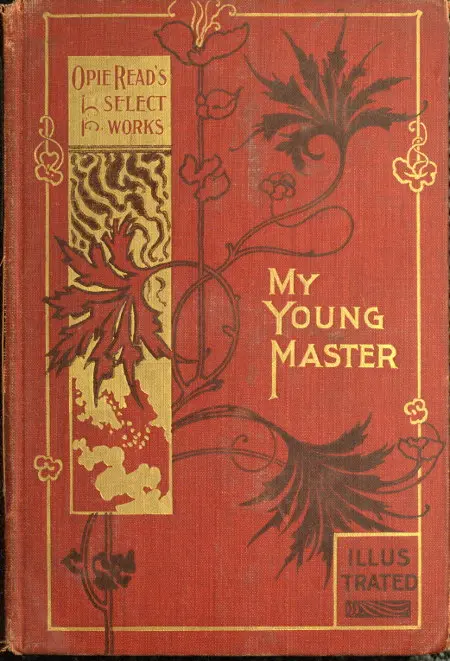
My Young Master: A Novel
Opie Percival Read

THE CLASSIC COLLECTION · 1888
"Up Terrapin River" by Opie Percival Read is a novel written in the late 19th century. The book explores the lives of rural inhabitants along the picturesque Terrapin River, with a focus on the character John Lucas, a young boy dealing with loss and hardship, who forms a bond with a mysterious stranger named Sam Potter. As they navigate life in an unsophisticated yet vibrant environment, themes of education, personal growth, and the contrast between ignorance and knowledge arise prominently. At the start of the novel, we are introduced to the serene and rustic landscape of Terrapin River and its unrefined inhabitants. The narrative follows a young plowboy, John Lucas, who encounters Sam Potter, an enigmatic man with a complex past. Their conversation reveals John's painful backstory related to the loss of his parents, while also showcasing his dreams and aspirations. Potter's interest in John leads to a budding mentor-student relationship, with the promise of adventure and learning as they devise plans to cultivate a farm together. The opening sets a tone of warmth and humor interlaced with deeper themes of aspiration and a yearning for knowledge.
Introduction adapted from the source catalogue; source summaries may be automatically generated.
Free to read · English · 36,684 words · No account needed
MAKE TIME FOR A GOOD BOOK
On by default. Untick to stop anonymous reading totals. Each page counts after 10 seconds in view. How this works.
Anonymous counting is on unless you have switched it off.
"He does, if the Lord has made him a promise."
"Yas, but he wants ter wait the Lord's own time."
"A good excuse," Hendricks replied. "You want to wait the Lord's own time, an' you hope that the Lord's time will be long."
"Hendricks, you kain't blame er man for wantin' to live."
"Yes, I can, if he believes that he would be better off in another
world."
"But he don't know that."
"Then he ain't got religion, an' don't b'l'eve what God says."
"Oh, yas, Hendricks. You know it would skeer you might'ly ef you knowed you had ter die ter-day."
"I'm not religious, but ter know that I had ter die ter-day wouldn't
skeer me."
"I think it would, Hendricks."
"But I know it wouldn't; so now, fur the sake uv argyment, let us say that I have got ter die ter-day."
"Yas," rejoined old Blue, "we ken say it fur argyment's sake, an' it won't skeer you, but ef it was sho' 'nuff, it would."
"Wall, then, say it's sho' 'nuff."
"We ken say it, but that won't skeer you, fur you know it ain't true."
"But I know it is true."
"What, you know that you are goin' ter die ter-day?"
"Yes, sir."
"How do you know it?"
"By this fack," Hendricks replied. He drew a revolver, placed it against his head, and fired. He fell from the chair, dead. The men looked in horror upon the scene. A breeze through the open doorway stirred Hendricks' hair into beautiful curls.
Among the guests at a small summer hotel were a little boy and his mother. The boy's fullness of life and richness of prankish resource kept the timid, shrinking mother in a constant state of alarm; and the servants, noticing that she was afraid that her son might give offense, took pains to increase her anxiety by telling the child, in those soft but forced tones of kindness which burn worse than harshness, not to make so much noise and not to scatter bread crumbs on the steps. The proprietor's wife, an old woman whom everyone said was motherly, unconsciously took a cue from the servants, and, forgetting that her own sons and daughters were once noisy children, began to oppress the boy.
"Sh-sh--don't make a fuss," she said, meeting him in the hall. "Little boys must be seen and not heard. Go and put that ball away. You might break something. Never mind that cat. Get out of my way. I wonder what your mother can be thinking about."
"Tommie," his mother called from a neighboring room.
"Maam."
"Come here."
"I ain't doin' nothin'."
Your reading position is saved on this browser. Take it to another device with a library code. Reading pages adapt to text, rather than matching a printed edition.
Opie Percival Read
Opie Percival Read
Opie Percival Read
Opie Percival Read
BEHIND THE BOOK
This eBook is for the use of anyone anywhere in the United States and most other parts of the world at no cost and with almost no restrictions whatsoever. You may copy it, give it away or re-use it under the terms of the Project Gutenberg License included with this eBook or online at www.gutenberg.org. If you are not located in the United States, you will have to check the laws of the country where you are located before using this eBook. Read the source licence.
The original source file, including credits and licence, is retained by this library. Request an original-format copy at no charge. Please include the book title and Project Gutenberg identifier #44879.
KEEP YOUR CURIOSITY GOING
Coulson Kernahan

Maurice Baring
Frances Wright
Cécile Tormay

Frederic Jesup Stimson

W. H. P. (William Henry Pope) Jarvis