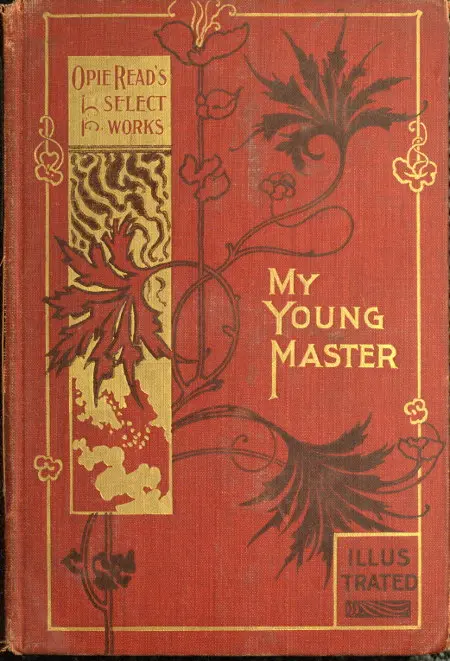
My Young Master: A Novel
Opie Percival Read

THE CLASSIC COLLECTION · 1888
"Up Terrapin River" by Opie Percival Read is a novel written in the late 19th century. The book explores the lives of rural inhabitants along the picturesque Terrapin River, with a focus on the character John Lucas, a young boy dealing with loss and hardship, who forms a bond with a mysterious stranger named Sam Potter. As they navigate life in an unsophisticated yet vibrant environment, themes of education, personal growth, and the contrast between ignorance and knowledge arise prominently. At the start of the novel, we are introduced to the serene and rustic landscape of Terrapin River and its unrefined inhabitants. The narrative follows a young plowboy, John Lucas, who encounters Sam Potter, an enigmatic man with a complex past. Their conversation reveals John's painful backstory related to the loss of his parents, while also showcasing his dreams and aspirations. Potter's interest in John leads to a budding mentor-student relationship, with the promise of adventure and learning as they devise plans to cultivate a farm together. The opening sets a tone of warmth and humor interlaced with deeper themes of aspiration and a yearning for knowledge.
Introduction adapted from the source catalogue; source summaries may be automatically generated.
Free to read · English · 36,684 words · No account needed
MAKE TIME FOR A GOOD BOOK
On by default. Untick to stop anonymous reading totals. Each page counts after 10 seconds in view. How this works.
Anonymous counting is on unless you have switched it off.
"No," Billingsly replied. "I was not in the army, but I was in one engagement. I was a boy and was living in Gallatin, Tenn., when John Morgan dashed in and captured Colonel Boon. Some time had elapsed since the Confederate forces were driven away, and the villagers, especially the boys, were almost wild with joy at the sight of gray uniform. A season of feasting followed, and then there came the report that Colonel Johnson, a dashing Federal officer, was, with a thousand picked cavalrymen, advancing upon the town. My mother gathered her children about her and took refuge in a cellar, but, feeling that my pride had been trampled upon, I escaped and mingled with the soldiers that were preparing for battle. Old wine, and whisky of less venerable age, had flowed during the feast, and many of the men and officers were drunk. Some were singing songs of more implied patriotism than of actual tune; others, with the rising fervor of tipsyness, declared that they would not go home till morning. Ah, before the next morning came many of them had gone home. I importuned a bugler to let me get on his horse behind him and ride out to the battle. He said that if I would take his canteen over to the house of a well-known old negro and bring it back full of peach brandy, I might go home with him. I did so, having left with the negro my hat and jacket as pawned evidences of good faith, and took my place behind the bugler. An officer ordered me to get down, but I begged so hard that his reckless good humor overcame his soberer sense of discipline. With shouts and songs of discordant loudness we marched out to battle. The morning was beautiful. The ironweed was in bloom, and sitting on its purple top the dryfly sang the song of midsummer. Mockingbirds flitted in the apple trees, and the bee-martin flew round and round, waiting for a sight of the honey-laden laborer that had just gone over into a field of clover. The troops dashed out upon a blue-grass plane, jeweled here and there with the rich setting of a long-cared-for and magnificent tree. Over the brow of a green slope--the phrenological bump of perception on the face of the landscape--the enemy was seen advancing. It was to be a cavalry fight. It was to be a shock of horse and a clash of sabre. I looked to the right and saw that our men were stretched out in a long line, and looking ahead, I saw that the enemy was in similar form. My friend blew his bugle. Every horse dashed forward. A line of blue dashed to meet us. I felt a keen sense of delight. My friend blew his bugle. Clash! The two lines had met with drawn sabres. It was a beautiful sight. Not a shot had been fired. There was no dust. Clash! Far to the right, as the sabres flashed, there were two long lines of brightness, broken into whirling glints of sun-ray-catching silver. I may not have had the spirit of a poet, but the beauty and not the horror impressed me. I lost not an adjunct--I failed not to catch a single shading. I saw a bee-martin catch a bee; I saw an ironweed bend its purple head beneath the touch of a lark; I saw a man, with his skull split open fall to the ground. My friend blew his bugle. The horses leaped forward. The line of blue began to grow ragged. Wild shouts arose. Gunshots with, it seemed to me, intruding noise like the yap, yap, yap of a stray dog, rang out here and there. The enemy was retreating. My friend, standing in his stirrups, waved his bugle high in the air and then blew upon it a triumphant blast. The enemy made a stand, and again the sabres flashed, but the old wine and new whisky made the Confederates impetuous. My friend blew his bugle. The opposing line broke, and then there came gunshots with, it seemed to me, a sort of revengful bark. My friend lifted his bugle, but did not blow it. I thought that he had taken pity upon the vanquished line. We bounded forward. My friend began to lean back against me. He was laughing, I could plainly see. He leaned back farther. 'Don't lean back so far,' I said. 'Stop; don't you see you are about to shove me off?' He leaned back farther. I moved to one side--reached around and took hold of the horn of the saddle. Blood spurted from the bugler's breast. I looked up and saw that death had thrown its film into his eyes. I reached down with my foot and kicked the stirrup away. The bugler leaned over and fell to the ground. I got into the saddle, rode up to a fence, threw the bridle rein over a stake, climbed down off the horse and ran away. I went back over the grassy slope. I saw a martin catch a bee; I saw the purple head of the ironweed bend beneath the touch of the lark."
Your reading position is saved on this browser. Take it to another device with a library code. Reading pages adapt to text, rather than matching a printed edition.
Opie Percival Read
Opie Percival Read
Opie Percival Read
Opie Percival Read
BEHIND THE BOOK
This eBook is for the use of anyone anywhere in the United States and most other parts of the world at no cost and with almost no restrictions whatsoever. You may copy it, give it away or re-use it under the terms of the Project Gutenberg License included with this eBook or online at www.gutenberg.org. If you are not located in the United States, you will have to check the laws of the country where you are located before using this eBook. Read the source licence.
The original source file, including credits and licence, is retained by this library. Request an original-format copy at no charge. Please include the book title and Project Gutenberg identifier #44879.
KEEP YOUR CURIOSITY GOING
Coulson Kernahan

Maurice Baring
Frances Wright
Cécile Tormay

Frederic Jesup Stimson

W. H. P. (William Henry Pope) Jarvis