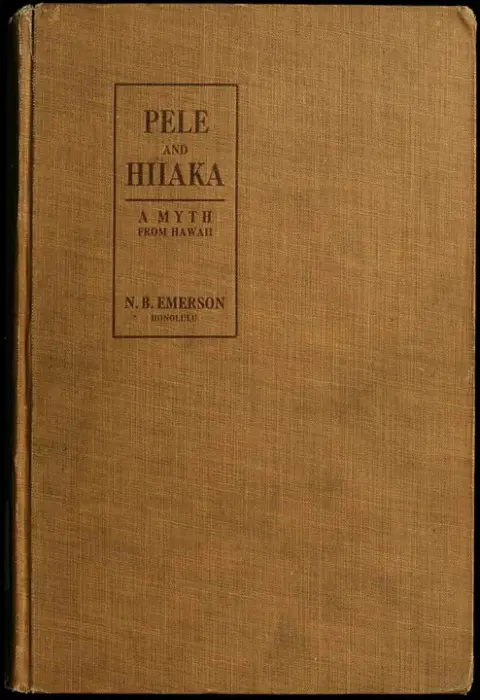
Pele and Hiiaka: A Myth From Hawaii
Nathaniel Bright Emerson
THE CLASSIC COLLECTION · 1909
"Unwritten Literature of Hawaii: The Sacred Songs of the Hula" by Nathaniel B. Emerson is an ethnographic work written in the early 20th century. This publication explores the deeply rooted cultural significance of hula dance and its associated sacred songs in Hawaiian society. The book serves as a collection of translations, notes, and accounts related to the hula, revealing its profound impact on the communal imagination and social life of the ancient Hawaiians. The opening of the work establishes the hula as a vital component of Hawaiian cultural expression, interweaving poetry, music, and dance in a manner that reflects the emotions and experiences of the people. Emerson conveys how hula served not just as entertainment but as a ritualistic practice steeped in religious significance and communal memory. He articulates the essence of hula, touching upon the relationships between the dancers, the spiritual dimensions of the performance, and the concept of storytelling through song, while highlighting the sacred aspects that elevate it beyond mere spectacle into a manifestation of cultural identity and heritage.
Introduction adapted from the source catalogue; source summaries may be automatically generated.
Free to read · English · 109,502 words · No account needed
MAKE TIME FOR A GOOD BOOK
On by default. Untick to stop anonymous reading totals. Each page counts after 10 seconds in view. How this works.
Anonymous counting is on unless you have switched it off.
[Page 66] Kahiko mau no o Ka-ú i ka makani. Makani ka Lae-ka-ilio i Unu-lau, 25 Kaili-ki’i[166] a ka lua a Kaheahea,[167] I ka ha’a nawali ia ino.
Ino wa o ka mankani o Kau-ná.
Nana aku o ka makani malaila!
O Hono-malino, malino i ka la’i o Kona.
30 He inoa la!
[Footnote 159: Hi’u-o-lani. A very blind phrase. Hawaiians disagree as to its meaning. In the author’s opinion, it is a word referring to the conjurer’s art.]
[Footnote 160: Ua o Hilo. Hilo is a very rainy country. The name Hilo seems to be used here as almost a synonym of violent rain. It calls to mind the use of the word Hilo to signify a strong wind:
Pa mai, pa mai,
Ka makani a Hilo![168]
Waiho ka ipu iki,
Homai ka ipu nui!
[Translation.]
Blow, blow, thou wind of Hilo!
Leave the little calabash,
Bring on the big one!
]
[Footnote 161: Pua-lani. The name of a deity who took the form of the rosy clouds of morning.]
[Footnote 162: Mahele ana. Literally the dividing; an allusion to the fact, it is said, that in Hilo a rain-cloud, or rain-squall, as it came up would often divide and a part of it turn off toward Puna at the cape named Lele-iwi, one-half watering, in the direction of the present town, the land known as Hana-kahi.]
[Footnote 163: Hana-kahi. Look at note f, p. 60.]
[Footnote 164: Mauna-ole. According to one authority this should be Mauna-Hilo. Verses 13, 14, 16, and 17 are difficult of translation. The play on the words ku a, standing at, or standing by, and kua, the back; also on the word kowa, a gulf or strait; and the repetition of the word mauna, mountain—all this is carried to such an extent as to be quite unintelligible to the Anglo-Saxon mind, though full of significance to a Hawaiian.]
[Footnote 165: A’e. A strong wind that prevails in Ka-u. The same word also means to step on, to climb. This double-meaning gives the poet opportunity for a euphuistic word-play that was much enjoyed by the Hawaiians. The Hawaiians of the present day are not quite up to this sort of logomachy.]
[Footnote 166: Kaili-ki’i. The promontory that shelters the
cove Ka-hewa-hewa.]
[Footnote 167: Ka-hea-hea. The name of the cove Ka-hewa-hewa, above mentioned, is here given in a softened form obtained by the elision of the letter w.]
[Footnote 168: Hilo, or Whiro, as in the Maori, was a great
navigator.]
[Translation.]
Heaven-magic, fetch a Hilo-pour from heaven! Morn’s cloud-buds, look! they swell in the East. The rain-cloud parts, Hilo is deluged with rain, The Hilo of King Hana-kahi.
Your reading position is saved on this browser. Take it to another device with a library code. Reading pages adapt to text, rather than matching a printed edition.
Nathaniel Bright Emerson
BEHIND THE BOOK
This eBook is for the use of anyone anywhere in the United States and most other parts of the world at no cost and with almost no restrictions whatsoever. You may copy it, give it away or re-use it under the terms of the Project Gutenberg License included with this eBook or online at www.gutenberg.org. If you are not located in the United States, you will have to check the laws of the country where you are located before using this eBook. Read the source licence.
The original source file, including credits and licence, is retained by this library. Request an original-format copy at no charge. Please include the book title and Project Gutenberg identifier #20299.
KEEP YOUR CURIOSITY GOING

David Patterson (Spirit) Hatch

David Patterson (Spirit) Hatch

David Patterson (Spirit) Hatch

Maurice Baring
Francis Greenleaf Allinson & Anne C. E. (Anne Crosby Emery) Allinson

Edwin Abbott Abbott