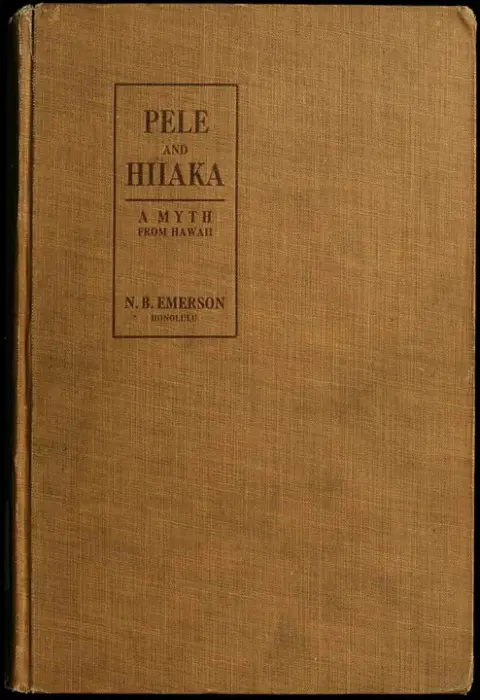
Pele and Hiiaka: A Myth From Hawaii
Nathaniel Bright Emerson
THE CLASSIC COLLECTION · 1909
"Unwritten Literature of Hawaii: The Sacred Songs of the Hula" by Nathaniel B. Emerson is an ethnographic work written in the early 20th century. This publication explores the deeply rooted cultural significance of hula dance and its associated sacred songs in Hawaiian society. The book serves as a collection of translations, notes, and accounts related to the hula, revealing its profound impact on the communal imagination and social life of the ancient Hawaiians. The opening of the work establishes the hula as a vital component of Hawaiian cultural expression, interweaving poetry, music, and dance in a manner that reflects the emotions and experiences of the people. Emerson conveys how hula served not just as entertainment but as a ritualistic practice steeped in religious significance and communal memory. He articulates the essence of hula, touching upon the relationships between the dancers, the spiritual dimensions of the performance, and the concept of storytelling through song, while highlighting the sacred aspects that elevate it beyond mere spectacle into a manifestation of cultural identity and heritage.
Introduction adapted from the source catalogue; source summaries may be automatically generated.
Free to read · English · 109,502 words · No account needed
MAKE TIME FOR A GOOD BOOK
On by default. Untick to stop anonymous reading totals. Each page counts after 10 seconds in view. How this works.
Anonymous counting is on unless you have switched it off.
The ai-lolo offering, cooked to a turn—no part raw, no part cracked or scorched—is brought in from the imu, its bearer sprinkled by the guard at the entrance. The kumu, having inspected the roast offering and having declared it ceremonially perfect, gives the signal, and the company break forth in songs of joy and of adulation to goddess Laka:
Mele Kuau
Noho ana Laka I ka ulu wehi-wehi,
Ku ana iluna i Mo’o-helaia,[33]
Ohia-Ku[34] ouna o Mauna-loa.[35]
Aloha mai Kaulana-ula[36] ia’u.
5 Eia ka ula la, he ula leo,[37]
He uku, he modai, he kanaenae,
He alana na’u ia oe.
E Laka e, e maliu mai;
E maliu mai oe, i pono au,
10 A pono au, a pono kaua.
[Footnote 33: Mo’o-helaia. A female deity, a kupua, who at death became one of the divinities, au-makua, of the hula. Her name was conferred on the place claimed as her residence, on Mauna-loa, island of Molokai.]
[Footnote 34: Ohia-Ku. Full name ohia-ku-makua; a variety of the ohìa, or lehua (pl. XIII), whose wood was used in making temple gods. A rough stem of this tree stood on each side near the hala-pepe. (See pl. III, also pp. 19–20.)]
[Footnote 35: Mauna-loa. Said to be the mountain of that name on Molokai, not that on Hawaii.]
[Footnote 36: Kaulana-ula. Full form Kaulana-a-ula; the name of a deity belonging to the order, papa, of the hula. Its meaning is explained in the expression ula leo, in the next line.]
[Footnote 37: Ula leo. A singing or trilling sound, a tinnitus aurium, a sign that the deity Kaulanaula was making some communication to the one who heard it.
“By the pricking of my thumbs
Something wicked this way comes.”]
[Page 34]
[Translation.]
Altar-Prayer
Laka sits in her shady grove,
Stands on her terrace, at Mo’o-helaia;
Like the tree of God Ku on Mauna-loa.
Kaulana-ula trills in my ear;
5 A whispered suggestion to me,
Lo, an offering, a payment,
A eulogy give I to thee.
O Laka, incline to me!
Have compassion, let it be well—
10 Well with me, well with us both.
There is no stint of prayer-song. While the offering rests on the kuahu, the joyful service continues:
Mele Kuahu
E Laka, e!
Pupu we’uwe’u e, Laka e!
E Laka i ka leo;
E laka i ka loaa;
5 E Laka i ka waiwai;
E Laka i na mea a pau!
[Translation.]
Altar-Prayer
O goddess Laka!
O wildwood bouquet, O Laka!
O Laka, queen of the voice!
O Laka, giver of gifts!
5 O Laka, giver of bounty!
O Laka, giver of all things!
Your reading position is saved on this browser. Take it to another device with a library code. Reading pages adapt to text, rather than matching a printed edition.
Nathaniel Bright Emerson
BEHIND THE BOOK
This eBook is for the use of anyone anywhere in the United States and most other parts of the world at no cost and with almost no restrictions whatsoever. You may copy it, give it away or re-use it under the terms of the Project Gutenberg License included with this eBook or online at www.gutenberg.org. If you are not located in the United States, you will have to check the laws of the country where you are located before using this eBook. Read the source licence.
The original source file, including credits and licence, is retained by this library. Request an original-format copy at no charge. Please include the book title and Project Gutenberg identifier #20299.
KEEP YOUR CURIOSITY GOING

David Patterson (Spirit) Hatch

David Patterson (Spirit) Hatch

David Patterson (Spirit) Hatch

Maurice Baring
Francis Greenleaf Allinson & Anne C. E. (Anne Crosby Emery) Allinson

Edwin Abbott Abbott