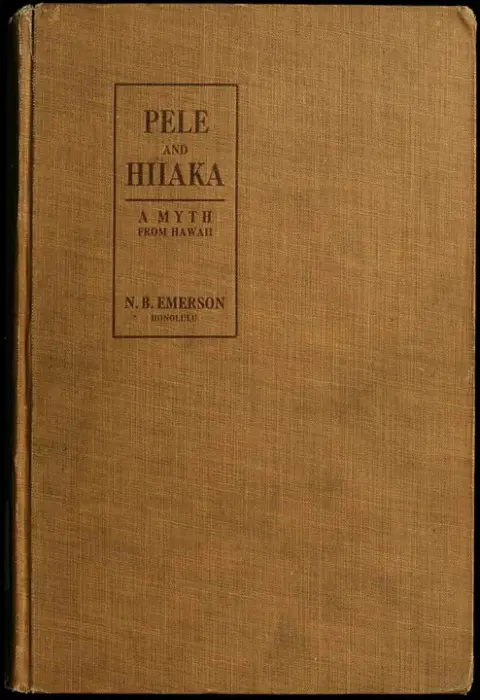
Pele and Hiiaka: A Myth From Hawaii
Nathaniel Bright Emerson
THE CLASSIC COLLECTION · 1909
"Unwritten Literature of Hawaii: The Sacred Songs of the Hula" by Nathaniel B. Emerson is an ethnographic work written in the early 20th century. This publication explores the deeply rooted cultural significance of hula dance and its associated sacred songs in Hawaiian society. The book serves as a collection of translations, notes, and accounts related to the hula, revealing its profound impact on the communal imagination and social life of the ancient Hawaiians. The opening of the work establishes the hula as a vital component of Hawaiian cultural expression, interweaving poetry, music, and dance in a manner that reflects the emotions and experiences of the people. Emerson conveys how hula served not just as entertainment but as a ritualistic practice steeped in religious significance and communal memory. He articulates the essence of hula, touching upon the relationships between the dancers, the spiritual dimensions of the performance, and the concept of storytelling through song, while highlighting the sacred aspects that elevate it beyond mere spectacle into a manifestation of cultural identity and heritage.
Introduction adapted from the source catalogue; source summaries may be automatically generated.
Free to read · English · 109,502 words · No account needed
MAKE TIME FOR A GOOD BOOK
On by default. Untick to stop anonymous reading totals. Each page counts after 10 seconds in view. How this works.
Anonymous counting is on unless you have switched it off.
Laa-mai-Kahiki—A prince who flourished some six or seven centuries ago and voyaged to Kahiki and back. He was an ardent patron of the hula (p. 103).
Lama (lá-ma)—a torch; a beautiful tree (Maba sandwicensis, Hillebrand) having fine-grained whitish wood that was much used for sacred purposes (p. 23).
Lanai (la-nái)—a shed or veranda; an open part of a house covered
only by a roof.
Lanai (La-na’i)—the small island lying southwest of Maui.
Lani (lá-ni)—the sky; the heaven or the heavens; a prince or king; heaven-born (pp. 81, 82).
Lehua, (le-hú-a)—a forest tree (Metrosideros polymorpha) whose beautiful scarlet or salmon-colored flowers were much used in decoration (Pule Hoo-noa, p. 126).
Lei (lei: both vowels are sounded, the i slightly)—a wreath of flowers, of leaves, feathers, beads, or shells (p. 56).
Liloa (Li-ló-a)—an ancient king of Hawaii, the father of Umi (p.
131).
Lohiau (Ló-hi-áu)—the prince of Haena, with whom Pele became enamored in her dreams (p. 186).
Lolo (ló-lo)—the brain (p. 34).
Lono (Ló-no)—one of the four major gods of Hawaii (p. 24).
Luau (lu-aú)—greens made by cooking young taro leaves; in modern times a term applied to a Hawaiian feast.
Mahele (ma-hé-le)—to divide; a division of a mele; a canto; a part of a song-service (p. 58).
Mahiole (má-hi-ó-le)—a helmet or war-cap, a style of hair-cutting in imitation of the same (p. 91).
Mahuna (ma-hú-na)—a small particle; a fine scale; a variety of delicate kapa; the desquamation of the skin resulting from habitual awa-drinking.
Makalii (Má-ka-li’i)—small eyes; small, fine; the Pleiades (p. 216
and note on p. 218).
Malo (má-lo)—a loin-cloth worn especially by men. (Verses 3, 4, 5, 6
of mele on p. 36).
Mano (ma-nó)—a shark; a variety of hula (p. 221).
Mauna (máu-na)—a mountain. A word possibly of Spanish origin.
Mele (mé-le)—a poem; a song; to chant; to sing.
Mele inoa—a name-song; a eulogy (pp. 27, 37).
Mele kahea (ka-héa = to call)—a password by which one gained admission to the halau (pp. 38, 41).
Moo (mó’o)—a reptile; a dragon; a mythologic monster (p. 260).
Muumuu (mu’u-mu’u)—an under garment worn by women; a shift; a chemise; a person maimed of hand or foot; the name of a hula (p. 212).
Naulu (náu-lu)—name of the seabreeze at Waimea, Kauai. Ua naulu = a heavy local rain (pp. 110, 112).
Noa (nó-a)—ceremonially free; unrestrained by tabu (p. 126).
Noni (no-ni)—a dye-plant (Morinda citrifolia) whose fruit was
sometimes eaten.
Nuuanu (Nu’u-á-nu) a valley back of Honolulu that leads to the “Pali.”
Ohe (ó-he)—bamboo; a flute; a variety of the hula (pp. 135, 145).
Your reading position is saved on this browser. Take it to another device with a library code. Reading pages adapt to text, rather than matching a printed edition.
Nathaniel Bright Emerson
BEHIND THE BOOK
This eBook is for the use of anyone anywhere in the United States and most other parts of the world at no cost and with almost no restrictions whatsoever. You may copy it, give it away or re-use it under the terms of the Project Gutenberg License included with this eBook or online at www.gutenberg.org. If you are not located in the United States, you will have to check the laws of the country where you are located before using this eBook. Read the source licence.
The original source file, including credits and licence, is retained by this library. Request an original-format copy at no charge. Please include the book title and Project Gutenberg identifier #20299.
KEEP YOUR CURIOSITY GOING

David Patterson (Spirit) Hatch

David Patterson (Spirit) Hatch

David Patterson (Spirit) Hatch

Maurice Baring
Francis Greenleaf Allinson & Anne C. E. (Anne Crosby Emery) Allinson

Edwin Abbott Abbott