THE CLASSIC COLLECTION✦An outlaw’s diary: the CommuneCLASSIC FREE BOOKS
An outlaw’s diary: the Commune
Cécile Tormay
THE CLASSIC COLLECTION · 1921
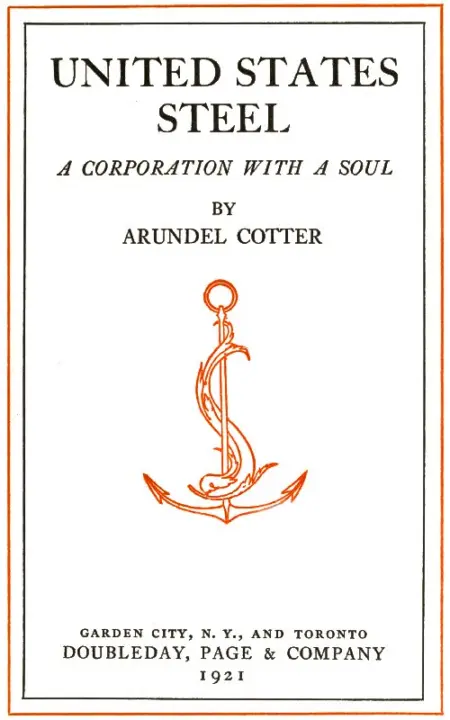
"United States Steel: A Corporation with a Soul" by Arundel Cotter is a historical account written in the early 20th century, specifically 1921. The work explores the foundational story of the United States Steel Corporation, emphasizing the interplay between corporate development and the broader context of the steel industry in America. Through the narrative, Cotter suggests that behind the formidable corporate structure lies a sense of ethics and responsibility, advocating for a perception of the corporation not merely as a business entity but as an institution with moral obligations towards its employees and society. The opening of the book establishes a clear framework for understanding the significance of the United States Steel Corporation within the larger narrative of American industrialization. It introduces Elbert H. Gary, the chairman and chief executive officer, whose vision and leadership are depicted as instrumental in shaping the corporation’s ethos. The prologue suggests that the corporation, which dwarfed its competitors in size and influence, also sought to redefine corporate responsibility by promoting fair competition and transparency in business practices. This veritable blend of corporate ambition and social consciousness lays the groundwork for the detailed history that follows, tracing the evolution of the steel industry's practices and its prominent figures, foreshadowing the in-depth examination of events leading to the establishment of this industrial giant.
Introduction adapted from the source catalogue; source summaries may be automatically generated.
Free to read · English · 96,408 words · No account needed
MAKE TIME FOR A GOOD BOOK
On by default. Untick to stop anonymous reading totals. Each page counts after 10 seconds in view. How this works.
Anonymous counting is on unless you have switched it off.
As may be supposed, conditions brought about by the war changed the situation materially, hence, figures illustrating the policy of the Corporation to develop exports more along the line of finished materials must be sought in the pre-war period. In 1912, the record pre-war export year, the Corporation shipped abroad 2,223,536 tons of finished steel products and only 42,031 tons of pig iron, ingots, and scrap. In the year 1904, immediately following the organization of the export company, foreign shipments were 1,002,967 tons of a gross value of $31,388,139, an average of $31.30 a ton. These figures are f. o. b. on the seaboard. In 1912 the tonnage exported was 2,265,567 of an average value of $40.60 a ton or a total value of $91,984,239. In the period indicated there had been an increase of 125.9 per cent. in tonnage, of 193.1 per cent. in total value, and of 29.7 per cent. in the average price, more than $9.00 a ton. Incidentally, the average price received on domestic business by the Corporation declined from $41.34 a ton in 1904 to $36.53 a ton in 1912, or nearly $5.00 a ton.
Part of the gain in export prices during the period in question was due to the increasing percentage of more highly finished goods in total export shipments and part to the fact that the Corporation’s products were becoming more established in world markets and were getting the confidence of buyers therein.
How important has been the part played by the U. S. Steel Corporation, through the Steel Products Co., in developing the iron and steel exports of this country, is shown in the table below. Tonnages given for the United States include only iron and steel exports proper, and not machinery and other articles not manufactured by the Corporation, or scrap sheet and iron:
=====================================
| UNITED STATES | U. S. STEEL
YEAR | GROSS TONS | CORPORATION
| | GROSS TONS
-----+------------------+------------
1904 | 1,139,519 | 1,002,967
1905 | 1,002,289 | 939,517
1906 | 1,314,444 | 1,123,545
1907 | 1,276,292 | 982,084
1908 | 942,409 | 765,947
1909 | 1,218,225 | 1,000,395
1910 | 1,509,864 | 1,270,599
1911 | 2,102,014 | 1,712,877
1912 | 2,826,576 | 2,265,567
1913 | 2,640,142 | 1,797,948
1914 | 1,512,848 | 1,108,483
1915 | 3,450,783 | 2,355,858
1916 | 5,885,948 | 2,463,922
1917 | 6,268,514 | 2,229,747
1918 | 5,341,360 | 1,648,160
1919 | 4,354,086 | 2,004,190
1920 | 4,925,000 (est.) | 1,645,192
-----+------------------+------------
Between 1904 and 1912 the Corporation’s exports increased 1,262,600 tons, and the exports of the country 1,687,057 tons, the Corporation’s increase in shipments accounting for approximately 75 per cent. of the total gain shown by the United States.
During the years of the World War the country’s annual exportations of iron and steel products were greatly increased as compared with the largest pre-war year. During the same period the Corporation’s exports were only slightly increased. The reason for this was that the Corporation’s operations were largely confined to commercial products and not to war munitions. Large quantities of steel were, however, produced and delivered to the government and to government agencies for use in the manufacture of munitions and for other purposes in carrying on the war.
Your reading position is saved on this browser. Take it to another device with a library code. Reading pages adapt to text, rather than matching a printed edition.
BEHIND THE BOOK
This eBook is for the use of anyone anywhere in the United States and most other parts of the world at no cost and with almost no restrictions whatsoever. You may copy it, give it away or re-use it under the terms of the Project Gutenberg License included with this eBook or online at www.gutenberg.org. If you are not located in the United States, you will have to check the laws of the country where you are located before using this eBook. Read the source licence.
The original source file, including credits and licence, is retained by this library. Request an original-format copy at no charge. Please include the book title and Project Gutenberg identifier #48465.
KEEP YOUR CURIOSITY GOING
Cécile Tormay

Moritz Busch
John L. Ransom
Frances Wright
Cécile Tormay

Mabel Potter Daggett