THE CLASSIC COLLECTION✦An outlaw’s diary: the CommuneCLASSIC FREE BOOKS
An outlaw’s diary: the Commune
Cécile Tormay
THE CLASSIC COLLECTION · 1921
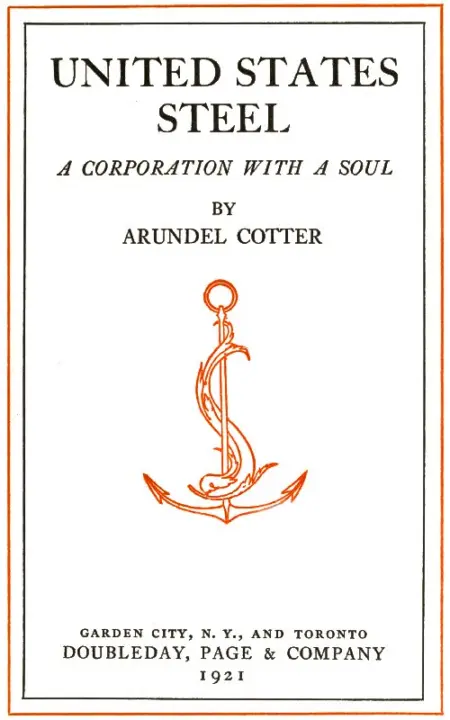
"United States Steel: A Corporation with a Soul" by Arundel Cotter is a historical account written in the early 20th century, specifically 1921. The work explores the foundational story of the United States Steel Corporation, emphasizing the interplay between corporate development and the broader context of the steel industry in America. Through the narrative, Cotter suggests that behind the formidable corporate structure lies a sense of ethics and responsibility, advocating for a perception of the corporation not merely as a business entity but as an institution with moral obligations towards its employees and society. The opening of the book establishes a clear framework for understanding the significance of the United States Steel Corporation within the larger narrative of American industrialization. It introduces Elbert H. Gary, the chairman and chief executive officer, whose vision and leadership are depicted as instrumental in shaping the corporation’s ethos. The prologue suggests that the corporation, which dwarfed its competitors in size and influence, also sought to redefine corporate responsibility by promoting fair competition and transparency in business practices. This veritable blend of corporate ambition and social consciousness lays the groundwork for the detailed history that follows, tracing the evolution of the steel industry's practices and its prominent figures, foreshadowing the in-depth examination of events leading to the establishment of this industrial giant.
Introduction adapted from the source catalogue; source summaries may be automatically generated.
Free to read · English · 96,408 words · No account needed
MAKE TIME FOR A GOOD BOOK
On by default. Untick to stop anonymous reading totals. Each page counts after 10 seconds in view. How this works.
Anonymous counting is on unless you have switched it off.
Conditions in the steel trade are not encouraging for the immediate future. The industry is apparently going through the period of deflation from a war to a peace basis just as are other industries all over the world, but while the immediate future is somewhat cloudy, the outlook for steel, if one looks ahead several years, is unquestionably bright. The world shortage of the metal caused by the war was by no means filled during the period of activity that lasted from October, 1919, to September, 1920. There is every reason to believe that the world still needs steel in immense quantities for the myriad uses in which the metal is employed, not only for future expansion but for replacement which should have occurred during the war years. As soon as the economic and financial difficulties from which the world is now suffering have been overcome--and the signs on the sky are that these clouds are already being dissipated--a great demand for steel can be prognosticated.
And United States Steel with its twenty-two million odd tons of capacity, its great resources, its good will, and its wonderful organization, will undoubtedly share generously in this anticipated trade revival. For it and for its stockholders the future holds a bright and glowing promise.
Perhaps no better conclusion for this volume can be found than the remark recently made to the writer by one of the leading independent steel makers. He said:
“United States Steel is a remarkable organization. Nothing like it exists or ever existed. It is in a class by itself.”
Table showing percentage of total steel and iron output of the United States produced by the U. S. Steel Corporation in the years 1901, 1911, 1913, and 1919. Figures for 1901 and 1911 are from the exhibit in the dissolution suit and for 1913 and 1919 from the reports of the American Iron & Steel Institute.
1901 1911 1913 1919 Iron ore from Lake Superior Ranges 61.6 54.3 50.46 45.94 Total iron ore 45.1 45.8 46.37 42.05 Total blast furnace products 43.2 45.4 45.47 43.97 Steel ingots and castings 65.7 53.9 53.21 49.61 Steel rails 59.8 56.1 55.51 61.96 Heavy structural shapes 62.2 47.0 54.03 43.77 Plates and sheets 64.6 45.7 49.13 44.30 Wire rods 77.6 64.7 58.44 55.42 Total finished products 50.1 45.7 47.81 44.60 Wire nails 65.8 51.4 44.55 51.86 Tin and terne plates 73.0 60.7 58.64 48.44
Summary of earnings and distribution thereof since organization:
Net profits from April 1, 1901 to December 31, 1919 $1,732,070,796 Deductions; special reserves, etc. 32,227,566 Balance of profits 1,699,843,230 Preferred dividends paid (131¼ per cent.) 496,391,722 Common dividends paid (89½ per cent.) 454,908,882 Total dividends paid 951,300,604 Surplus profits 748,542,626 Appropriations for capital expenditures, etc. 280,494,424 Balance of profits carried to surplus account 468,048,202
Summary of undivided surplus:
Surplus or working capital provided at organization $ 25,000,000 Balance of surplus accumulated to Dec., 1919 468,048,202 Total undivided surplus 493,048,202 Appropriated surplus 280,494,424 Total appropriated and undivided surplus 773,542,626
Your reading position is saved on this browser. Take it to another device with a library code. Reading pages adapt to text, rather than matching a printed edition.
BEHIND THE BOOK
This eBook is for the use of anyone anywhere in the United States and most other parts of the world at no cost and with almost no restrictions whatsoever. You may copy it, give it away or re-use it under the terms of the Project Gutenberg License included with this eBook or online at www.gutenberg.org. If you are not located in the United States, you will have to check the laws of the country where you are located before using this eBook. Read the source licence.
The original source file, including credits and licence, is retained by this library. Request an original-format copy at no charge. Please include the book title and Project Gutenberg identifier #48465.
KEEP YOUR CURIOSITY GOING
Cécile Tormay

Moritz Busch
John L. Ransom
Frances Wright
Cécile Tormay

Mabel Potter Daggett