THE CLASSIC COLLECTION✦An outlaw’s diary: the CommuneCLASSIC FREE BOOKS
An outlaw’s diary: the Commune
Cécile Tormay
THE CLASSIC COLLECTION · 1921
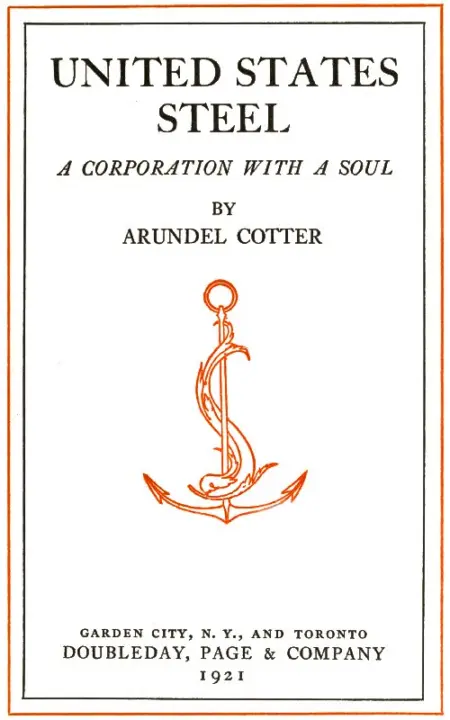
"United States Steel: A Corporation with a Soul" by Arundel Cotter is a historical account written in the early 20th century, specifically 1921. The work explores the foundational story of the United States Steel Corporation, emphasizing the interplay between corporate development and the broader context of the steel industry in America. Through the narrative, Cotter suggests that behind the formidable corporate structure lies a sense of ethics and responsibility, advocating for a perception of the corporation not merely as a business entity but as an institution with moral obligations towards its employees and society. The opening of the book establishes a clear framework for understanding the significance of the United States Steel Corporation within the larger narrative of American industrialization. It introduces Elbert H. Gary, the chairman and chief executive officer, whose vision and leadership are depicted as instrumental in shaping the corporation’s ethos. The prologue suggests that the corporation, which dwarfed its competitors in size and influence, also sought to redefine corporate responsibility by promoting fair competition and transparency in business practices. This veritable blend of corporate ambition and social consciousness lays the groundwork for the detailed history that follows, tracing the evolution of the steel industry's practices and its prominent figures, foreshadowing the in-depth examination of events leading to the establishment of this industrial giant.
Introduction adapted from the source catalogue; source summaries may be automatically generated.
Free to read · English · 96,408 words · No account needed
MAKE TIME FOR A GOOD BOOK
On by default. Untick to stop anonymous reading totals. Each page counts after 10 seconds in view. How this works.
Anonymous counting is on unless you have switched it off.
And these facts were fully realized by Judge Gary and his colleagues. While probably believing that full value in earning power had been received for the hundreds of millions paid for good will, they were not satisfied to let matters remain in that state, and bent their energies, at the sacrifice of immediate dividends to stockholders, toward squeezing out every possible drop of water behind the stock, and putting at least one hundred cents of tangible assets behind every dollar of securities of any kind in the hands of the public.
In this they have more than succeeded. The bonds and preferred stock of the Steel Corporation are to-day recognized as being absolutely gilt-edged, and even the most captious critics do not attempt to deny that every share of common stock is backed up by assets far exceeding its face value.
Reference has already been made to Judge Gary’s statement, in October, 1919, before the Senate Committee on Education and Labor, then investigating the steel strike, that the Corporation’s properties were worth at least $2,200,000,000. Competent steel men, outside the Corporation, express the opinion that this valuation was ultra conservative. They point to the fact that the Judge’s valuation was obviously based upon expenditures of approximately $900,000,000 for new plants between 1901 and 1919, and assert that it will never be possible to replace these plants for less than $1,250,000,000. But accepting Judge Gary’s valuation as accurate, Steel common has between $260 and $270 in assets behind it.
Just as the investment behind the stock has been increased and accumulated, so has earning power been strengthened. So great is the Corporation’s capacity to-day and so strong is it financially that it is almost inconceivable that it will at any time in the future be unable to maintain its present dividend rate of $5.00 a share annually on the junior stock.
From the date of its incorporation in 1901, to December, 1919, the big company expended for new construction, increasing its capacity and modernizing its plants, $888,301,355, or the equivalent of $159 on every share of its common stock, and $19,717,755 more than its entire stock capitalization, common and preferred. Nor did this include approximately $108,000,000 spent for plants for producing war materials and written off as operating expenses.
Construction expenditures in 1920 were, approximately, $102,000,000, making a total on this account since incorporation of a billion dollars in round figures.
Appropriations for depreciation, sinking funds, and repairs to plants have been enormous, aggregating in nineteen years $1,424,415,590, or almost as great a sum as that at which the property account is now carried, $1,573,661,547.
The Corporation has expended, for ordinary repairs alone, $835,900,568, or about the actual investment value of the properties acquired at incorporation.
As a result of these enormous expenditures, it has:
Your reading position is saved on this browser. Take it to another device with a library code. Reading pages adapt to text, rather than matching a printed edition.
BEHIND THE BOOK
This eBook is for the use of anyone anywhere in the United States and most other parts of the world at no cost and with almost no restrictions whatsoever. You may copy it, give it away or re-use it under the terms of the Project Gutenberg License included with this eBook or online at www.gutenberg.org. If you are not located in the United States, you will have to check the laws of the country where you are located before using this eBook. Read the source licence.
The original source file, including credits and licence, is retained by this library. Request an original-format copy at no charge. Please include the book title and Project Gutenberg identifier #48465.
KEEP YOUR CURIOSITY GOING
Cécile Tormay

Moritz Busch
John L. Ransom
Frances Wright
Cécile Tormay

Mabel Potter Daggett