THE CLASSIC COLLECTION✦An outlaw’s diary: the CommuneCLASSIC FREE BOOKS
An outlaw’s diary: the Commune
Cécile Tormay
THE CLASSIC COLLECTION · 1921
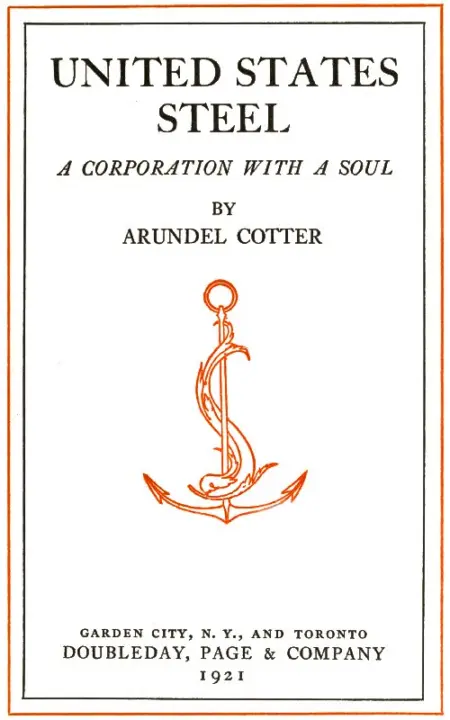
"United States Steel: A Corporation with a Soul" by Arundel Cotter is a historical account written in the early 20th century, specifically 1921. The work explores the foundational story of the United States Steel Corporation, emphasizing the interplay between corporate development and the broader context of the steel industry in America. Through the narrative, Cotter suggests that behind the formidable corporate structure lies a sense of ethics and responsibility, advocating for a perception of the corporation not merely as a business entity but as an institution with moral obligations towards its employees and society. The opening of the book establishes a clear framework for understanding the significance of the United States Steel Corporation within the larger narrative of American industrialization. It introduces Elbert H. Gary, the chairman and chief executive officer, whose vision and leadership are depicted as instrumental in shaping the corporation’s ethos. The prologue suggests that the corporation, which dwarfed its competitors in size and influence, also sought to redefine corporate responsibility by promoting fair competition and transparency in business practices. This veritable blend of corporate ambition and social consciousness lays the groundwork for the detailed history that follows, tracing the evolution of the steel industry's practices and its prominent figures, foreshadowing the in-depth examination of events leading to the establishment of this industrial giant.
Introduction adapted from the source catalogue; source summaries may be automatically generated.
Free to read · English · 96,408 words · No account needed
MAKE TIME FOR A GOOD BOOK
On by default. Untick to stop anonymous reading totals. Each page counts after 10 seconds in view. How this works.
Anonymous counting is on unless you have switched it off.
How gigantic was the task of building Gary may be gathered from its cost to the Corporation. The construction of the steel plant and the creation of the town has involved an expenditure of over $100,000,000, and work is yet to do. Of the fifty-six open-hearth and other steel furnaces contemplated in the original plan, forty-seven have been completed so far. The first heat of pig iron was produced on December 21, 1908, and the first steel ingots early the following year.
The Gary plant is probably the largest single steel plant in the world. It consists of twelve blast furnaces, forty-seven steel furnaces, a rail mill, billet mill, plate mill, five merchant mills, slab mills, an axle plant, and a by-product coke plant of ten batteries, each of seventy ovens. With these are auxiliary shops, machine shop, roll shop, electric repair shop, boiler shop, blacksmith shop, etc., and the necessary electrical equipment.
Sixteen gas engines of 2,000 H. P. each, supplemented by four 3,000 H. P. steam engines, are used to operate the blast furnaces. The power required to run the open-hearth furnaces and steel mills is supplied by seventeen 3,000 H. P. gas engines, driving an equal number of electric generators, the gas for these engines and for the blowing engines being supplied from the blast furnaces. In this way the power required for the entire plant is supplied by blast furnace by-product gas. Part of the power generated is transmitted to Buffington, five miles away, where it is used to run the machinery of the Universal Portland Cement Works. The rail mill is driven by three electric motors, each of 6,000 H. P.
The annual capacity of the big plant is as follows:
TONS
Pig iron 2,173,200
Coke 3,360,000
Ingots 3,030,000
Billets, blooms and slabs 1,544,600
Sheet bars 104,000
Rails 750,000
Finished steel, including rails 1,997,900
During the construction of the plant, over 10,000,000 cubic yards of material were excavated and over 1,200,000 cubic yards of concrete placed. More than 150,000 tons of fabricated steel were used in its construction. The plant covers an area of 1,250 acres, and a plot of land of approximately the same size and adjoining the existing plant is being reserved for possible further extensions.
Gary, the town, was incorporated in June, 1906, only a few months after the foundations for the first buildings were excavated. At the first election for town officials, only 33 votes were cast. Seven years later, in 1913, over 9,000 voters marked the ballots.
Your reading position is saved on this browser. Take it to another device with a library code. Reading pages adapt to text, rather than matching a printed edition.
BEHIND THE BOOK
This eBook is for the use of anyone anywhere in the United States and most other parts of the world at no cost and with almost no restrictions whatsoever. You may copy it, give it away or re-use it under the terms of the Project Gutenberg License included with this eBook or online at www.gutenberg.org. If you are not located in the United States, you will have to check the laws of the country where you are located before using this eBook. Read the source licence.
The original source file, including credits and licence, is retained by this library. Request an original-format copy at no charge. Please include the book title and Project Gutenberg identifier #48465.
KEEP YOUR CURIOSITY GOING
Cécile Tormay

Moritz Busch
John L. Ransom
Frances Wright
Cécile Tormay

Mabel Potter Daggett