A Prisoner of the Khaleefa: Twelve Years Captivity at Omdurman
Charles Neufeld
THE CLASSIC COLLECTION · 1900
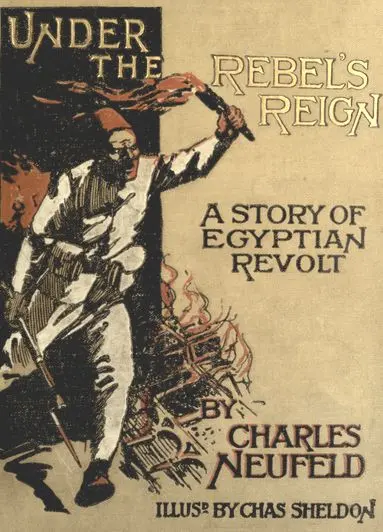
"Under the Rebel's Reign" by Charles Neufeld is a novel written in the early 20th century. This story is set against the backdrop of an Egyptian revolt, intertwining themes of adventure and conflict with vivid character interactions. The narrative likely centers around George Helmar, a young man entangled in tumultuous events in Egypt following a contentious duel and a series of life-changing decisions that lead him into a world of danger and intrigue. At the start of the novel, we are introduced to George Helmar, a university student who finds himself at the center of a duel that results in the injury of his opponent, John Landauer. The societal pressures of honor and the prohibition of dueling for a theological student like his friend, Charlie Osterberg, leave George grappling with the moral implications of violence. Following the duel, George decides to leave Europe and embark on an adventure with Charlie and another acquaintance to escape the weight of responsibility and bloodshed. Their journey leads them through Vienna and onto the Danube, where they plan to reach Constantinople and ultimately Egypt. However, their trip quickly turns dangerous as they encounter brigands and political unrest. The opening chapters set the stage for a gripping tale of survival, camaraderie, and the quest for redemption amidst chaos.
Introduction adapted from the source catalogue; source summaries may be automatically generated.
Free to read · English · 81,850 words · No account needed
MAKE TIME FOR A GOOD BOOK
On by default. Untick to stop anonymous reading totals. Each page counts after 10 seconds in view. How this works.
Anonymous counting is on unless you have switched it off.
"Simple enough," replied the other; "he's forgotten about the wind. There isn't too much, it's true, but what there is is coming from the west, and consequently the sound travels with it. Now, you listen. You can't hear a sound of him now."
It was as the Irishman said. Strain as they would, there was not a sound to be heard from his retreating horse.
"You're right," said George, at last, "and the other sound is still to be heard, which means----"
"Which means that some one is approaching us from the west, and the sound is travelling with the wind. Before he gets back we'll have trouble on our hands, or I'm--I'm--a Dutchman," he finished up in his broad Irish brogue.
Although Helmar was determined and courageous, he was a novice at the art of war, and was ready to adopt any plan that appealed to his common-sense when danger threatened, so he consulted his companion.
"Assuming that we are right, what plan do you suggest?" he asked,
eyeing the Irishman keenly.
"Well, it's hard to say what's best. Sure, I'm right on for a fight, but we must first locate how many are coming, and p'raps after all they may be friendlies, though I wouldn't give much for the chance."
"Neither would I," replied George, laughing. "Well, I'll tell you what I propose; we'll just lay low and be guided by circumstances, and, in the meantime, look to our arms."
The two men's revolvers were loaded, and the magazine of their rifles full; after they had examined them carefully they sat in solemn silence, with every nerve strained to its highest tension for the slightest suspicious sound.
Every moment increased their certainty of the approach of horsemen,
although at a slow pace, for the sounds were infinitely more
distinct.
"They're coming, right enough," said Brian abruptly in a whisper. "I caught the sound of voices just now, and by jabers it seems to me they're Gypies."
This was a surmise of the Irishman's imagination, for as yet Helmar had heard no voice; but still the sounds came nearer.
"Another two minutes and it'll be time to give the signal to Captain Forsyth," said Helmar, feeling over the face of his watch.
"Eh? And bring a hornet's nest about us!" exclaimed the Irishman in disgust. "But there, it's military orders, and I suppose they must be obeyed, whatever the consequences."
Your reading position is saved on this browser. Take it to another device with a library code. Reading pages adapt to text, rather than matching a printed edition.
BEHIND THE BOOK
This eBook is for the use of anyone anywhere in the United States and most other parts of the world at no cost and with almost no restrictions whatsoever. You may copy it, give it away or re-use it under the terms of the Project Gutenberg License included with this eBook or online at www.gutenberg.org. If you are not located in the United States, you will have to check the laws of the country where you are located before using this eBook. Read the source licence.
The original source file, including credits and licence, is retained by this library. Request an original-format copy at no charge. Please include the book title and Project Gutenberg identifier #23829.
KEEP YOUR CURIOSITY GOING
Cécile Tormay

Moritz Busch
Coulson Kernahan
John L. Ransom

Maurice Baring
Frances Wright