THE CLASSIC COLLECTION✦A dead man’s diaryCLASSIC FREE BOOKS
A dead man’s diary
Coulson Kernahan
THE CLASSIC COLLECTION · 1905
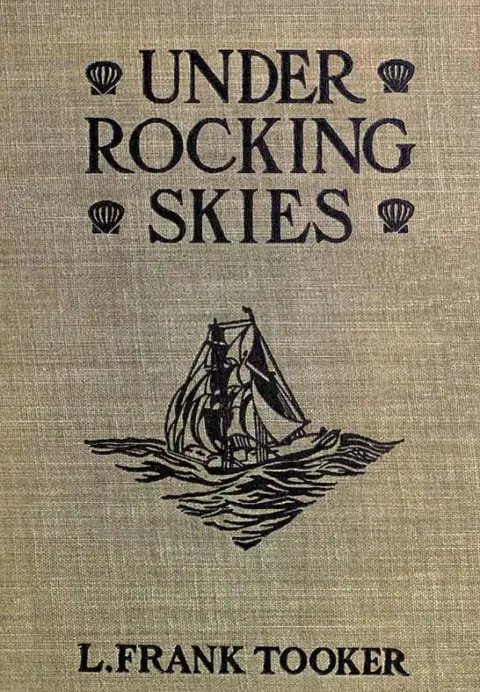
"Under Rocking Skies" by L. Frank Tooker is a novel likely written in the early 20th century. The story introduces us to Thomas Medbury, a young man deeply connected to the sea and nautical life, highlighting the intricate dynamics of relationships among sailors and their families. Central to the narrative is the tension between Medbury and the adventurous spirit of Hetty March, the captain's daughter, as various characters grapple with personal desires and familial expectations. The opening of "Under Rocking Skies" presents a rich, atmospheric scene with Medbury observing his neighbor's household. After a brief exchange with Hetty's husband, Bob, who is preparing for a fishing trip, Medbury expresses his desire to go to sea himself, hinting at a deeper connection to the maritime lifestyle. As the story unfolds, Medbury's interactions with Hetty and the reigning sentiments of longing, duty, and ambition surrounding their lives on the water become apparent. The novel's beginning sets the stage for exploring themes of love, ambition, and the pull of the sea, promising complexity as the characters navigate their intertwined fates.
Introduction adapted from the source catalogue; source summaries may be automatically generated.
Free to read · English · 40,172 words · No account needed
MAKE TIME FOR A GOOD BOOK
On by default. Untick to stop anonymous reading totals. Each page counts after 10 seconds in view. How this works.
Anonymous counting is on unless you have switched it off.
"Mon Dieu!" she cried, "eet iss betteh--dees." She watched the others coming over the rail, and, when all were safe, turned to Medbury with a little courtesy. "Eet iss ver' romanteec tow be safed from doze salt wateh by so nize young gentleman," she murmured, with a gleeful face. "Yo' happen tow be a mah'ied man, maybe?"
"No, ma'am," Medbury answered soberly.
She laughed in his face.
"Yo' sad faw das, maybe?" she asked mischievously.
"Oh, no," he answered, laughingly recovering himself.
"Das iss mo' betteh," she said demurely, and turned to Hetty.
Taking both her hands in her own, she kissed her impulsively.
"Ah ahm mo' gladdeh faw tow see yo' naw ahnybody," she said. "Ah see nut'ing but doze mens all tam. Ah t'ink Ah go git crezzy," she added laughingly.
They got the brig on her course again, and took the captain of the boat and his two passengers down into the cabin. The captain said his vessel was a Danish bark from Copenhagen, bound for Santa Cruz, and she had been burned two days before. They had taken to their boats, but, as there was no wind, they had lingered near, in the hope that the smoke from the burning vessel would be a beacon for some rescuer. But no vessel had been sighted, and before night came on they had started on their long road. Their other boat had been lost in the fog.
The captain had told his story in fair English, and at its close he turned to his passengers, and said they were going home to Santa Cruz, where the young man, a lieutenant in the army, was stationed. His sister, Miss Stromberg, he added, lived with her brother. As he mentioned their names, he bowed. Both rose, and, passing gravely around the group, shook hands with all. They were much alike--small, dark-haired, with handsome, piquant faces. Life seemed a huge joke to both.
As they seated themselves again, the girl looked about her and smiled.
"Ah t'ink dis iss mo' nizeh naw das liddy boat," she said.
"Mooch mo' nizeh," her brother agreed. He smiled, and bowed to the collected company, beginning with Hetty and ending with her.
"I hope so," said Captain March; then he turned to the Danish captain and added: "I'm glad to get your men; I've already found your vessel."
When he had finished the story of his own misfortune, he went up on deck, followed by the two rescued men.
"My dear," said Mrs. March to the girl, "you must be tired out. Now you must have something to eat and then go straight to bed. My daughter can easily take you in her room."
Your reading position is saved on this browser. Take it to another device with a library code. Reading pages adapt to text, rather than matching a printed edition.
BEHIND THE BOOK
This eBook is for the use of anyone anywhere in the United States and most other parts of the world at no cost and with almost no restrictions whatsoever. You may copy it, give it away or re-use it under the terms of the Project Gutenberg License included with this eBook or online at www.gutenberg.org. If you are not located in the United States, you will have to check the laws of the country where you are located before using this eBook. Read the source licence.
The original source file, including credits and licence, is retained by this library. Request an original-format copy at no charge. Please include the book title and Project Gutenberg identifier #55721.
KEEP YOUR CURIOSITY GOING
Coulson Kernahan

Maurice Baring
Frances Wright
Cécile Tormay

Frederic Jesup Stimson

W. H. P. (William Henry Pope) Jarvis