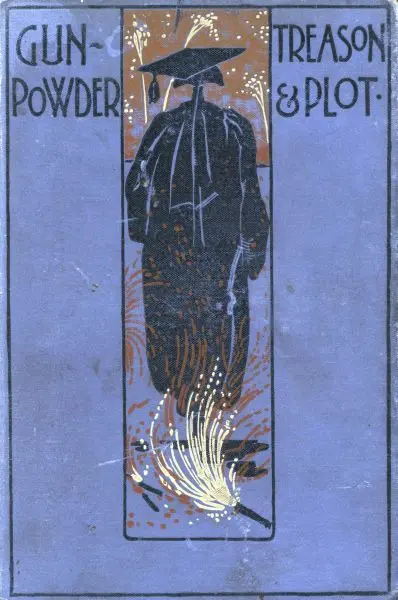
Gunpowder Treason and Plot, and Other Stories for Boys
Harold Avery & R. B. (Richard Baxter) Townshend & Frederick Whishaw

THE CLASSIC COLLECTION · 1905
"Under Padlock and Seal" by Harold Avery is a children's adventure novel likely written in the early 20th century. The story revolves around a group of siblings—Elsie, Ida, Guy, and their cousin Brian—as they navigate mysterious events in their lives, particularly the enigma of "Uncle Roger's Box." This box, sealed for twenty years, piques their curiosity and serves as a focal point for their explorations and imaginative speculations. The beginning of the narrative introduces Elsie, who is disturbed in the middle of the night by the sound of a grindstone coming from the tool-house. This prompts her to investigate, suspecting her cousin Brian is at work. Despite her brave intent, she hesitates and fears the unknown, leading her to retreat. Later, at breakfast, the family discusses the strange happenings, including the mysterious loss and reappearance of a carving knife, which ties back to Elsie's earlier fright. This sets the stage for a mix of suspense and whimsy as the children seek answers, involving them in a series of curious events that challenge their bravery and problem-solving skills.
Introduction adapted from the source catalogue; source summaries may be automatically generated.
Free to read · English · 22,787 words · No account needed
MAKE TIME FOR A GOOD BOOK
On by default. Untick to stop anonymous reading totals. Each page counts after 10 seconds in view. How this works.
Anonymous counting is on unless you have switched it off.
"Where did you say it was picked up, sir?" he asked.
"It was at the bottom of our little pond," was the answer. "The boys had one of their toy boats sunk, and, in dragging for it with a rake, they brought up this."
"At the bottom of the pond," murmured the policeman thoughtfully. "Then it is evident that the person who ground it down threw the knife into the water, so that it shouldn't be found again.--You don't remember on what day the knife was lost, I suppose, ma'am?"
"No, I'm afraid I can't tell you that," answered Mrs. Ormond. "We missed it first last Saturday week; but we don't use it every day, so it might have been before then."
"You've no idea who could have done this?"
"None whatever. We had an idea that one of the boys might have been the culprit; but, as I said to Mrs. Ormond, I don't think a boy could have ground a knife blade down as cleverly as that."
The sergeant held the carver nearer to the lamp, and looked at it for a
few moments in silence.
"I've seen some queer tools," he said, "manufactured by what's called a thieves' blacksmith, and sometimes by the men themselves--all kinds of odd contrivances, made out of the most unexpected things you can imagine, from a knitting-needle to a steel fork or a poker."
"You don't think that was done by a robber, do you?" exclaimed Mrs. Ormond, looking up from her work.
"No, ma'am; I can't see what the use of it could have been, it's so thin and fragile. Now, if it had been turned into a fine saw," the speaker continued, feeling along the edge of the blade with his finger and thumb, "it would have made me feel a bit suspicious.--I suppose, sir, you've had no cause lately to think the house has been broken into--no drawers forced, or windows opened?"
"Oh no!" answered Mr. Ormond. "Nothing of the kind."
The sergeant nodded. "It's difficult to understand," he said, "why any one should take the trouble to grind a knife like this, and then throw it into a pond, unless they was trying their 'and to see how thin the blade could be made."
The speaker stood thoughtfully balancing the carver across the palm of his large hand; then a close observer might have seen the ghost of a smile appear on his ruddy face.
"I expect, sir, you've got a grindstone on the premises?"
"Yes, there's one out in the tool-house."
Evans made no reply, but after a moment's pause laid the knife down on the table, and prepared to go.
Your reading position is saved on this browser. Take it to another device with a library code. Reading pages adapt to text, rather than matching a printed edition.
Harold Avery & R. B. (Richard Baxter) Townshend & Frederick Whishaw
BEHIND THE BOOK
This eBook is for the use of anyone anywhere in the United States and most other parts of the world at no cost and with almost no restrictions whatsoever. You may copy it, give it away or re-use it under the terms of the Project Gutenberg License included with this eBook or online at www.gutenberg.org. If you are not located in the United States, you will have to check the laws of the country where you are located before using this eBook. Read the source licence.
The original source file, including credits and licence, is retained by this library. Request an original-format copy at no charge. Please include the book title and Project Gutenberg identifier #31231.
KEEP YOUR CURIOSITY GOING
Coulson Kernahan

Maurice Baring
Frances Wright
Cécile Tormay

Frederic Jesup Stimson

W. H. P. (William Henry Pope) Jarvis