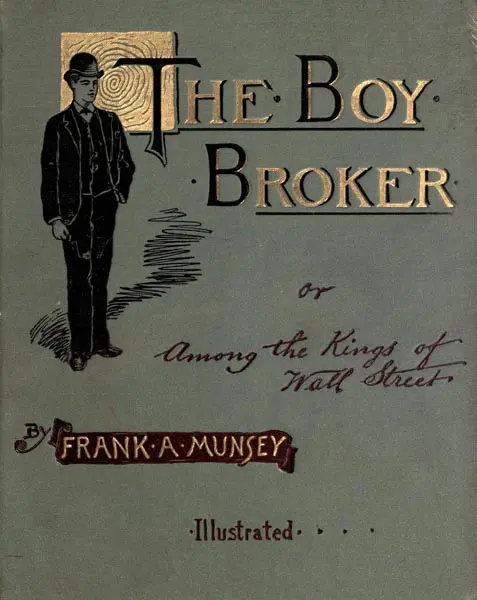
The Boy Broker; Or, Among the Kings of Wall Street
Frank Andrew Munsey
THE CLASSIC COLLECTION · 1897
"Under Fire: A Tale of New England Village Life" by Frank Andrew Munsey is a novel written in the late 19th century. Set in the quaint New England village of Mapleton, it explores themes of social class, friendship, and youthful ambition as it follows the life of Fred Worthington, a young boy navigating the complexities of social status, rivalry, and coming-of-age challenges against the backdrop of small-town dynamics. The opening portion of the novel introduces us to the boys of Mapleton, engaging in lively discussions about a local baseball game and a party hosted by Grace Bernard, a prominent figure in their social sphere. Through these conversations, Fred Worthington emerges as the central character, caught in the crosshairs of social prejudice fueled by Matthew De Vere, a rival who harbors resentment towards Fred's intelligence and budding friendship with the charming Nellie Dutton. As tension escalates with De Vere's malicious intentions, the stage is set for Fred's impending conflict as he struggles against societal expectations and strives to earn his place among peers, leading to a narrative ripe with emotional and moral complexities.
Introduction adapted from the source catalogue; source summaries may be automatically generated.
Free to read · English · 50,824 words · No account needed
MAKE TIME FOR A GOOD BOOK
On by default. Untick to stop anonymous reading totals. Each page counts after 10 seconds in view. How this works.
Anonymous counting is on unless you have switched it off.
"But I submit that the circumstances--the facts, if you please--lead to that conclusion," put in attorney Ham.
"To be sure, they give rise to a strong suspicion that it was, but unless we get further testimony to this end, the court cannot hold the prisoner for trial."
Mr. Rexford now gave his evidence, showing why he suspected Fred of
being the guilty party.
This being simply a hearing before a justice, Mr. Farrington was allowed to serve Fred in place of a lawyer.
"You say," said Mr. Farrington, addressing the witness, "you thought at the time you discharged Fred Worthington from your employ that some sort of revenge would follow. Will you kindly state why you thought so?"
"His manner indicated it."
"In what way, please?"
"He was very saucy and impudent."
"In what manner was he impudent?"
"He threatened me."
"Simply because you informed him you wouldn't need his services longer?"
"Well, yes, that is about it," answered the witness hesitatingly.
"The court would like to know the exact facts," said Judge Plummer.
"I shall endeavor to give them," answered the witness.
"Then please state in what way he threatened you," said Mr. Farrington.
"It was in his manner. I had to conciliate him to save trouble. I was
absolutely afraid of him."
"In what way did you conciliate him?"
"By modifying my statement."
"What was your statement?"
"It was something about his taking money from my drawer."
"You charged him, then, with stealing?"
"Not exactly."
"This was the point, however, that you modified?"
"Yes."
"Did that satisfy him?"
"Well, yes, it seemed to," admitted the witness reluctantly.
"Then, Mr. Rexford, your testimony shows that Fred Worthington did not complain at being discharged, but at a statement which you had no right to make. I judge he simply acted as any proud spirited boy would have done."
John Rexford grew fidgety.
"Was there any other cause for his being impudent?"
"No."
"No question of settlement, I suppose?"
"Nothing worth speaking of," answered the witness, growing very nervous.
"As it may have some bearing upon this case, you will please state what
it was."
Mr. Farrington had a whispered consultation with Fred at this juncture, which made the merchant very ill at ease, and caused him to testify more fully upon the point than he otherwise would have done.
"I at first thought I would keep the amount due him to make up my loss; but his manner was so hostile that I feared he would injure me in some way, so I gave him the money."
"Did he threaten you with personal violence?"
"No."
"He made no threat at all, then?"
Your reading position is saved on this browser. Take it to another device with a library code. Reading pages adapt to text, rather than matching a printed edition.
Frank Andrew Munsey
BEHIND THE BOOK
This eBook is for the use of anyone anywhere in the United States and most other parts of the world at no cost and with almost no restrictions whatsoever. You may copy it, give it away or re-use it under the terms of the Project Gutenberg License included with this eBook or online at www.gutenberg.org. If you are not located in the United States, you will have to check the laws of the country where you are located before using this eBook. Read the source licence.
The original source file, including credits and licence, is retained by this library. Request an original-format copy at no charge. Please include the book title and Project Gutenberg identifier #27935.
KEEP YOUR CURIOSITY GOING
Coulson Kernahan

Maurice Baring
Frances Wright
Cécile Tormay

Frederic Jesup Stimson

W. H. P. (William Henry Pope) Jarvis