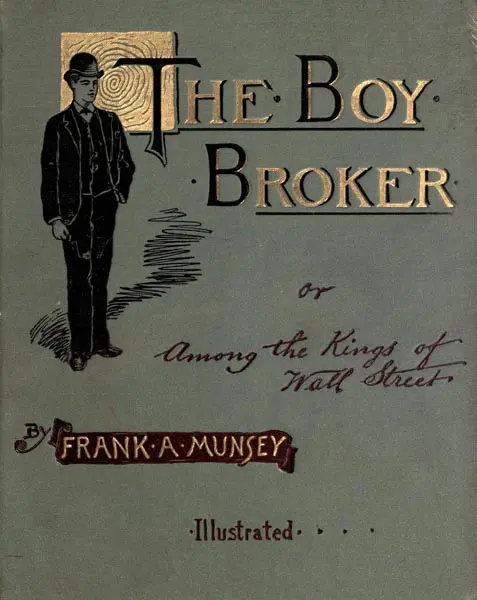
The Boy Broker; Or, Among the Kings of Wall Street
Frank Andrew Munsey
THE CLASSIC COLLECTION · 1897
"Under Fire: A Tale of New England Village Life" by Frank Andrew Munsey is a novel written in the late 19th century. Set in the quaint New England village of Mapleton, it explores themes of social class, friendship, and youthful ambition as it follows the life of Fred Worthington, a young boy navigating the complexities of social status, rivalry, and coming-of-age challenges against the backdrop of small-town dynamics. The opening portion of the novel introduces us to the boys of Mapleton, engaging in lively discussions about a local baseball game and a party hosted by Grace Bernard, a prominent figure in their social sphere. Through these conversations, Fred Worthington emerges as the central character, caught in the crosshairs of social prejudice fueled by Matthew De Vere, a rival who harbors resentment towards Fred's intelligence and budding friendship with the charming Nellie Dutton. As tension escalates with De Vere's malicious intentions, the stage is set for Fred's impending conflict as he struggles against societal expectations and strives to earn his place among peers, leading to a narrative ripe with emotional and moral complexities.
Introduction adapted from the source catalogue; source summaries may be automatically generated.
Free to read · English · 50,824 words · No account needed
MAKE TIME FOR A GOOD BOOK
On by default. Untick to stop anonymous reading totals. Each page counts after 10 seconds in view. How this works.
Anonymous counting is on unless you have switched it off.
"Oh, yes, I heard it--he probably wanted me to hear it--but I could not
notice it there."
"It was hateful and mean in him," replied Nellie sympathetically; "and he was as rude as he could be all the evening."
Fred had too much spirit to take kindly to being insulted, but Nellie's warm hearted manner of sympathizing with him, and her criticism of his rival, made him almost wish De Vere were again present to make some insolent remark, that he might have the pleasure of hearing Nellie still further champion his cause.
"But you did not tell me what made him so uncivil," continued Nellie.
"No."
"Do you know?"
"I suppose he was vexed."
"I should think he must have been very much piqued to act as he did."
"Yes, it would seem so."
"But what could have caused it, I wonder?" asked Nellie, with much
innocence.
"Do you really want me to tell you?"
"Why, to be sure I do."
"Couldn't you guess?"
"I know I could not."
"Not if you were to try very hard?"
"No."
"You should be more egotistical, then."
"Why, what do you mean, Fred?"
"I mean that what made him unhappy was just the thing that made me happy, and gave me the pleasantest evening of my life," replied Fred, tightening the pressure slightly on his companion's arm.
"I cannot see how this affects me, or proves, as you say, that I should be more egotistical," replied Miss Nellie, continuing, with feminine perversity, to feign innocence and ignorance, that she might keep Fred longer on a topic at once so flattering and delightful.
"Then I will be plainer--very plain--and say that you were the cause
yourself."
If the night had been a light one, Fred would have seen a bewildering blush cover the face of his companion. As it was, he guessed the truth, and realized that the effect of his words was altogether gratifying to Nellie's pride--it could hardly be anything more sentimental than pride.
But now they were at her home--all too soon as it seemed to Fred--and her father and mother had heard them come up the steps; so the "good night" must be brief.
Nellie extended her hand, with its graceful, tapering fingers, to him, and thanked him very prettily for his attention during the evening, and for escorting her safely home. In return, Fred gave her hand a slight pressure from the impulse of his honest, manly heart, that meant a thousand thanks for the pleasure she had given him, which would be a gratifying recollection for weeks and months to come.
Your reading position is saved on this browser. Take it to another device with a library code. Reading pages adapt to text, rather than matching a printed edition.
Frank Andrew Munsey
BEHIND THE BOOK
This eBook is for the use of anyone anywhere in the United States and most other parts of the world at no cost and with almost no restrictions whatsoever. You may copy it, give it away or re-use it under the terms of the Project Gutenberg License included with this eBook or online at www.gutenberg.org. If you are not located in the United States, you will have to check the laws of the country where you are located before using this eBook. Read the source licence.
The original source file, including credits and licence, is retained by this library. Request an original-format copy at no charge. Please include the book title and Project Gutenberg identifier #27935.
KEEP YOUR CURIOSITY GOING
Coulson Kernahan

Maurice Baring
Frances Wright
Cécile Tormay

Frederic Jesup Stimson

W. H. P. (William Henry Pope) Jarvis