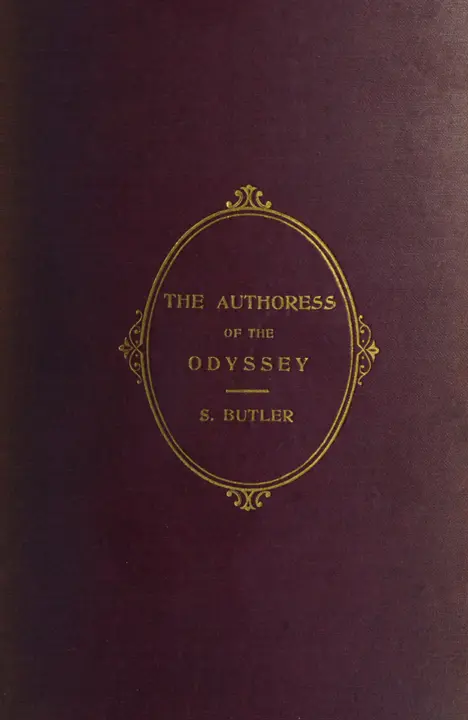
The Authoress of the Odyssey Where and when she wrote, who she was, the use she made of the Iliad, and how the poem grew under her hands
Samuel Butler
THE CLASSIC COLLECTION · 1880
"Unconscious Memory" by Samuel Butler is a treatise on biological theory, written in the late 19th century. This work explores the concept of memory as an unconscious process that shapes the behavior and development of living organisms, linking it to the broader context of evolution. Through his examination, Butler seeks to identify a connection between inherited traits and the unconscious memory of ancestral actions, attempting to provide a framework that supports and expands upon Darwinian evolution. The opening of "Unconscious Memory" introduces Butler's reflective journey into the realm of biological thought and the evolution of consciousness. He discusses the historical context surrounding Darwin's theory of natural selection, emphasizing the prevailing ignorance of earlier evolutionary thinkers and contrasting their ideas with his own theories. The text serves as a personal account of how Butler arrived at his conclusions, specifically through the intertwining of memory and habit in the development of life. He outlines his argument that memories and actions of ancestors influence the present generation's behavior, proposing that these processes are innate and performed unconsciously. This complex relationship sets the stage for Butler's exploration of the implications of memory in the context of evolution.
Introduction adapted from the source catalogue; source summaries may be automatically generated.
Free to read · English · 72,696 words · No account needed
MAKE TIME FOR A GOOD BOOK
On by default. Untick to stop anonymous reading totals. Each page counts after 10 seconds in view. How this works.
Anonymous counting is on unless you have switched it off.
{129} “Wir werden trotzdem diese gomeinsame Wirkung eines Masseninstincts in der Entstehung der Sprache und den grossen politischen und socialen Bewegungen in der Woltgeschichte deutlich wieder erkennen; hier handelt es sich um möglichst einfache und deutliche Beispiele, und darum greifen wir zu niederen Thieren, wo die Mittel der Gedankenmittheilung bei fehlender Stimme, Mimik und Physiognomie so unvollkommen sind, dass die Uebereinstimmung und das Ineinandergreifen der einzelnen Leistungen in den Hauptsachen unmöglich der bewussten Verständigung durch Sprache zugeschrieben werden darf.”—Philosophy of the Unconscious, 3d ed., p. 98.
{131a} “Und wie durch Instinct dot Plan des ganzen Stocks in unbewusstem Hellsehen jeder einzelnen Biene einwohnt.”—Philosophy of the Unconscious, 3d ed., p. 99.
{131b} “Indem jedes Individuum den Plan des Ganzen und Sämmtliche gegenwartig zu ergreifende Mittel im unbewussten Hellsehen hat, wovon aber nut das Eine, was ihm zu thun obliegt, in sein Bewusstsein fällt.”—Philosophy of the Unconscious, 3d ed., p. 99.
{132} “Der Instinct ist nicht Resultat bewusster Ueberlegung, nicht Folge der körperlichen Organisation, nicht blosses Resultat eines in der Organisation des Gehirns gelegenen Mechanismus, nicht Wirkung eines dem Geiste von aussen angeklebten todten, seinem innersten Wesen fremden Mechanismus, sondern selbsteigene Leistung des Individuum aus seinem innersten Wesen und Character entspringend.”—Philosophy of the Unconscious, 3d ed., p. 100.
{133} “Häufig ist die Kenntniss des Zwecks der bewussten Erkenntniss durch sinnliche Wahrnehmung gar nicht zugänglich; dann documentirt sich die Eigenthümlichkeit des Unbewussten im Hellsehen, von welchem das Bewusstsein theils nar eine verschwindend dumpfe, theils auch namentlich beim Menschen mehr oder minder deutliche Resonanz als Ahnung verspütt.”—Philosophy of the Unconscious, 3d ed., p. 100.
{135} “Und eine so dämonische Gewalt sollte durch etwas ausgeübt werden könnon, was als ein dem inneren Wesen fremder Mechanismus dem Geiste aufgepfropft ist, oder gar durch eine bewusste Ueberlegung, welche doch stets nur im kahlen Egoismus stecken bleibt,” &c.—Philosophy of the Unconscious, 3d ed., p. 101.
{139a} Page 100 of this vol.
{139b} Pp. 106, 107 of this vol.
{140} Page 100 of this vol.
{141} Page 99 of this vol.
{144a} See page 115 of this volume.
{144b} Page 104 of this vol.
{146} The Spirit of Nature. J. A. Churchill & Co., 1880, p. 39.
{149} I have put these words into the mouth of my supposed objector, and shall put others like them, because they are characteristic; but nothing can become so well known as to escape being an inference.
{153} Erewhon, chap. xxiii.
{160} It must be remembered that this passage is put as if in the mouth
of an objector.
{177a} “The Unity of the Organic Individual,” by Edward Montgomery. Mind, October 1880, p. 477.
{177b} Ibid., p. 483.
{179a} Professor Huxley, Encycl. Brit., 9th ed., art. Evolution, p.
750.
{179b} “Hume,” by Professor Huxley, p. 45.
Your reading position is saved on this browser. Take it to another device with a library code. Reading pages adapt to text, rather than matching a printed edition.
Samuel Butler
Samuel Butler
Samuel Butler
Samuel Butler
BEHIND THE BOOK
This eBook is for the use of anyone anywhere in the United States and most other parts of the world at no cost and with almost no restrictions whatsoever. You may copy it, give it away or re-use it under the terms of the Project Gutenberg License included with this eBook or online at www.gutenberg.org. If you are not located in the United States, you will have to check the laws of the country where you are located before using this eBook. Read the source licence.
The original source file, including credits and licence, is retained by this library. Request an original-format copy at no charge. Please include the book title and Project Gutenberg identifier #6605.
KEEP YOUR CURIOSITY GOING

David Patterson (Spirit) Hatch
Coulson Kernahan

Ralph Waldo Emerson
Frances Wright

Edwin Abbott Abbott

Joseph Droz