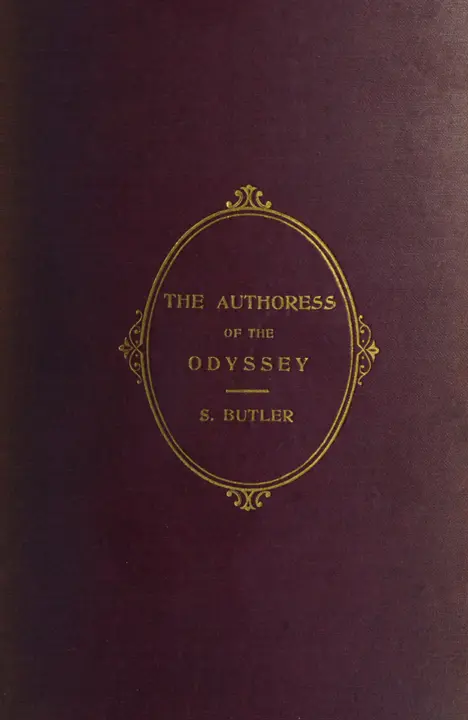
The Authoress of the Odyssey Where and when she wrote, who she was, the use she made of the Iliad, and how the poem grew under her hands
Samuel Butler
THE CLASSIC COLLECTION · 1880
"Unconscious Memory" by Samuel Butler is a treatise on biological theory, written in the late 19th century. This work explores the concept of memory as an unconscious process that shapes the behavior and development of living organisms, linking it to the broader context of evolution. Through his examination, Butler seeks to identify a connection between inherited traits and the unconscious memory of ancestral actions, attempting to provide a framework that supports and expands upon Darwinian evolution. The opening of "Unconscious Memory" introduces Butler's reflective journey into the realm of biological thought and the evolution of consciousness. He discusses the historical context surrounding Darwin's theory of natural selection, emphasizing the prevailing ignorance of earlier evolutionary thinkers and contrasting their ideas with his own theories. The text serves as a personal account of how Butler arrived at his conclusions, specifically through the intertwining of memory and habit in the development of life. He outlines his argument that memories and actions of ancestors influence the present generation's behavior, proposing that these processes are innate and performed unconsciously. This complex relationship sets the stage for Butler's exploration of the implications of memory in the context of evolution.
Introduction adapted from the source catalogue; source summaries may be automatically generated.
Free to read · English · 72,696 words · No account needed
MAKE TIME FOR A GOOD BOOK
On by default. Untick to stop anonymous reading totals. Each page counts after 10 seconds in view. How this works.
Anonymous counting is on unless you have switched it off.
{0k} Semon’s technical terms are exclusively taken from the Greek, but as experience tells that plain men in England have a special dread of suchlike, I have substituted “imprint” for “engram,” “outcome” for “ecphoria”; for the latter term I had thought of “efference,” “manifestation,” etc., but decided on what looked more homely, and at the same time was quite distinctive enough to avoid that confusion which Semon has dodged with his Græcisms.
{0l} “Between the ‘me’ of to-day and the ‘me’ of yesterday lie night and sleep, abysses of unconsciousness; nor is there any bridge but memory with which to span them.”—Unconscious Memory, p. 71.
{0m} Preface by Mr. Charles Darwin to “Erasmus Darwin.” The Museum has copies of a Kosmos that was published 1857–60 and then discontinued; but this is clearly not the Kosmos referred to by Mr. Darwin, which began to appear in 1878.
{0n} Preface to “Erasmus Darwin.”
{2} May 1880.
{3} Kosmos, February 1879, Leipsic.
{4} Origin of Species, ed. i., p. 459.
{8a} Origin of Species, ed. i., p. 1.
{8b} Kosmos, February 1879, p. 397.
{8c} Erasmus Darwin, by Ernest Krause, pp. 132, 133.
{9a} Origin of Species, ed. i., p. 242.
{9b} Ibid., p. 427.
{10a} Nineteenth Century, November 1878; Evolution, Old and New, pp.
360. 361.
{10b} Encyclopædia Britannica, ed. ix., art. “Evolution,” p. 748.
{11} Ibid.
{17} Encycl. Brit., ed. ix., art. “Evolution,” p. 750.
{23a} Origin of Species, 6th ed., 1876, p. 206.
{23b} Ibid., p. 233.
{24a} Origin of Species, 6th ed., p. 171, 1876.
{24b} Pp. 258–260.
{26} Zoonomia, vol. i. p. 484; Evolution, Old and New, p. 214.
{27} “Erasmus Darwin,” by Ernest Krause, p. 211, London, 1879.
{28a} See “Evolution, Old and New,” p. 91, and Buffon, tom. iv. p. 383,
ed. 1753.
{28b} Evolution, Old and New, p. 104.
{29a} Encycl. Brit., 9th ed., art. “Evolution,” p. 748.
{29b} Palingénésie Philosophique, part x. chap. ii. (quoted from Professor Huxley’s article on “Evolution,” Encycl. Brit., 9th ed., p. 745).
{31} The note began thus: “I have taken the date of the first publication of Lamarck from Isidore Geoffroy St. Hilaire’s (Hist. Nat. Générale tom. ii. p. 405, 1859) excellent history of opinion upon this subject. In this work a full account is given of Buffon’s fluctuating conclusions upon the same subject.”—Origin of Species, 3d ed., 1861, p. xiv.
{33a} Life of Erasmus Darwin, pp. 84, 85.
{33b} See Life and Habit, p. 264 and pp. 276, 277.
{33c} See Evolution, Old and New, pp. 159–165.
{33d} Ibid., p. 122.
{34} See Evolution, Old and New, pp. 247, 248.
{35a} Vestiges of Creation, ed. 1860, “Proofs, Illustrations, &c.,” p.
lxiv.
{35b} The first announcement was in the Examiner, February 22, 1879.
{36} Saturday Review, May 31, 1879.
{37a} May 26, 1879.
{37b} May 31, 1879.
{37c} July 26, 1879.
{37d} July 1879.
{37e} July 1879.
{37f} July 29, 1879.
{37g} January 1880.
{39} How far Kosmos was “a well-known” journal, I cannot determine. It had just entered upon its second year.
{41} Evolution, Old and New, p. 120, line 5.
Your reading position is saved on this browser. Take it to another device with a library code. Reading pages adapt to text, rather than matching a printed edition.
Samuel Butler
Samuel Butler
Samuel Butler
Samuel Butler
BEHIND THE BOOK
This eBook is for the use of anyone anywhere in the United States and most other parts of the world at no cost and with almost no restrictions whatsoever. You may copy it, give it away or re-use it under the terms of the Project Gutenberg License included with this eBook or online at www.gutenberg.org. If you are not located in the United States, you will have to check the laws of the country where you are located before using this eBook. Read the source licence.
The original source file, including credits and licence, is retained by this library. Request an original-format copy at no charge. Please include the book title and Project Gutenberg identifier #6605.
KEEP YOUR CURIOSITY GOING

David Patterson (Spirit) Hatch
Coulson Kernahan

Ralph Waldo Emerson
Frances Wright

Edwin Abbott Abbott

Joseph Droz