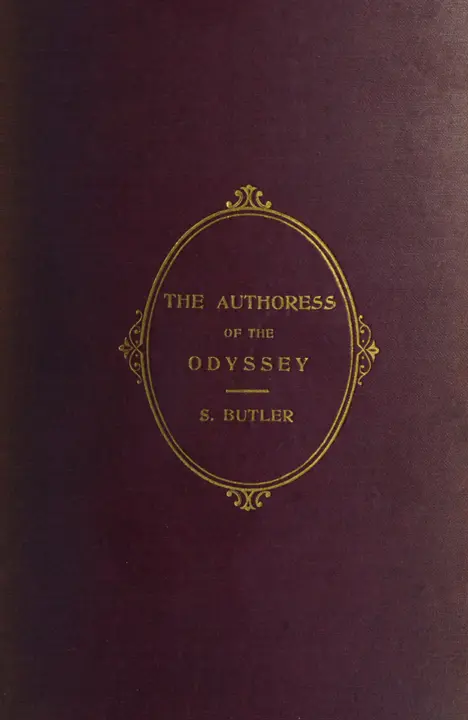
The Authoress of the Odyssey Where and when she wrote, who she was, the use she made of the Iliad, and how the poem grew under her hands
Samuel Butler
THE CLASSIC COLLECTION · 1880
"Unconscious Memory" by Samuel Butler is a treatise on biological theory, written in the late 19th century. This work explores the concept of memory as an unconscious process that shapes the behavior and development of living organisms, linking it to the broader context of evolution. Through his examination, Butler seeks to identify a connection between inherited traits and the unconscious memory of ancestral actions, attempting to provide a framework that supports and expands upon Darwinian evolution. The opening of "Unconscious Memory" introduces Butler's reflective journey into the realm of biological thought and the evolution of consciousness. He discusses the historical context surrounding Darwin's theory of natural selection, emphasizing the prevailing ignorance of earlier evolutionary thinkers and contrasting their ideas with his own theories. The text serves as a personal account of how Butler arrived at his conclusions, specifically through the intertwining of memory and habit in the development of life. He outlines his argument that memories and actions of ancestors influence the present generation's behavior, proposing that these processes are innate and performed unconsciously. This complex relationship sets the stage for Butler's exploration of the implications of memory in the context of evolution.
Introduction adapted from the source catalogue; source summaries may be automatically generated.
Free to read · English · 72,696 words · No account needed
MAKE TIME FOR A GOOD BOOK
On by default. Untick to stop anonymous reading totals. Each page counts after 10 seconds in view. How this works.
Anonymous counting is on unless you have switched it off.
Lastly, all instinctive actions give us an impression of absolute security and infallibility. With instinct the will is never hesitating or weak, as it is when inferences are being drawn consciously. We never find instinct making mistakes; we cannot, therefore, ascribe a result which is so invariably precise to such an obscure condition of mind as is implied when the word presentiment is used; on the contrary, this absolute certainty is so characteristic a feature of instinctive actions, that it constitutes almost the only well-marked point of distinction between these and actions that are done upon reflection. But from this it must again follow that some principle lies at the root of instinct other than that which underlies reflective action, and this can only be looked for in a determination of the will through a process that lies in the unconscious, {115a} to which this character of unhesitating infallibility will attach itself in all our future investigations.
Many will be surprised at my ascribing to instinct an unconscious knowledge, arising out of no sensual impression, and yet invariably accurate. This, however, is not a consequence of my theory concerning instinct; it is the foundation on which that theory is based, and is forced upon us by facts. I must therefore adduce examples. And to give a name to the unconscious knowledge, which is not acquired through impression made upon the senses, but which will be found to be in our possession, though attained without the instrumentality of means, {115b} I prefer the word “clairvoyance” {115c} to “presentiment,” which, for reasons already given, will not serve me. This word, therefore, will be here employed throughout, as above defined.
Let us now consider examples of the instincts of self-preservation, subsistence, migration, and the continuation of the species. Most animals know their natural enemies prior to experience of any hostile designs upon themselves. A flight of young pigeons, even though they have no old birds with them, will become shy, and will separate from one another on the approach of a bird of prey. Horses and cattle that come from countries where there are no lions become unquiet and display alarm as soon as they are aware that a lion is approaching them in the night. Horses going along a bridle-path that used to leave the town at the back of the old dens of the carnivora in the Berlin Zoological Gardens were often terrified by the propinquity of enemies who were entirely unknown to them. Sticklebacks will swim composedly among a number of voracious pike, knowing, as they do, that the pike will not touch them. For if a pike once by mistake swallows a stickleback, the stickleback will stick in its throat by reason of the spine it carries upon its back, and the pike must starve to death without being able to transmit his painful experience to his descendants. In some countries there are people who by choice eat dog’s flesh; dogs are invariably savage in the presence of these persons, as recognising in them enemies at whose hands they may one day come to harm. This is the more wonderful inasmuch as dog’s fat applied externally (as when rubbed upon boots) attracts dogs by its smell. Grant saw a young chimpanzee throw itself into convulsions of terror at the sight of a large snake; and even among ourselves a Gretchen can often detect a Mephistopheles. An insect of the genius bombyx will seize another of the genus parnopæa, and kill it wherever it finds it, without making any subsequent use of the body; but we know that the last-named insect lies in wait for the eggs of the first, and is therefore the natural enemy of its race. The phenomenon known to stockdrivers and shepherds as “das Biesen des Viehes” affords another example. For when a “dassel” or “bies” fly draws near the herd, the cattle become unmanageable and run about among one another as though they were mad, knowing, as they do, that the larvæ from the eggs which the fly will lay upon them will presently pierce their hides and occasion them painful sores. These “dassel” flies—which have no sting—closely resemble another kind of gadfly which has a sting. Nevertheless, this last kind is little feared by cattle, while the first is so to an inordinate extent. The laying of the eggs upon the skin is at the time quite painless, and no ill consequences follow until long afterwards, so that we cannot suppose the cattle to draw a conscious inference concerning the connection that exists between the two. I have already spoken of the foresight shown by ferrets and buzzards in respect of adders; in like manner a young honey-buzzard, on being shown a wasp for the first time, immediately devoured it after having squeezed the sting from its body. No animal, whose instinct has not been vitiated by unnatural habits, will eat poisonous plants. Even when apes have contracted bad habits through their having been brought into contact with mankind, they can still be trusted to show us whether certain fruits found in their native forests are poisonous or no; for if poisonous fruits are offered them they will refuse them with loud cries. Every animal will choose for its sustenance exactly those animal or vegetable substances which agree best with its digestive organs, without having received any instruction on the matter, and without testing them beforehand. Even, indeed, though we assume that the power of distinguishing the different kinds of food is due to sight and not to smell, it remains none the less mysterious how the animal can know what it is that will agree with it. Thus the kid which Galen took prematurely from its mother smelt at all the different kinds of food that were set before it, but drank only the milk without touching anything else. The cherry-finch opens a cherry-stone by turning it so that her beak can hit the part where the two sides join, and does this as much with the first stone she cracks as with the last. Fitchets, martens, and weasels make small holes on the opposite sides of an egg which they are about to suck, so that the air may come in while they are sucking. Not only do animals know the food that will suit them best, but they find out the most suitable remedies when they are ill, and constantly form a correct diagnosis of their malady with a therapeutical knowledge which they cannot possibly have acquired. Dogs will often eat a great quantity of grass—particularly couch-grass—when they are unwell, especially after spring, if they have worms, which thus pass from them entangled in the grass, or if they want to get fragments of bone from out of their stomachs. As a purgative they make use of plants that sting. Hens and pigeons pick lime from walls and pavements if their food does not afford them lime enough to make their eggshells with. Little children eat chalk when suffering from acidity of the stomach, and pieces of charcoal if they are troubled with flatulence. We may observe these same instincts for certain kinds of food or drugs even among grown-up people, under circumstances in which their unconscious nature has unusual power; as, for example, among women when they are pregnant, whose capricious appetites are probably due to some special condition of the fœtus, which renders a certain state of the blood desirable. Field-mice bite off the germs of the corn which they collect together, in order to prevent its growing during the winter. Some days before the beginning of cold weather the squirrel is most assiduous in augmenting its store, and then closes its dwelling. Birds of passage betake themselves to warmer countries at times when there is still no scarcity of food for them here, and when the temperature is considerably warmer than it will be when they return to us. The same holds good of the time when animals begin to prepare their winter quarters, which beetles constantly do during the very hottest days of autumn. When swallows and storks find their way back to their native places over distances of hundreds of miles, and though the aspect of the country is reversed, we say that this is due to the acuteness of their perception of locality; but the same cannot be said of dogs, which, though they have been carried in a bag from one place to another that they do not know, and have been turned round and round twenty times over, have still been known to find their way home. Here we can say no more than that their instinct has conducted them—that the clairvoyance of the unconscious has allowed them to conjecture their way. {119a}
Your reading position is saved on this browser. Take it to another device with a library code. Reading pages adapt to text, rather than matching a printed edition.
Samuel Butler
Samuel Butler
Samuel Butler
Samuel Butler
BEHIND THE BOOK
This eBook is for the use of anyone anywhere in the United States and most other parts of the world at no cost and with almost no restrictions whatsoever. You may copy it, give it away or re-use it under the terms of the Project Gutenberg License included with this eBook or online at www.gutenberg.org. If you are not located in the United States, you will have to check the laws of the country where you are located before using this eBook. Read the source licence.
The original source file, including credits and licence, is retained by this library. Request an original-format copy at no charge. Please include the book title and Project Gutenberg identifier #6605.
KEEP YOUR CURIOSITY GOING

David Patterson (Spirit) Hatch
Coulson Kernahan

Ralph Waldo Emerson
Frances Wright

Edwin Abbott Abbott

Joseph Droz