THE CLASSIC COLLECTION✦A dead man’s diaryCLASSIC FREE BOOKS
A dead man’s diary
Coulson Kernahan
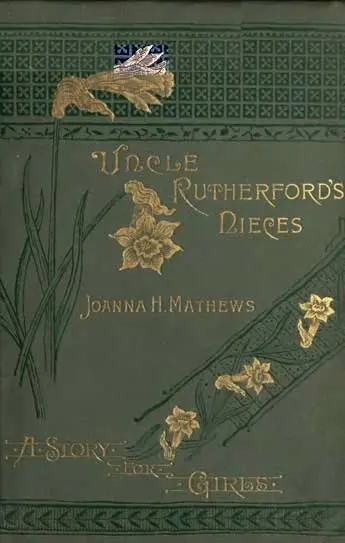
THE CLASSIC COLLECTION · 1888
"Uncle Rutherford's Nieces: A Story for Girls" by Joanna H. Mathews is a novel written in the late 19th century. This story centers around a group of children—particularly, two sisters named Allie and Daisy, along with their friend Jim, who is a young boy with aspirations of helping others and becoming a lawyer. The narrative explores their youthful adventures, including Jim's plans to run a peanut business to help another pair of disabled children, showcasing themes of kindness, ambition, and the challenges of childhood. At the start of the book, readers are introduced to the children at their summer home, tackling an arithmetic problem that stumps them. This light-hearted scene sets the tone for their playful interactions, highlighting Jim's ambitious dreams for the future, particularly his desire to own a business that aids disabled friends. The opening captures the innocence and camaraderie of childhood while foreshadowing the social lessons and adventures that will unfold throughout their summer days. Meanwhile, the arrival of Uncle Rutherford and Aunt Emily hints at broader family dynamics and potential story developments involving mentorship and guidance.
Introduction adapted from the source catalogue; source summaries may be automatically generated.
Free to read · English · 62,542 words · No account needed
MAKE TIME FOR A GOOD BOOK
On by default. Untick to stop anonymous reading totals. Each page counts after 10 seconds in view. How this works.
Anonymous counting is on unless you have switched it off.
"I hope he'll do well, an' turn out a credit to ye, Gov'nor an' Mr. Livingstone," he continued, as though washing his hands of the boy, though all the while the trouble dwelt upon his weather-beaten old face; "but I bet on Jim, an' I wish it was him had the chance ye speak of. Mebbe it is, now; an' if it was, it'd be 'most a set-off agin the other not havin' it. I set a lot on Jim!"
And the old man looked inquiringly at uncle Rutherford, who was not, however, quite so indiscreet as his interlocutor, and kept his own counsel so far as this.
So it was settled, then. Theodore was to be removed from the school he was attending at present, and sent to the boarding-school, where he would be under far closer restraint than he could be in the city, or even at home with his grandparents; and there could be no question that the old man felt that a great responsibility was taken from his shoulders.
"I wish it was time to go home. I mean, I wish Miss Yorke was cured up so's we could go home," he said. "I reckon I've seen about all there is to see in this town; an' it's my opinions I might 'bout as well be thinkin' of the seines an' poles, an' lobster-pots, an' so on. Course they wants lookin' arter 'cordin' to custom this time o' year; an' Jabez he's took so to carpenterin' an' what he calls cabiny-makin', he's goin' to let 'em slip, Jabez is; an' come time for settin' 'em they ain't goin' to be ready, an' I reckon I oughter to be there; but the doctor, he says four weeks more for Miss Yorke, an' he'll let her go cured. She's pretty first-rate now, an' she don't walk no more with a cane, on'y comin' up an' down the stairs. I never did see such folks to have long ladders of stairs as York folks is; when I fust come, I used to think I wouldn't never get to the top of 'em; an' even the poor folks here has to go a-pilin' theirselves up atop of stairs as high as a mast, one lot atop of another. Ye get up near the sky there; not that folks is so good an' heavenly; no, no; there's on'y a few of 'em that way;" with an approving nod at father and uncle Rutherford, and a comprehensive wave of his hand, as if to say that he excepted from his adverse criticism both of his present companions, and all who belonged to them; "on'y a few; but they're pintin' straight for the New Jerusylem,"--another nod pointed the compliment. "Where was I? Oh, them stairs. Wa'l, as I was a-sayin', I reckon I've had 'bout enuf of 'em, an' I'd like to be home where I can be down onto the flat groun' an' not like to what's his name's coffin, what I heerd the boys speakin' about, what got hitched half way up to heaven an' stuck there. He's a fable feller, ov course; Mahomet, that's his name; there ain't never been no such doin's sence miracle days 'cept in the theayters an' them places. An' t'other night Miss Dodge, she asked me would I go to the opery, an' I says 'yes.' I was boun' to see all there was to see, an' we went; an' such a goin' up stairs as there was there, up an' up an' up, an' when we got there I thought we might ha' stopped sooner; for down below there was lots of folks sittin' an' standin', an' I asked Miss Dodge why she didn't stop onto some of them floors, three or four of 'em below, an' she kinder smirked, an' says it costs lots to go in there. Wa'l, I couldn't make out what they was at on the platform,--the play actors; it wasn't half so nice as the mother-in-law actin'; they did all their talkin' to singin', an' they died singin', an' all sorts of things; an' there was a old man got young an' fell spooney on a girl; an' they all got foolisher an' foolisher, an' the devil was there, an' such a mix-up; an' bimeby the girl, she died in a prison, an' angel actin' folks come down an' took her up,--leastways was takin' her up to heaven,--an' there come a hitch, an' there they stuck, half up, half down. Miss Dodge said there must ha' been somethin' wrong with the machinery what h'isted 'em; an' it made me think of that feller's coffin, so I sung out, 'Mahomet's coffin!' an' the folks, some larfed, they was mostly boys an' young fellers, an' some few below looked up; an' Miss Dodge, she was awful affronted, an' she says she was glad enough we wasn't below, she would ha' been too mortified. W'al, that ain't nothin' to do with Miss Yorke, for she wasn't along; she couldn't ha' clumb so high; an' I never was a man of many words, so I'll get to my p'int. As I was a-sayin', Miss Yorke, she can't go home yet, an' she can't be left alone, so I've got to stay on."
Your reading position is saved on this browser. Take it to another device with a library code. Reading pages adapt to text, rather than matching a printed edition.
BEHIND THE BOOK
This eBook is for the use of anyone anywhere in the United States and most other parts of the world at no cost and with almost no restrictions whatsoever. You may copy it, give it away or re-use it under the terms of the Project Gutenberg License included with this eBook or online at www.gutenberg.org. If you are not located in the United States, you will have to check the laws of the country where you are located before using this eBook. Read the source licence.
The original source file, including credits and licence, is retained by this library. Request an original-format copy at no charge. Please include the book title and Project Gutenberg identifier #21666.
KEEP YOUR CURIOSITY GOING
Coulson Kernahan

Maurice Baring
Frances Wright
Cécile Tormay

Frederic Jesup Stimson

W. H. P. (William Henry Pope) Jarvis