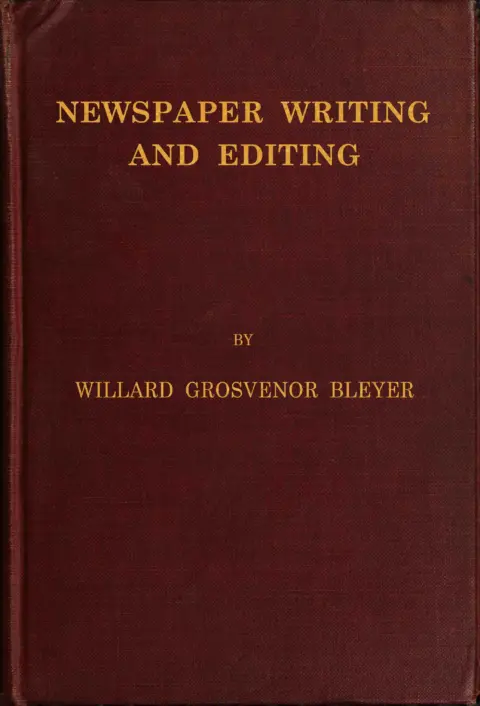
Newspaper Writing and Editing
Willard Grosvenor Bleyer
THE CLASSIC COLLECTION · 1916
"Types of News Writing" by Willard Grosvenor Bleyer is a textbook on journalism written in the early 20th century. The book serves as a resource for students of journalism and beginning reporters, providing a collection of news stories that exemplify different types of news writing. It aims to guide readers in understanding what news to gather, where to find it, and how to effectively present it. The opening of the book introduces the author's intentions and outlines the purpose of the text, establishing it as an essential guide for education in news writing. It emphasizes the significance of typical news stories over extraordinary ones, promoting the idea that a reporter must first master routine news to address exceptional events. Bleyer highlights the varied content of newspapers and organizes the chapters by the type of news story, emphasizing clarity, conciseness, and the importance of understanding how news can influence public opinion. The book sets the stage for a detailed analysis of journalistic practices, illustrating the balance between informative reporting and engaging writing styles.
Introduction adapted from the source catalogue; source summaries may be automatically generated.
Free to read · English · 161,683 words · No account needed
MAKE TIME FOR A GOOD BOOK
On by default. Untick to stop anonymous reading totals. Each page counts after 10 seconds in view. How this works.
Anonymous counting is on unless you have switched it off.
The boy started training his mule five years ago, when he was 13 years old and Zip was 3. Henry lived on a farm and he had no brothers and sisters. So he made a pet of Zip, and taught him all sorts of tricks. Then he began showing him at county fairs and saving the money that he got to spend for education. One of these days he hopes to be as well educated for a boy as Zip is for a mule. And if they gave degrees to mules, Zip would certainly be a Ph.D.
Zip is also quite a teacher. He has taught this
country boy a philosophy of life.
“You have to be patient--patient and kind,” Henry said yesterday. “The first thing I ever taught Zip took me two hours and a half. I wanted to see if I could make him lie down. I grabbed his opposite foreleg and held it up. I just had to tire him out, but at last he keeled over. Next day he did it in two minutes. He had learned what I wanted. It was easy after that.”
Henry had never seen a trick mule, but he began thinking of other tricks. With infinite patience he showed Zip what was wanted.
“Then he did it because he loved me,” said the boy
simply.
Henry never uses a whip to teach Zip tricks. He feeds him sugar, and is just kind to him and works with him and is patient. Now he learns faster than ever. You can teach an old mule new tricks, according to Henry.
Accident, automobile, 23, 24.
Accident, drowning, 39, 40, 42.
Accident, fall from scaffold, 39.
Accident, humorous treatment of, 25.
Accident, marine, 32, 34, 35.
Accident, mine, 36, 38.
Accident, pathetic treatment of, 25.
Accident, railroad, 29, 30, 31.
Accident, shooting, 42.
Accident, storm, 35, 196.
Accident, subway, 26.
Accidents, 22-44.
Addresses, 127-131.
Adoption of child, 100.
Agricultural fair, 143.
Alumnae meeting, 228.
Animal stories, 19, 256-259.
Anniversary, church celebration of, 228.
Arrest for embezzlement, 50.
Arrest for forgery, 49.
Arrest for hold-up, 55, 56, 57.
Arrest for intoxication, 48.
Arrest for murder, 59, 65.
Arrest for passing worthless checks, 50.
Arrest for swindle, 49.
Arrest, humorous treatment of, 48.
Arrest, pathetic treatment of, 57.
“Asleep at the switch,” 48.
Assignment in bankruptcy, 96.
Attorney general, opinion of, 90.
Automobile bandits, 55.
Automobile collision, 23, 24.
Automobile drivers’ strike, 187.
Automobile ordinance, violation of, 78.
Automobile parade, 149, 150.
Automobile show, opening of, 142.
Bandit, automobile, 55.
Bandit, pathetic story of, 57.
Bandit, street car, 57.
Bankruptcy case, 95, 96.
Banquet, 157.
Baseball, 212-216.
Baseball game, humorous treatment of, 215.
Bazaar, charity, 230.
Bonds, sale of municipal, 245.
Boston Advertiser, story from, 25.
Boston Globe, story from, 212.
Boston Herald, stories from, 23, 40, 143, 171, 246.
Boston Journal, story from, 251.
Boston Post, story from, 212.
Boston Transcript, stories from, 16, 18, 34, 138, 192,
219, 224, 239, 240, 244, 247.
Boston Traveler, story from, 29.
Bridge party, 229.
Brooklyn Eagle, stories from, 42, 88.
Building of new hotel, 244.
Burglary, 54.
Burglary, human interest treatment of, 54.
Business merger, 242.
Card party, 228, 229.
Your reading position is saved on this browser. Take it to another device with a library code. Reading pages adapt to text, rather than matching a printed edition.
Willard Grosvenor Bleyer
Willard Grosvenor Bleyer
BEHIND THE BOOK
This eBook is for the use of anyone anywhere in the United States and most other parts of the world at no cost and with almost no restrictions whatsoever. You may copy it, give it away or re-use it under the terms of the Project Gutenberg License included with this eBook or online at www.gutenberg.org. If you are not located in the United States, you will have to check the laws of the country where you are located before using this eBook. Read the source licence.
The original source file, including credits and licence, is retained by this library. Request an original-format copy at no charge. Please include the book title and Project Gutenberg identifier #59606.
KEEP YOUR CURIOSITY GOING

Charles G. (Charles Griffith) Ross
Hannah Webster Foster

Emily Lawless
Edwin Hamlin Carr

Charles De Lano Hine
Andrew Ure