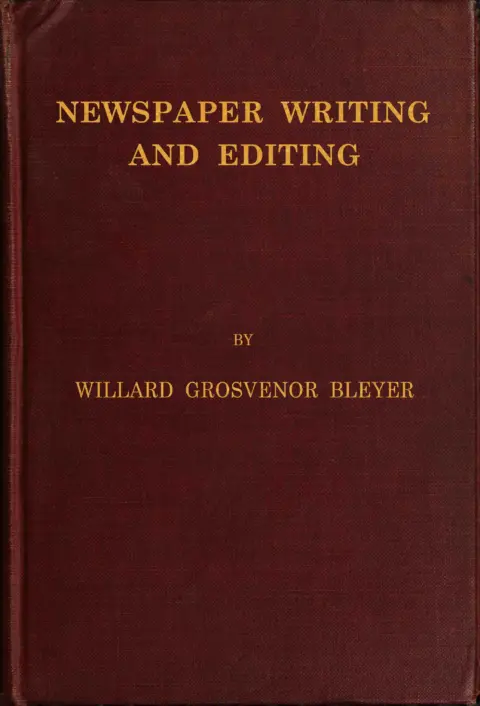
Newspaper Writing and Editing
Willard Grosvenor Bleyer
THE CLASSIC COLLECTION · 1916
"Types of News Writing" by Willard Grosvenor Bleyer is a textbook on journalism written in the early 20th century. The book serves as a resource for students of journalism and beginning reporters, providing a collection of news stories that exemplify different types of news writing. It aims to guide readers in understanding what news to gather, where to find it, and how to effectively present it. The opening of the book introduces the author's intentions and outlines the purpose of the text, establishing it as an essential guide for education in news writing. It emphasizes the significance of typical news stories over extraordinary ones, promoting the idea that a reporter must first master routine news to address exceptional events. Bleyer highlights the varied content of newspapers and organizes the chapters by the type of news story, emphasizing clarity, conciseness, and the importance of understanding how news can influence public opinion. The book sets the stage for a detailed analysis of journalistic practices, illustrating the balance between informative reporting and engaging writing styles.
Introduction adapted from the source catalogue; source summaries may be automatically generated.
Free to read · English · 161,683 words · No account needed
MAKE TIME FOR A GOOD BOOK
On by default. Untick to stop anonymous reading totals. Each page counts after 10 seconds in view. How this works.
Anonymous counting is on unless you have switched it off.
Quickly slipping in Alexander Hamilton, making him as Scotch as possible and crediting him with everything that hadn’t been already cornered by Judge Wilson, Mr. Carnegie then got along to the matter of education, and showed that Scotland, as copied by America, led the world.
Witness John Witherspoon, of the early days of Princeton, America’s model educator ever since. On account of him and for all the aforesaid reasons, said Mr. Carnegie, a Scotchman always feels at home in the United States; Scotland is his mother, America is his wife, and there is nothing inconsistent in his loving both.
Besides Mr. Carnegie, the speakers of the evening were Hamilton Mabie, Gen. Leonard Wood, E. Theodore Martin, Irving Bacheller, Julius M. Mayer, Dr. Alexander McGregor and Harry Lauder. Lauder responded to the toast “Honest Men an’ Bonnie Lassies”; Gen. Wood, to the “Army and Navy.”
A bagpipe band played alternately with a string orchestra, and a lot of the Scotsmen present came in kilts and bare legs. It was noticeable, though, that most of the latter wore long fur overcoats and went home in closed automobiles.
In addition to Lauder, Messrs. John Reid, E. Theodore Mayer and George A. Fleming, all well known Scottish singers, enlivened the evening with ballads. A few of those present were:
Robert Foulis, Frank W. McLaughlin, Rev. David G. Wylie, Alexander McGregor, of Boston; Lieut.-Col. Allan C. Bakewell, Dr. Neil MacPhatter, Rev. Anthony H. Evans, D. D., Evert Jansen Wendell, Gen. John T. Lockman, Edgar L. Marston, Rev. George Alexander, Robert C. Ogen, Courtenay Walter Bennett, British Consul-General at New York; J. Edward Simmons, president of the Chamber of Commerce, and Rear-Admiral Caspar F. Goodrich, U. S. N.
New York Times
The crippled children of Public School 2, Primary, almost believed that they were the butterflies and bees and flowers that they impersonated in the playlet of “Cinderella in Flowerland” in the auditorium of Public School 62, at Hester and Essex Streets, yesterday afternoon, for the entertainment of the primary children of other schools in the neighborhood. And a happy woman was Mrs. Elizabeth Waldo Schuarz, Principal of Public School 2, Primary, who has taken the crippled children’s annex under her special supervision. As the children sang and haltingly danced on their unstable little legs she smiled and almost wept by turns.
Other grown-ups in the audience, too, had recourse to handkerchiefs as children dressed as butterflies fluttered in, some with creaking braces on their legs, singing:
Lightly, lightly winging, on the breezes swinging, Airy little fairies, full of grace and glee, Dancing with the sunbeams, weaving dainty day dreams, Could mortals be as light and free? Airy fairies we!
Your reading position is saved on this browser. Take it to another device with a library code. Reading pages adapt to text, rather than matching a printed edition.
Willard Grosvenor Bleyer
Willard Grosvenor Bleyer
BEHIND THE BOOK
This eBook is for the use of anyone anywhere in the United States and most other parts of the world at no cost and with almost no restrictions whatsoever. You may copy it, give it away or re-use it under the terms of the Project Gutenberg License included with this eBook or online at www.gutenberg.org. If you are not located in the United States, you will have to check the laws of the country where you are located before using this eBook. Read the source licence.
The original source file, including credits and licence, is retained by this library. Request an original-format copy at no charge. Please include the book title and Project Gutenberg identifier #59606.
KEEP YOUR CURIOSITY GOING

Charles G. (Charles Griffith) Ross
Hannah Webster Foster

Emily Lawless
Edwin Hamlin Carr

Charles De Lano Hine
Andrew Ure