
Last letters from the living dead man
David Patterson (Spirit) Hatch
THE CLASSIC COLLECTION · 1778
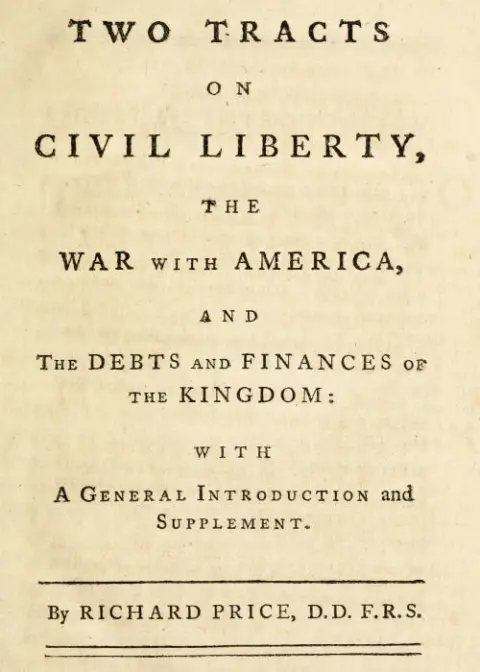
"Two Tracts on Civil Liberty, the War with America, and the Debts and Finances of the Kingdom" by Richard Price is a historical treatise written in the late 18th century. The work comprises two tracts that explore the concepts of civil liberty and the implications of the American War for Independence, as well as the financial implications of these issues for Britain. Price delves into the philosophical underpinnings of government and the nature of liberty, emphasizing the importance of representation and consent within a just society. The opening of this treatise presents an introduction to the fundamental arguments for civil liberty that Price aims to make. He contrasts two competing views of government: one that establishes authority through the people's consent and another that derives authority from divine right. Price articulates his belief that legitimate government must be founded on the principles of freedom and equality, where laws are a reflection of the collective will. Furthermore, he addresses the growing tensions between Britain and America, arguing that the rights and liberties of the American colonies must be acknowledged, warning that attempts to subjugate them could lead to a broader conflict that undermines the values of civil liberty he cherishes. The matters discussed set the stage for his detailed exploration of political philosophy and practical governance as the historical context unfolds.
Introduction adapted from the source catalogue; source summaries may be automatically generated.
Free to read · English · 84,822 words · No account needed
MAKE TIME FOR A GOOD BOOK
On by default. Untick to stop anonymous reading totals. Each page counts after 10 seconds in view. How this works.
Anonymous counting is on unless you have switched it off.
April 24, 1778.
In the following tracts I have reckoned, among the destructive consequences of the war with America, the loss of a considerable part of our trade. In consequence of several accidental causes, particularly the demand created by the war, this effect has not yet been so much felt as was generally expected. The truth, however, is, that the war has operated in this way to a degree that is alarming, as will appear from the following account of the CUSTOMS for the last six years.
Gross Receipt. Debentures. Net Receipt. Payments into the Exchequer. 1772 5.134,503 2.214,508 2.441,038 2.525,515 1773 5.159,800 2.463,767 2.221,460 2.431,071 1774 5.068,000 2.132,600 2.455,500 2.547,717 1775 5.146,900 1.904,900 2.709,340 2.476,302 1776 3.726,970 1.544,300 1.633,380 2.460,402 1777 3.293,200 932,860 1.846,390 2.199,105
It should be observed, that though, in 1776, there had been no importation of tobacco, yet the duties on tobacco brought into the Exchequer as much as ever, these duties having been paid for old stock taken out of the warehouses for home consumption, instead of exportation. This is one of the causes which kept up the payments into the Exchequer in 1776, notwithstanding a sudden fall of near a MILLION AND A HALF in the gross receipt, and a MILLION in the net receipt.—In the last year, or 1777, the duties on tobacco fell very short; and this contributed to diminish the payments into the Exchequer near a quarter of a million. But what seems of more importance is, that the debentures (or duties returned at exportation) which had fallen in 1775 and 1776 above a fourth, continued to fall in 1777; and did not then amount to more than two-fifths of the usual sum.
I have examined the customs from the Revolution to the present time; but cannot find that any thing like such a fall in them has ever happened before.
The present state of the public funds makes it necessary for me to acquaint the reader, that when the Supplement to the following Tracts was written, the 3 per cent. annuities were at the price which the calculations in it suppose, or nearly at 78. They have since fallen to 72, and once even below 69, which is a lower price than they were ever at during the whole last war, except just at the pinch of the loan of twelve millions in 1762.—The difference of price also between them and the new 4 per cents. is fallen, (for no reason that I can discover) from 14 to about 10½.—I find, likewise, that in consequence of a distressing scarcity of money, the subscribers to the last loan of five millions have not yet been able to complete their payments.—These facts afford a dark prospect; and make it doubtful whether, if things don’t mend, it will be possible, by any schemes, to procure the money necessary to bear the expence of another campaign.—Should it happen, for these reasons, that what I have written on loans can be of no use; or, though capable of being of use, should it be neglected; I shall still reflect with satisfaction, that I have now given what I wished to offer on this subject with more correctness; and proved, beyond a doubt, that a great part of the National Debt is an artificial debt, for which no money has been received, and which might have been easily avoided.
Your reading position is saved on this browser. Take it to another device with a library code. Reading pages adapt to text, rather than matching a printed edition.
BEHIND THE BOOK
This eBook is for the use of anyone anywhere in the United States and most other parts of the world at no cost and with almost no restrictions whatsoever. You may copy it, give it away or re-use it under the terms of the Project Gutenberg License included with this eBook or online at www.gutenberg.org. If you are not located in the United States, you will have to check the laws of the country where you are located before using this eBook. Read the source licence.
The original source file, including credits and licence, is retained by this library. Request an original-format copy at no charge. Please include the book title and Project Gutenberg identifier #57970.
KEEP YOUR CURIOSITY GOING
David Patterson (Spirit) Hatch
Cécile Tormay

Moritz Busch
Coulson Kernahan
John L. Ransom

Ralph Waldo Emerson