
Last letters from the living dead man
David Patterson (Spirit) Hatch
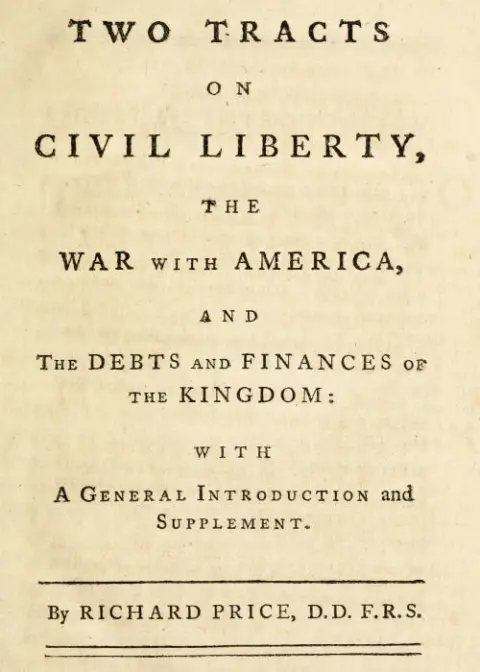
THE CLASSIC COLLECTION · 1778
"Two Tracts on Civil Liberty, the War with America, and the Debts and Finances of the Kingdom" by Richard Price is a historical treatise written in the late 18th century. The work comprises two tracts that explore the concepts of civil liberty and the implications of the American War for Independence, as well as the financial implications of these issues for Britain. Price delves into the philosophical underpinnings of government and the nature of liberty, emphasizing the importance of representation and consent within a just society. The opening of this treatise presents an introduction to the fundamental arguments for civil liberty that Price aims to make. He contrasts two competing views of government: one that establishes authority through the people's consent and another that derives authority from divine right. Price articulates his belief that legitimate government must be founded on the principles of freedom and equality, where laws are a reflection of the collective will. Furthermore, he addresses the growing tensions between Britain and America, arguing that the rights and liberties of the American colonies must be acknowledged, warning that attempts to subjugate them could lead to a broader conflict that undermines the values of civil liberty he cherishes. The matters discussed set the stage for his detailed exploration of political philosophy and practical governance as the historical context unfolds.
Introduction adapted from the source catalogue; source summaries may be automatically generated.
Free to read · English · 84,822 words · No account needed
MAKE TIME FOR A GOOD BOOK
On by default. Untick to stop anonymous reading totals. Each page counts after 10 seconds in view. How this works.
Anonymous counting is on unless you have switched it off.
The truth is, that a government by law is or is not liberty, just as the laws are just or unjust; and as the body of the people do or do not participate in the power of making them. The learned Prelate seems to have thought otherwise, and therefore has given a definition of liberty, which might as well have been given of slavery.
At the conclusion of his sermon, the Archbishop adds words which he calls comfortable, addressed to those who had been patient in tribulation,[6] and intimating that they might rejoice in hope, “a ray of brightness then appearing after a prospect which had been long dark.” And in an account which follows the sermon, from one of the missionaries in the province of New-York, it is said, that “the rebellion would undoubtedly be crushed, and that THEN will be the time for taking steps for the increase of the church in America, by granting it an episcopate.” In conformity to the sentiments of this missionary, the Archbishop also expresses his hope, that the opportunity which such an event will give, for establishing episcopacy among the colonists, will not be lost; and advises, that measures should be thought of for that purpose, and for thereby rescuing the church from the persecution it has long suffered in America.
This is a subject so important, and it has been so much misrepresented, that I cannot help going out of my way to give a brief account of it.
It does not appear that the lay members themselves of the church in America have ever wished for Bishops. On the contrary, the assembly of Virginia (the first episcopal colony) some years ago returned thanks to two clergymen in that colony, who had protested against a resolution of the other clergy to petition for Bishops. The church here cannot have a right to impose Bishops on the church in another country; and therefore, while churchmen in America are averse to Bishops, it must be persecution to send Bishops among them. The Presbyterians, and other religious sects there, are willing, from a sense of the reasonableness of toleration, to admit Bishops whenever the body of episcopalian laity shall desire them, provided security is given that they shall be officers merely spiritual, possessed of no other powers than those which are necessary to the full exercise of that mode of religious worship. It is not Bishops, as spiritual officers, they have opposed; but Bishops on a state-establishment; Bishops with civil powers; Bishops at the head of ecclesiastical courts, maintained by taxing other sects, and possessed of a PRE-EMINENCE which would be incompatible with the equality which has long subsisted among all religious sects in America. In this last respect, the colonies have hitherto enjoyed a happiness which is unparalleled, but which the introduction of such Bishops as would be sent from hence would destroy. In Pensilvania (one of the happiest countries under heaven before we carried into it desolation and carnage) all sects of christians have been always perfectly on a level, the legislature taking no part with any one sect against others, but protecting all equally as far as they are peaceable. The state of the colonies north of Pensilvania is much the same; and, in the province of Massachusett’s-Bay in particular, civil authority interposes no farther in religion than by imposing a tax for supporting public worship, leaving to all the power of applying the tax to the support of that mode of public worship which they like best. This tax the episcopalians were, at one time, obliged to pay in common with others; but so far did the province carry its indulgence to them, that an act was passed on purpose to excuse them.—With this let the state of Protestant Dissenters in this country be compared. Not only are they obliged to pay tithes for the support of the established church, but their worship is not even tolerated, unless their ministers will subscribe the articles of the church. In consequence of having long scrupled this subscription, they have lost all legal right to protection, and are exposed to the cruellest penalties. Uneasy in such a situation, they not long ago applied twice to parliament for the repeal of the penal laws against them. Bills for that purpose were brought into the House of Commons, and passed that House. But, in the House of Lords, they were rejected in consequence of the opposition of the Bishops.—There are few I reverence so much as some on the sacred bench; but such conduct (and may I not add the alacrity with which most of them support the present measures?) must leave an indelible stain upon them, and will probably exclude them for ever from America.
Your reading position is saved on this browser. Take it to another device with a library code. Reading pages adapt to text, rather than matching a printed edition.
BEHIND THE BOOK
This eBook is for the use of anyone anywhere in the United States and most other parts of the world at no cost and with almost no restrictions whatsoever. You may copy it, give it away or re-use it under the terms of the Project Gutenberg License included with this eBook or online at www.gutenberg.org. If you are not located in the United States, you will have to check the laws of the country where you are located before using this eBook. Read the source licence.
The original source file, including credits and licence, is retained by this library. Request an original-format copy at no charge. Please include the book title and Project Gutenberg identifier #57970.
KEEP YOUR CURIOSITY GOING
David Patterson (Spirit) Hatch
Cécile Tormay

Moritz Busch
Coulson Kernahan
John L. Ransom

Ralph Waldo Emerson