
Last letters from the living dead man
David Patterson (Spirit) Hatch
THE CLASSIC COLLECTION · 1778
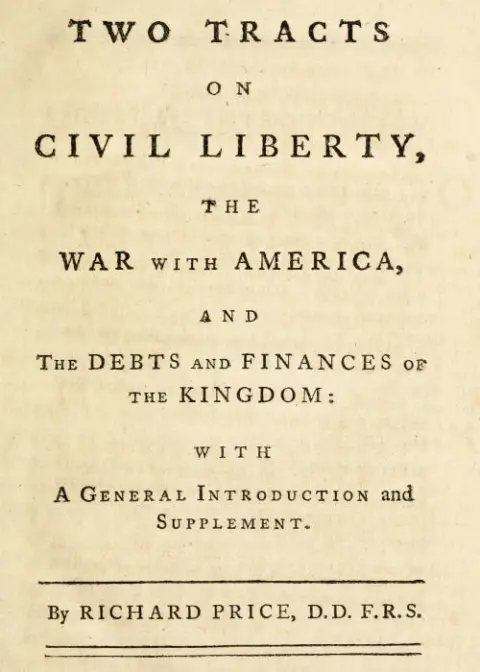
"Two Tracts on Civil Liberty, the War with America, and the Debts and Finances of the Kingdom" by Richard Price is a historical treatise written in the late 18th century. The work comprises two tracts that explore the concepts of civil liberty and the implications of the American War for Independence, as well as the financial implications of these issues for Britain. Price delves into the philosophical underpinnings of government and the nature of liberty, emphasizing the importance of representation and consent within a just society. The opening of this treatise presents an introduction to the fundamental arguments for civil liberty that Price aims to make. He contrasts two competing views of government: one that establishes authority through the people's consent and another that derives authority from divine right. Price articulates his belief that legitimate government must be founded on the principles of freedom and equality, where laws are a reflection of the collective will. Furthermore, he addresses the growing tensions between Britain and America, arguing that the rights and liberties of the American colonies must be acknowledged, warning that attempts to subjugate them could lead to a broader conflict that undermines the values of civil liberty he cherishes. The matters discussed set the stage for his detailed exploration of political philosophy and practical governance as the historical context unfolds.
Introduction adapted from the source catalogue; source summaries may be automatically generated.
Free to read · English · 84,822 words · No account needed
MAKE TIME FOR A GOOD BOOK
On by default. Untick to stop anonymous reading totals. Each page counts after 10 seconds in view. How this works.
Anonymous counting is on unless you have switched it off.
From 15.483,553l. the total of debts discharged, subtract 7.150,000l. the total of debts contracted; and the remainder, or 8.333,553l. will be the diminution of the public debts since 1763. Also, from 568,842l. the total of the decrease of the annual interest, subtract 199,500l. (the total of its increase), and the remainder, or 369,342l. will be the interest or annuity saved since 1763.—To this must be added 12,537l per ann. saved by changing a capital of 1.253,700l. (part of 20.240,000l.) from an interest of 4 to 3 per cent. pursuant to an act of the 10th of George III.; also the life-annuities that have fallen in; which will make a saving in the whole of near 400,000l. per annum: And it is to this saving, together with the increase of luxury, that the increase of the Sinking Fund for the last ten years has been owing.
To the debts discharged the following additions must be made.
In 1764 there was paid towards discharging the extraordinary expences of the army, 987,434l. In 1765, these expences amounted to 404,496l. In 1766, to 479,088l.—Total 1.871,018l.—This sum is 1.100,000l. higher than the extraordinary expences of the army for three years in a time of peace. This excess, being derived from the preceding war, must be reckoned a debt left by the war. And the same is true of 1.106,000l. applied, in 1764, 1765, and 1766, towards satisfying German demands.—There are likewise some smaller sums of the same kind; such as subsidies to Hesse-Cassel, Brunswick, &c. And they may be taken at 200,000l.—The total of all these sums is 2.406,240l. which, added to 8.333,553l. makes the whole diminution of the public debts, or the whole saving of the kingdom, since 1763, to be 10.739,793l.
Soon after the peace in 1763, an unfunded debt, amounting to 6.983,553l. was funded on the Sinking Fund, and on new duties on wine and cyder, at 4 per cent. There has been since borrowed and funded on coals exported, window-lights, &c. 6.400,000l. The funded debt, therefore, has increased since the war 13.383,553l. It has decreased (as may appear from page 177) 11.983,553l. and, consequently, there has been on the whole an addition to it of 1.400,000l.—During seven years, from 1768 to 1774, 1.115,883l. navy-debt was paid off. See page 178. But, as this is a debt arising from constant deficiencies in the peace estimates for the navy, it is a part of the current peace expences.—On the 31st of December, 1767, this debt was 1.213,072l.—On the 31st of December, 1774, it was 1.850,000l. and consequently, though 1.115,883l. was paid off, an addition was made to it, in seven years, of 673,028l. It increased, therefore, at the rate of 255,558l. per ann.
Your reading position is saved on this browser. Take it to another device with a library code. Reading pages adapt to text, rather than matching a printed edition.
BEHIND THE BOOK
This eBook is for the use of anyone anywhere in the United States and most other parts of the world at no cost and with almost no restrictions whatsoever. You may copy it, give it away or re-use it under the terms of the Project Gutenberg License included with this eBook or online at www.gutenberg.org. If you are not located in the United States, you will have to check the laws of the country where you are located before using this eBook. Read the source licence.
The original source file, including credits and licence, is retained by this library. Request an original-format copy at no charge. Please include the book title and Project Gutenberg identifier #57970.
KEEP YOUR CURIOSITY GOING
David Patterson (Spirit) Hatch
Cécile Tormay

Moritz Busch
Coulson Kernahan
John L. Ransom

Ralph Waldo Emerson