
Last letters from the living dead man
David Patterson (Spirit) Hatch
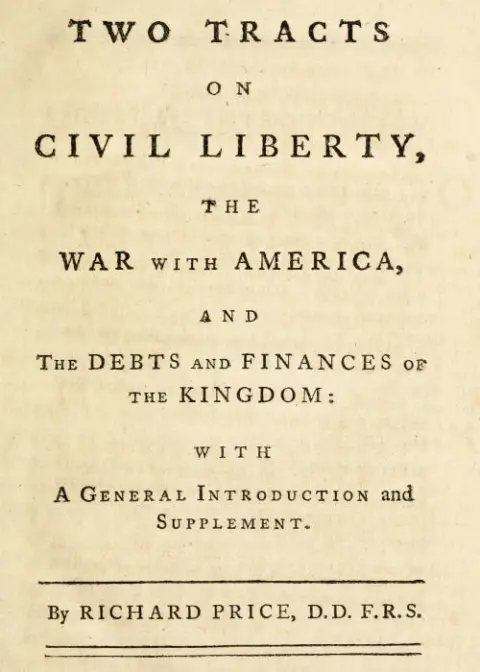
THE CLASSIC COLLECTION · 1778
"Two Tracts on Civil Liberty, the War with America, and the Debts and Finances of the Kingdom" by Richard Price is a historical treatise written in the late 18th century. The work comprises two tracts that explore the concepts of civil liberty and the implications of the American War for Independence, as well as the financial implications of these issues for Britain. Price delves into the philosophical underpinnings of government and the nature of liberty, emphasizing the importance of representation and consent within a just society. The opening of this treatise presents an introduction to the fundamental arguments for civil liberty that Price aims to make. He contrasts two competing views of government: one that establishes authority through the people's consent and another that derives authority from divine right. Price articulates his belief that legitimate government must be founded on the principles of freedom and equality, where laws are a reflection of the collective will. Furthermore, he addresses the growing tensions between Britain and America, arguing that the rights and liberties of the American colonies must be acknowledged, warning that attempts to subjugate them could lead to a broader conflict that undermines the values of civil liberty he cherishes. The matters discussed set the stage for his detailed exploration of political philosophy and practical governance as the historical context unfolds.
Introduction adapted from the source catalogue; source summaries may be automatically generated.
Free to read · English · 84,822 words · No account needed
MAKE TIME FOR A GOOD BOOK
On by default. Untick to stop anonymous reading totals. Each page counts after 10 seconds in view. How this works.
Anonymous counting is on unless you have switched it off.
In point of territory and number of inhabitants, the two countries will bear no comparison[124]. We have hitherto opposed France by our free spirit, and our colonies; and to them chiefly we owe our prosperity and victories. Our colonies once separated from us, the islands will soon follow. But should they remain ours, our comparative advantages will best appear from the following authentic account of the imports into France from their islands.
In 1774.
Weight in Pounds.
Sugar imported into France 147.986,959 Indigo 1.734,206 Rocou 210,187 Coffee 58.247,133 ----------- 208.178,485
In 1775.
Weight in Pounds.
Sugar imported into France 171.932,972 Indigo 2.134,247 Rocou 169,831 Coffee 58.545,000 ----------- [125]232.782,050
Value of the above commodities re-exported from France, taken upon the
average price.
Livres. Sterling.
In 1774 75.901,373 3.373,000
In 1775 74.961,318 3.331,000
The whole importation from the West Indies into Britain is about
three millions per ann.
But I have gone much beyond the views with which I begun this section. The facts which have been stated, and the reflections which they have occasioned, are intended principally to shew that we ought not to suffer ourselves to be drawn into security by any assurances of the weakness of France.—May she, however, find herself the weakest of kingdoms whenever, from motives of interest or ambition, she shall attempt to injure any of her neighbours.—May Britain, hitherto the most favoured spot under heaven, always preserve her distinguished happiness, and escape the danger which now threatens her. And may the time soon come, when all mankind, sensible of the value of the blessings of peace and equal liberty, shall suffer one another to enjoy them, and learn war no more.
Containing an Account of the National Income and Expenditure; the Surplus of the Revenue; and the Money drawn from the Public by the Taxes; with Remarks on Lord STAIR’S Account.
APPROPRIATED REVENUE at Midsummer, 1775.
Interest of the national debt 4.440,821
Civil list revenue. See the note in page 163 800,000
Expences of management attending the national debt; of which 71,432 l. is the expence of management at the Bank, South-Sea House, and India House; and 5.900 l. salaries to Exchequer Officers. See Page 119, &c. 77,332
Annuities payable out of the Aggregate Fund to the DUKE OF GLOUCESTER, 8000 l.—DUKE OF CUMBERLAND, 8000 l.—the Representatives of ARTHUR ONSLOW, Esq; 3000 l.—And the Sheriffs of ENGLAND and WALES, 4000 l.—In all 23,000
Clerk of the Hanaper in Chancery—Coinage[126] expence—Tenths and first-fruits of the Clergy appropriated to the augmentation of small livings—Extra revenues of the crown, consisting of American quit-rents; duty of 4½ per cent. in the Leeward Islands; revenues of Gibraltar and dutchy of Cornwall, &c.—Fees for warrants and orders, for auditing and engrossing accounts of dividend warrants, and other charges at the EXCHEQUER and TREASURY[127] 100,000 --------- Total of the Appropriated Revenue £. 5.441,153
Your reading position is saved on this browser. Take it to another device with a library code. Reading pages adapt to text, rather than matching a printed edition.
BEHIND THE BOOK
This eBook is for the use of anyone anywhere in the United States and most other parts of the world at no cost and with almost no restrictions whatsoever. You may copy it, give it away or re-use it under the terms of the Project Gutenberg License included with this eBook or online at www.gutenberg.org. If you are not located in the United States, you will have to check the laws of the country where you are located before using this eBook. Read the source licence.
The original source file, including credits and licence, is retained by this library. Request an original-format copy at no charge. Please include the book title and Project Gutenberg identifier #57970.
KEEP YOUR CURIOSITY GOING
David Patterson (Spirit) Hatch
Cécile Tormay

Moritz Busch
Coulson Kernahan
John L. Ransom

Ralph Waldo Emerson