
Last letters from the living dead man
David Patterson (Spirit) Hatch
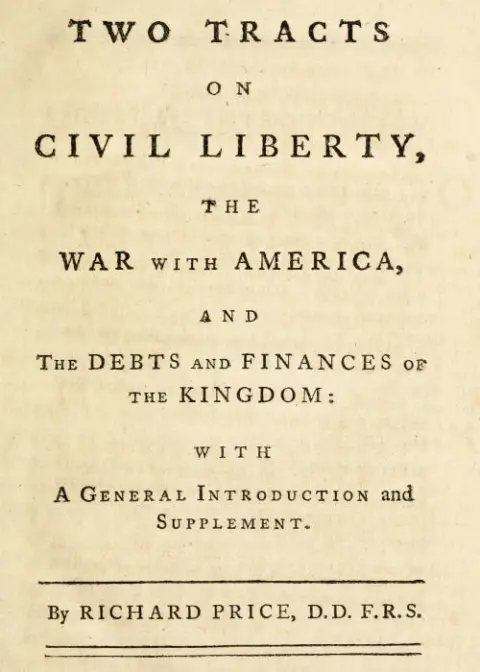
THE CLASSIC COLLECTION · 1778
"Two Tracts on Civil Liberty, the War with America, and the Debts and Finances of the Kingdom" by Richard Price is a historical treatise written in the late 18th century. The work comprises two tracts that explore the concepts of civil liberty and the implications of the American War for Independence, as well as the financial implications of these issues for Britain. Price delves into the philosophical underpinnings of government and the nature of liberty, emphasizing the importance of representation and consent within a just society. The opening of this treatise presents an introduction to the fundamental arguments for civil liberty that Price aims to make. He contrasts two competing views of government: one that establishes authority through the people's consent and another that derives authority from divine right. Price articulates his belief that legitimate government must be founded on the principles of freedom and equality, where laws are a reflection of the collective will. Furthermore, he addresses the growing tensions between Britain and America, arguing that the rights and liberties of the American colonies must be acknowledged, warning that attempts to subjugate them could lead to a broader conflict that undermines the values of civil liberty he cherishes. The matters discussed set the stage for his detailed exploration of political philosophy and practical governance as the historical context unfolds.
Introduction adapted from the source catalogue; source summaries may be automatically generated.
Free to read · English · 84,822 words · No account needed
MAKE TIME FOR A GOOD BOOK
On by default. Untick to stop anonymous reading totals. Each page counts after 10 seconds in view. How this works.
Anonymous counting is on unless you have switched it off.
These EXCHEQUER Annuities consist farther of
£. s. d. 30,400 6 8 purchased for 99 years from Christmas 1705, by 2d and 3d of Anne, with 1450l. for management. 23,234 16 6 purchased for 99 years from Lady-day, 1706, by 4 Anne, with 1470l. per ann. for management. 7,776 10 0 purchased for 99 years from Lady-day, 1707, by 5 Anne, with 375l. 12s. per ann. for management. 4,710 0 0 purchased for 99 years from Lady-day, 1708, by 6th of Anne, with 208l. 2s. per ann. for management. 10,181 0 0 purchased for 99 years from Lady-day, 1707, by a 2d Act of 5th of Anne, with 416l. per ann. for management. Add 54,900 14 6 ----------------- 131,203 7 8 Total.
The original sum contributed for these annuities was 1.836,276l. They are even now worth more than this sum. The public has already paid above TEN MILLIONS; and by the time they are all extinct, it will have paid above THIRTEEN MILLIONS, on their account. This is great extravagance; but it is nothing to the extravagance constantly practised of borrowing on perpetual annuities, without putting them into a fixed course of redemption.
NOTE (14).—TONTINE by an act of 6 Geo. III. See page 124.—The intention of this Act was to raise 300,000l. towards paying off navy bills, by offering to subscribers for every 100l. advanced, an annuity of 3l. for their lives, with benefit of survivorship. But the scheme did not succeed, and only 18000l. was subscribed.
NOTE (15).—LIFE ANNUITIES. See page 124.—The annuities on two lives in 1694, were sold at 12l. per ann. during two lives, of any ages, and the annuities on three lives, at 10l. per ann. during three lives, for every 100l. advanced.—This was very extravagant; for, supposing the annuitants in general, about the age of 20 or 30, it was the same, in the case of two lives, with giving above 10 per cent. for money, and in the case of three lives, 9 per cent.—It is, likewise, extremely absurd in these cases to pay no regard to difference of ages. A single life at the age of 60, supposing money improved at 4 per cent. is intitled to 11 per cent. but at the age of 10, scarcely to 6 per cent. Two lives at 60, are entitled, on the same supposition, to 8½ per cent. but at 10, not to 5 per cent.—The original amount of these annuities was 22,700l. nearly. In 1762, that is, in 68 years, they were reduced by deaths no lower than 9,215l.
The other life-annuities mentioned in the preceding account were douceurs granted for loans in 1745, 1746, and 1757. An account of the annuities granted in the last of these years may be seen in page 101.
The life-annuities in 1745, amounted to 22,500l. and were granted, together with the profits of a lottery, for a loan of two millions at 4 per cent.
Your reading position is saved on this browser. Take it to another device with a library code. Reading pages adapt to text, rather than matching a printed edition.
BEHIND THE BOOK
This eBook is for the use of anyone anywhere in the United States and most other parts of the world at no cost and with almost no restrictions whatsoever. You may copy it, give it away or re-use it under the terms of the Project Gutenberg License included with this eBook or online at www.gutenberg.org. If you are not located in the United States, you will have to check the laws of the country where you are located before using this eBook. Read the source licence.
The original source file, including credits and licence, is retained by this library. Request an original-format copy at no charge. Please include the book title and Project Gutenberg identifier #57970.
KEEP YOUR CURIOSITY GOING
David Patterson (Spirit) Hatch
Cécile Tormay

Moritz Busch
Coulson Kernahan
John L. Ransom

Ralph Waldo Emerson