
Last letters from the living dead man
David Patterson (Spirit) Hatch
THE CLASSIC COLLECTION · 1778
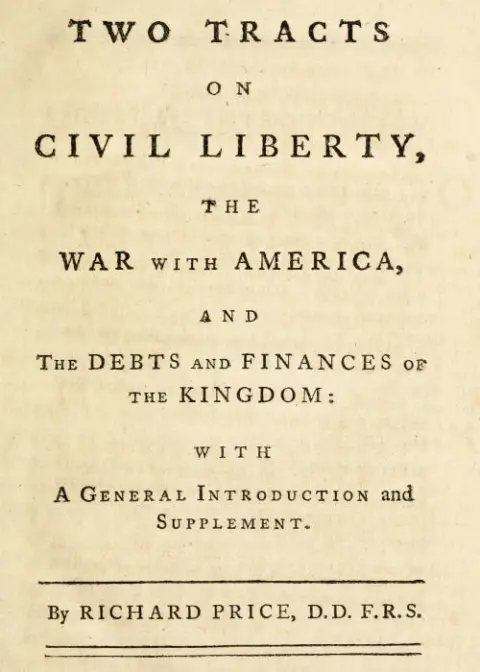
"Two Tracts on Civil Liberty, the War with America, and the Debts and Finances of the Kingdom" by Richard Price is a historical treatise written in the late 18th century. The work comprises two tracts that explore the concepts of civil liberty and the implications of the American War for Independence, as well as the financial implications of these issues for Britain. Price delves into the philosophical underpinnings of government and the nature of liberty, emphasizing the importance of representation and consent within a just society. The opening of this treatise presents an introduction to the fundamental arguments for civil liberty that Price aims to make. He contrasts two competing views of government: one that establishes authority through the people's consent and another that derives authority from divine right. Price articulates his belief that legitimate government must be founded on the principles of freedom and equality, where laws are a reflection of the collective will. Furthermore, he addresses the growing tensions between Britain and America, arguing that the rights and liberties of the American colonies must be acknowledged, warning that attempts to subjugate them could lead to a broader conflict that undermines the values of civil liberty he cherishes. The matters discussed set the stage for his detailed exploration of political philosophy and practical governance as the historical context unfolds.
Introduction adapted from the source catalogue; source summaries may be automatically generated.
Free to read · English · 84,822 words · No account needed
MAKE TIME FOR A GOOD BOOK
On by default. Untick to stop anonymous reading totals. Each page counts after 10 seconds in view. How this works.
Anonymous counting is on unless you have switched it off.
Thirdly. Employing foreign troops to subdue them. This produced a greater effect in America than is commonly imagined. And it is remarkable, that even the writers in America who answered the pamphlet entitled COMMON SENSE, acknowledge, that should the British ministry have recourse to foreign aid, it might become[95] proper to follow their example, and to embrace the necessity of resolving upon independence.
I have, further, reason to believe, that the answer to the last petition of the City of London, presented in March 1776,[96] had no small share in producing the same effect.
By these measures, and others of the same kind, those Colonists who had all along most dreaded and abhorred independence, were at last reconciled to it.—I can, however, say from particular information, that even so lately as the month of June last, an accommodation might have been obtained with the Colonies, on a reasonable and moderate plan; without giving up any one of the rights claimed by this country, except that of altering their charters and disposing of their property.—And, as it would have restored peace and prevented the desolating calamities into which America and Britain are now plunged, no friend to humanity can avoid regretting that such a plan, when offered, was not adopted. But our rulers preferred coercion and conquest: And the consequence has been, that the Colonies, after being goaded and irritated to the utmost, resolved to disengage themselves, and directed the CONGRESS to declare them Independent States; which was accordingly done, as is well-known, on the 4th of July last. Since that time, they have, probably, been making applications to foreign powers; and it is to be feared, that now we may in vain offer them the very terms for which they once sued.—All this is the necessary consequence of the principles by which human nature is governed.—There was a time when, perhaps, we should ourselves have acted with more violence; and, instead of remonstrating and praying, as America has done, have refused the most advantageous terms when offered with defiance, and under an awe from a military force. Had King WILLIAM, instead of coming over by invitation to deliver us, invaded us; and, at the head of an army, offered us the BILL OF RIGHTS; we should, perhaps, have spurned at it; and considered LIBERTY itself as no better than SLAVERY, when enjoyed as a boon from an insolent conqueror.—But we have all along acted as if we thought the people of America did not possess the feelings and passions of men, much less of Englishmen.—It is indeed strange our ministers did not long ago see, that they had mistaken the proper method of treating the Colonies; and that though they might be gradually influenced to any thing, they could be dragooned to nothing.—Had King James the Second avoided violence; and been a little more patient and secret in pursuing his views, he might have gained all he wished for. But an eager haste and an open avowal of the odious claims of prerogative ruined him.—This has been since considered; and a plan both here and in Ireland,[97] less expeditious indeed, but more sure, has been pursued. And had the same plan been pursued in America, the whole empire might in time have been brought, without a struggle, to rest itself quietly in the lap of corruption and slavery. It may, therefore, in the issue prove happy to the Colonies, that they have not been thought worthy of any such cautious treatment. Our coercive measures have done all for them that their warmest patriots could have desired. They have united them among themselves, and bound them together under one government. They have checked them in the career of vicious luxury; guarded them against any farther infection from hence; taught them to seek all their resources within themselves; instructed them in the use of arms; and led them to form a naval and military power which may, perhaps, in time, become superior to any force that can attack them, and prove the means of preserving from invasion and violence, a government of justice and virtue, to which the oppressed in every quarter of the globe may fly, and find peace, protection, and liberty.—In short. These measures have, in all probability, hastened that disruption of the new from the old world, which will begin a new æra in the annals of mankind;[98] and produce a revolution more important, perhaps, than any that has happened in human affairs.—As a friend, therefore, to the general interest of mankind, I ought, probably, to rejoice in these measures; and to bless that all-governing Providence, which, often, out of the evil intended by wretched mortals, brings the greatest good.—But when I consider the present sufferings which these measures must occasion, and the catastrophe with which they threaten GREAT-BRITAIN; I am shocked; and feel myself incapable of looking forward, without distress, to the fate of an empire, once united and happy, but now torn to pieces, and falling a sacrifice to despotic violence and blindness. Under the impressions of these sentiments, and dreading the awful crisis before us, I cannot help, however impotent my voice, crying out to this country—“Make no longer war against yourselves. Withdraw your armies from your Colonies. Offer your power to them as a protecting, not a destroying power. Grant the security they desire to their property and charters; and renounce those notions of dignity, which lead you to prefer the exactions of force to the offerings of gratitude, and to hazard every thing to gain nothing.—By such wisdom and equity America may, perhaps, be still preserved; and that dreadful breach healed, which your enemies are viewing with triumph, and all Europe with astonishment.”
Your reading position is saved on this browser. Take it to another device with a library code. Reading pages adapt to text, rather than matching a printed edition.
BEHIND THE BOOK
This eBook is for the use of anyone anywhere in the United States and most other parts of the world at no cost and with almost no restrictions whatsoever. You may copy it, give it away or re-use it under the terms of the Project Gutenberg License included with this eBook or online at www.gutenberg.org. If you are not located in the United States, you will have to check the laws of the country where you are located before using this eBook. Read the source licence.
The original source file, including credits and licence, is retained by this library. Request an original-format copy at no charge. Please include the book title and Project Gutenberg identifier #57970.
KEEP YOUR CURIOSITY GOING
David Patterson (Spirit) Hatch
Cécile Tormay

Moritz Busch
Coulson Kernahan
John L. Ransom

Ralph Waldo Emerson