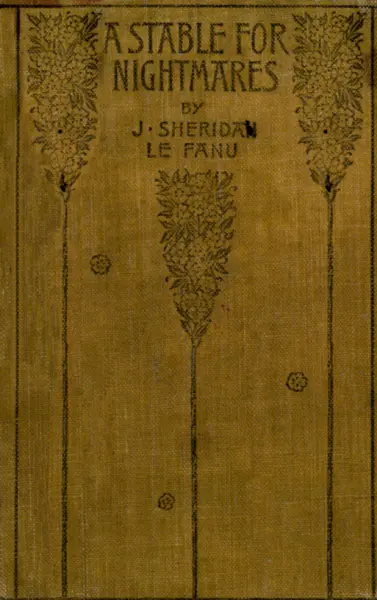
A Stable for Nightmares; or, Weird Tales
Joseph Sheridan Le Fanu & Charles L. (Charles Lawrence), Sir Young
THE CLASSIC COLLECTION · 1836
"Two Ghostly Mysteries" by Joseph Sheridan Le Fanu is a collection of two supernatural stories written during the mid-19th century. The first tale, "A Chapter in the History of a Tyrone Family", revolves around a tragic narrative centered on family and loss, featuring the protagonist's emotional turmoil following the death of her sister. The second story, "The Murdered Cousin", focuses on themes of suspicion and intrigue within a family, likely revealing dark secrets connected to a gruesome murder. At the start of the collection, the story "A Chapter in the History" introduces the narrator, Fanny Richardson, who recounts her childhood in a wealthy yet emotionally cold family. Following her sister's marriage and subsequent death, Fanny grapples with feelings of neglect from her parents and the overwhelming loneliness that ensues. As the story unfolds, the tension builds around the mystery of her sister's death and the haunting events that accompany it. The opening sections set the stage for a tale steeped in themes of loss, familial duty, and the eerie presence of the supernatural, leading readers to anticipate a rich exploration of the impact of such dark occurrences on the human psyche.
Introduction adapted from the source catalogue; source summaries may be automatically generated.
Free to read · English · 27,919 words · No account needed
MAKE TIME FOR A GOOD BOOK
On by default. Untick to stop anonymous reading totals. Each page counts after 10 seconds in view. How this works.
Anonymous counting is on unless you have switched it off.
My uncle, Sir Arthur Tyrrell, was a gay and extravagant man, and, among other vices, was ruinously addicted to gaming. This unfortunate propensity, even after his fortune had suffered so severely as to render retrenchment imperative, nevertheless continued to engross him, nearly to the exclusion of every other pursuit. He was, however, a proud, or rather a vain man, and could not bear to make the diminution of his income a matter of triumph to those with whom he had hitherto competed; and the consequence was, that he frequented no longer the expensive haunts of his dissipation, and retired from the gay world, leaving his coterie to discover his reasons as best they might. He did not, however, forego his favourite vice, for though he could not worship his great divinity in those costly temples where he was formerly wont to take his place, yet he found it very possible to bring about him a sufficient number of the votaries of chance to answer all his ends. The consequence was, that Carrickleigh, which was the name of my uncle's residence, was never without one or more of such visiters as I have described. It happened that upon one occasion he was visited by one Hugh Tisdall, a gentleman of loose, and, indeed, low habits, but of considerable wealth, and who had, in early youth, travelled with my uncle upon the Continent. The period of this visit was winter, and, consequently, the house was nearly deserted excepting by its ordinary inmates; it was, therefore, highly acceptable, particularly as my uncle was aware that his visiter's tastes accorded exactly with his own.
Both parties seemed determined to avail themselves of their mutual suitability during the brief stay which Mr. Tisdall had promised; the consequence was, that they shut themselves up in Sir Arthur's private room for nearly all the day and the greater part of the night, during the space of almost a week, at the end of which the servant having one morning, as usual, knocked at Mr. Tisdall's bed-room door repeatedly, received no answer, and, upon attempting to enter, found that it was locked. This appeared suspicious, and the inmates of the house having been alarmed, the door was forced open, and, on proceeding to the bed, they found the body of its occupant perfectly lifeless, and hanging halfway out, the head downwards, and near the floor. One deep wound had been inflicted upon the temple, apparently with some blunt instrument, which had penetrated the brain, and another blow, less effective--probably the first aimed--had grazed his head, removing some of the scalp. The door had been double locked upon the inside, in evidence of which the key still lay where it had been placed in the lock. The window, though not secured on the interior, was closed; a circumstance not a little puzzling, as it afforded the only other mode of escape from the room. It looked out, too, upon a kind of court-yard, round which the old buildings stood, formerly accessible by a narrow doorway and passage lying in the oldest side of the quadrangle, but which had since been built up, so as to preclude all ingress or egress; the room was also upon the second story, and the height of the window considerable; in addition to all which the stone window-sill was much too narrow to allow of any one's standing upon it when the window was closed. Near the bed were found a pair of razors belonging to the murdered man, one of them upon the ground, and both of them open. The weapon which inflicted the mortal wound was not to be found in the room, nor were any footsteps or other traces of the murderer discoverable. At the suggestion of Sir Arthur himself, the coroner was instantly summoned to attend, and an inquest was held. Nothing, however, in any degree conclusive was elicited. The walls, ceiling, and floor of the room were carefully examined, in order to ascertain whether they contained a trap-door or other concealed mode of entrance, but no such thing appeared. Such was the minuteness of investigation employed, that, although the grate had contained a large fire during the night, they proceeded to examine even the very chimney, in order to discover whether escape by it were possible. But this attempt, too, was fruitless, for the chimney, built in the old fashion, rose in a perfectly perpendicular line from the hearth, to a height of nearly fourteen feet above the roof, affording in its interior scarcely the possibility of ascent, the flue being smoothly plastered, and sloping towards the top like an inverted funnel; promising, too, even if the summit were attained, owing to its great height, but a precarious descent upon the sharp and steep-ridged roof; the ashes, too, which lay in the grate, and the soot, as far as it could be seen, were undisturbed, a circumstance almost conclusive upon the point.
Your reading position is saved on this browser. Take it to another device with a library code. Reading pages adapt to text, rather than matching a printed edition.
Joseph Sheridan Le Fanu & Charles L. (Charles Lawrence), Sir Young
Joseph Sheridan Le Fanu
Joseph Sheridan Le Fanu
Joseph Sheridan Le Fanu
BEHIND THE BOOK
This eBook is for the use of anyone anywhere in the United States and most other parts of the world at no cost and with almost no restrictions whatsoever. You may copy it, give it away or re-use it under the terms of the Project Gutenberg License included with this eBook or online at www.gutenberg.org. If you are not located in the United States, you will have to check the laws of the country where you are located before using this eBook. Read the source licence.
The original source file, including credits and licence, is retained by this library. Request an original-format copy at no charge. Please include the book title and Project Gutenberg identifier #12828.
KEEP YOUR CURIOSITY GOING
Coulson Kernahan

Maurice Baring
Frances Wright
Cécile Tormay
Francis Greenleaf Allinson & Anne C. E. (Anne Crosby Emery) Allinson

Frederic Jesup Stimson