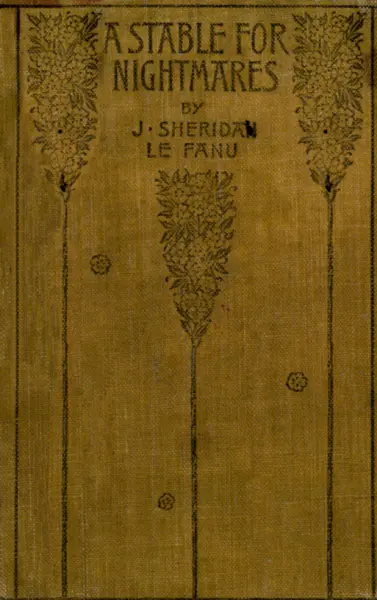
A Stable for Nightmares; or, Weird Tales
Joseph Sheridan Le Fanu & Charles L. (Charles Lawrence), Sir Young
THE CLASSIC COLLECTION · 1836
"Two Ghostly Mysteries" by Joseph Sheridan Le Fanu is a collection of two supernatural stories written during the mid-19th century. The first tale, "A Chapter in the History of a Tyrone Family", revolves around a tragic narrative centered on family and loss, featuring the protagonist's emotional turmoil following the death of her sister. The second story, "The Murdered Cousin", focuses on themes of suspicion and intrigue within a family, likely revealing dark secrets connected to a gruesome murder. At the start of the collection, the story "A Chapter in the History" introduces the narrator, Fanny Richardson, who recounts her childhood in a wealthy yet emotionally cold family. Following her sister's marriage and subsequent death, Fanny grapples with feelings of neglect from her parents and the overwhelming loneliness that ensues. As the story unfolds, the tension builds around the mystery of her sister's death and the haunting events that accompany it. The opening sections set the stage for a tale steeped in themes of loss, familial duty, and the eerie presence of the supernatural, leading readers to anticipate a rich exploration of the impact of such dark occurrences on the human psyche.
Introduction adapted from the source catalogue; source summaries may be automatically generated.
Free to read · English · 27,919 words · No account needed
MAKE TIME FOR A GOOD BOOK
On by default. Untick to stop anonymous reading totals. Each page counts after 10 seconds in view. How this works.
Anonymous counting is on unless you have switched it off.
"I have been too much of a rake, lately; I am racking out my nerves," said I, speaking aloud, with a view to reassure myself. I rang the bell, and, attended by old Martha, I retired to settle for the night. While the servant was, as was her custom, arranging the lamp which I have already stated always burned during the night in my chamber, I was employed in undressing, and, in doing so, I had recourse to a large looking-glass which occupied a considerable portion of the wall in which it was fixed, rising from the ground to a height of about six feet; this mirror filled the space of a large pannel in the wainscoting opposite the foot of the bed. I had hardly been before it for the lapse of a minute, when something like a black pall was slowly waved between me and it.
"Oh, God! there it is," I exclaimed wildly. "I have seen it again,
Martha--the black cloth."
"God be merciful to us, then!" answered she, tremulously crossing herself. "Some misfortune is over us."
"No, no, Martha," said I, almost instantly recovering my collectedness; for, although of a nervous temperament, I had never been superstitious. "I do not believe in omens. You know, I saw, or fancied I saw, this thing before, and nothing followed."
"The Dutch lady came the next morning," replied she.
"Methinks, such an occurrence scarcely deserved a supernatural
announcement," I replied.
"She is a strange woman, my lady," said Martha, "and she is not gone
yet--mark my words."
"Well, well, Martha," said I, "I have not wit enough to change your opinions, nor inclination to alter mine; so I will talk no more of the matter. Good night," and so I was left to my reflections. After lying for about an hour awake, I at length fell into a kind of doze; but my imagination was still busy, for I was startled from this unrefreshing sleep by fancying that I heard a voice close to my face exclaim as before, "There is blood upon your ladyship's throat." The words were instantly followed by a loud burst of laughter. Quaking with horror, I awakened, and heard my husband enter the room. Even this was a relief. Scared as I was, however, by the tricks which my imagination had played me, I preferred remaining silent, and pretending to sleep, to attempting to engage my husband in conversation, for I well knew that his mood was such, that his words would not, in all probability, convey anything that had not better be unsaid and unheard. Lord Glenfallen went into his dressing-room, which lay upon the right-hand side of the bed. The door lying open, I could see him by himself, at full length upon a sofa, and, in about half an hour, I became aware, by his deep and regularly drawn respiration, that he was fast asleep. When slumber refuses to visit one, there is something peculiarly irritating, not to the temper, but to the nerves, in the consciousness that some one is in your immediate presence, actually enjoying the boon which you are seeking in vain; at least, I have always found it so, and never more than upon the present occasion. A thousand annoying imaginations harassed and excited me, every object which I looked upon, though ever so familiar, seemed to have acquired a strange phantom-like character, the varying shadows thrown by the flickering of the lamp-light, seemed shaping themselves into grotesque and unearthly forms, and whenever my eyes wandered to the sleeping figure of my husband, his features appeared to undergo the strangest and most demoniacal contortions. Hour after hour was told by the old clock, and each succeeding one found me, if possible, less inclined to sleep than its predecessor. It was now considerably past three; my eyes, in their involuntary wanderings, happened to alight upon the large mirror which was, as I have said, fixed in the wall opposite the foot of the bed. A view of it was commanded from where I lay, through the curtains, as I gazed fixedly upon it, I thought I perceived the broad sheet of glass shifting its position in relation to the bed; I rivetted my eyes upon it with intense scrutiny; it was no deception, the mirror, as if acting of its own impulse moved slowly aside, and disclosed a dark aperture in the wall, nearly as large as an ordinary door; a figure evidently stood in this; but the light was too dim to define it accurately. It stepped cautiously into the chamber, and with so little noise, that had I not actually seen it, I do not think I should have been aware of its presence. It was arrayed in a kind of woollen night-dress, and a white handkerchief or cloth was bound tightly about the head; I had no difficulty spite of the strangeness of the attire in recognising the blind woman whom I so much dreaded. She stooped down, bringing her head nearly to the ground, and in that attitude she remained motionless for some moments, no doubt in order to ascertain if any suspicious sound were stirring. She was apparently satisfied by her observations, for she immediately recommenced her silent progress towards a ponderous mahogany dressing table of my husband's; when she had reached it, she paused again, and appeared to listen attentively for some minutes; she then noiselessly opened one of the drawers from which, having groped for some time, she took something which I soon perceived to be a case of razors; she opened it and tried the edge of each of the two instruments upon the skin of her hand; she quickly selected one, which she fixed firmly in her grasp; she now stooped down as before, and having listened for a time, she, with the hand that was disengaged, groped her way into the dressing room where Lord Glenfallen lay fast asleep. I was fixed as if in the tremendous spell of a night mare. I could not stir even a finger; I could not lift my voice; I could not even breathe, and though I expected every moment to see the sleeping man murdered, I could not even close my eyes to shut out the horrible spectacle, which I had not the power to avert. I saw the woman approach the sleeping figure, she laid the unoccupied hand lightly along his clothes, and having thus ascertained his identity, she, after a brief interval, turned back and again entered my chamber; here she bent down again to listen. I had now not a doubt but that the razor was intended for my throat; yet the terrific fascination which had locked all my powers so long, still continued to bind me fast. I felt that my life depended upon the slightest ordinary exertion, and yet I could not stir one joint from the position in which I lay, nor even make noise enough to waken Lord Glenfallen. The murderous woman now, with long, silent steps, approached the bed; my very heart seemed turning to ice; her left hand, that which was disengaged, was upon the pillow; she gradually slid it forward towards my head, and in an instant, with the speed of lightning, it was clutched in my hair, while, with the other hand, she dashed the razor at my throat. A slight inaccuracy saved me from instant death; the blow fell short, the point of the razor grazing my throat; in a moment I know not how, I found myself at the other side of the bed uttering shriek after shriek; the wretch was, however, determined if possible to murder me; scrambling along by the curtains, she rushed round the bed towards me; I seized the handle of the door to make my escape; it was, however, fastened; at all events I could not open it, from the mere instinct of recoiling terror, I shrunk back into a corner--she was now within a yard of me--her hand was upon my face--I closed my eyes fast, expecting never to open them again, when a blow, inflicted from behind by a strong arm, stretched the monster senseless at my feet; at the same moment the door opened, and several domestics, alarmed by my cries, entered the apartment. I do not recollect what followed, for I fainted. One swoon succeeded another so long and death-like, that my life was considered very doubtful. At about ten o'clock, however, I sunk into a deep and refreshing sleep, from which I was awakened at about two, that I might swear my deposition before a magistrate, who attended for that purpose. I, accordingly, did so, as did also Lord Glenfallen; and the woman was fully committed to stand her trial at the ensuing assizes. I shall never forget the scene which the examination of the blind woman and of the other parties afforded. She was brought into the room in the custody of two servants; she wore a kind of flannel wrapper which had not been changed since the night before; it was torn and soiled, and here and there smeared with blood, which had flowed in large quantities from a wound in her head; the white handkerchief had fallen off in the scuffle; and her grizzled hair fell in masses about her wild and deadly pale countenance. She appeared perfectly composed, however, and the only regret she expressed throughout, was at not having succeeded in her attempt, the object of which she did not pretend to conceal. On being asked her name, she called herself the Countess Glenfallen, and refused to give any other title.
Your reading position is saved on this browser. Take it to another device with a library code. Reading pages adapt to text, rather than matching a printed edition.
Joseph Sheridan Le Fanu & Charles L. (Charles Lawrence), Sir Young
Joseph Sheridan Le Fanu
Joseph Sheridan Le Fanu
Joseph Sheridan Le Fanu
BEHIND THE BOOK
This eBook is for the use of anyone anywhere in the United States and most other parts of the world at no cost and with almost no restrictions whatsoever. You may copy it, give it away or re-use it under the terms of the Project Gutenberg License included with this eBook or online at www.gutenberg.org. If you are not located in the United States, you will have to check the laws of the country where you are located before using this eBook. Read the source licence.
The original source file, including credits and licence, is retained by this library. Request an original-format copy at no charge. Please include the book title and Project Gutenberg identifier #12828.
KEEP YOUR CURIOSITY GOING
Coulson Kernahan

Maurice Baring
Frances Wright
Cécile Tormay
Francis Greenleaf Allinson & Anne C. E. (Anne Crosby Emery) Allinson

Frederic Jesup Stimson