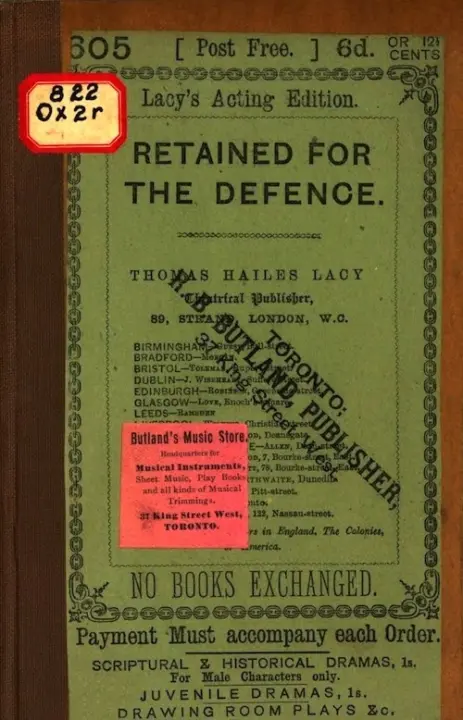
Retained for the Defence: A Farce, in One Act
John Oxenford
THE CLASSIC COLLECTION · 1835
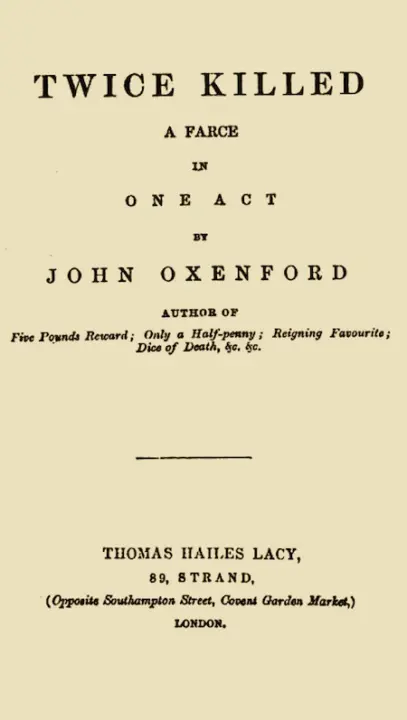
"Twice Killed: A Farce in One Act" by John Oxenford is a comedic play written during the early 19th century, specifically in the Victorian era. This farce revolves around themes of mistaken identities and romantic entanglements, set against the backdrop of societal norms and the absurdity of love. Through lively characters and humorous scenarios, it explores the consequences of secrecy and deception in romantic pursuits. The storyline follows Mr. Ralph Reckless, who pursues a young lady named Julia Flighty while using a false identity to avoid the scrutiny of his guardian. Meanwhile, Tom, his servant, devises a heartfelt plan to win over Fanny Pepper by gifting her a basket filled with groceries. However, the situation escalates when Reckless finds himself hidden inside a basket intended for Fanny, leading to a chaotic series of events as various characters misunderstand the circumstances. The play culminates in a humorous resolution as all characters come together, revealing true identities and intentions amidst a series of blunders, making for a tangled, yet comedic finale.
Introduction adapted from the source catalogue; source summaries may be automatically generated.
Free to read · English · 7,254 words · No account needed
MAKE TIME FOR A GOOD BOOK
On by default. Untick to stop anonymous reading totals. Each page counts after 10 seconds in view. How this works.
Anonymous counting is on unless you have switched it off.
EUCLID. (aside.) That's the constable. No, sir, not here; it came from the window next door. What, Reckless! Ah, how do you do? (aside.) Where the deuce did he come from?
RECK. I won't say a word about the basket; I'll feign I called to see him. How do you do, my boy? We have not seen one another these--
EUCLID. These four years. So you remember me, and came to call?
RECK. Yes, ahem!
EUCLID. Very kind. But how did you know I lived here?
RECK. Oh, I saw you at the window.
EUCLID. Come, come, we don't occupy the front, and the back of the
house is in the water.
RECK. Ahem! Oh, ah! I was rowing past a quarter of an hour ago.
EUCLID. Ah--h--h! And you saw me at the window, did you? You did not see me do anything particular, did you?
RECK. No. (aside.) Good reason, I never saw you at all. No.
EUCLID. Ha! ha! no, of course not. What was there particular for me to
do, eh?
RECK. (aside.) What a strange manner he has!
FANNY. And I was not standing by him, was I?
RECK. No.
EUCLID. No, to be sure not.
RECK. What the devil does this mean? They seem uneasy about something. I suppose he has been kissing the girl at the window. Ha! ha! I understand you.
EUCLID. Eh? do you though?
FANNY. Oh, gemini, oh!
RECK. You are a sly fellow, Euclid. (whispers.) Eh?
EUCLID. (aside.) It's all right--no, no, wrong, I assure you. But you always had such odd ideas--still in the same spirits.
RECK. Yes, I can always smile; like that water which wears a smooth countenance, whatever is beneath its surface.
EUCLID. (aside.) Curse his similes!
FANNY. (aside.) I hates figurative language.
RECK. Gad! what a lumping I had in that basket--I feel quite knocked up! (aside.) A little refreshment--Euclid, my old friend, you know I don't mind taking liberties with you--could you give me a glass of wine?
FANNY. Yes, sir, I saw a bottle in the room where the bas--
EUCLID. Ah--h--hem! the store-room you mean. Fetch it.
[Exit FANNY, R.
RECK. It will be rather acceptable, I assure you. I have just come off a very unpleasant journey.
EUCLID. What? by the coach?
RECK. (aside.) No, by the basket. You mentioned your wife. You are married--and these are your lodgings?
EUCLID. For the present; I don't think I shall stay here.
RECK. Where shall you go then?
EUCLID. (aside.) To Newgate, most likely. That, sir, depends
entirely upon circumstances.
Enter FANNY with bottle and glass, R.
Your reading position is saved on this browser. Take it to another device with a library code. Reading pages adapt to text, rather than matching a printed edition.
BEHIND THE BOOK
This eBook is for the use of anyone anywhere in the United States and most other parts of the world at no cost and with almost no restrictions whatsoever. You may copy it, give it away or re-use it under the terms of the Project Gutenberg License included with this eBook or online at www.gutenberg.org. If you are not located in the United States, you will have to check the laws of the country where you are located before using this eBook. Read the source licence.
The original source file, including credits and licence, is retained by this library. Request an original-format copy at no charge. Please include the book title and Project Gutenberg identifier #49481.
KEEP YOUR CURIOSITY GOING
Maurice Baring
W. B. (William Butler) Yeats
Edward Martyn

John Brougham & Charlotte Brontë
Marguerite Merington
Leonid Andreyev