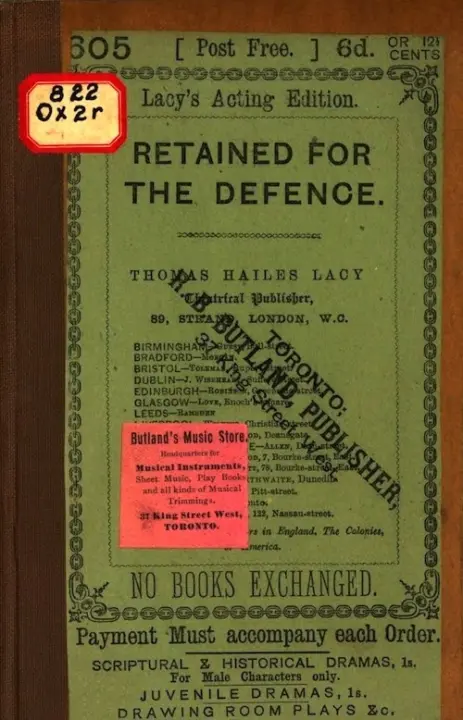
Retained for the Defence: A Farce, in One Act
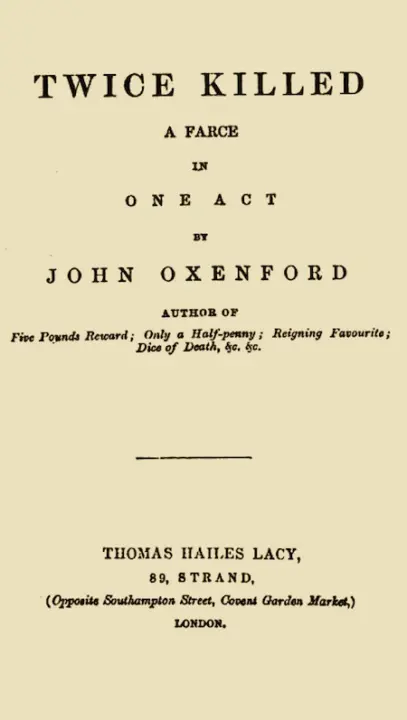
John Oxenford
THE CLASSIC COLLECTION · 1835
"Twice Killed: A Farce in One Act" by John Oxenford is a comedic play written during the early 19th century, specifically in the Victorian era. This farce revolves around themes of mistaken identities and romantic entanglements, set against the backdrop of societal norms and the absurdity of love. Through lively characters and humorous scenarios, it explores the consequences of secrecy and deception in romantic pursuits. The storyline follows Mr. Ralph Reckless, who pursues a young lady named Julia Flighty while using a false identity to avoid the scrutiny of his guardian. Meanwhile, Tom, his servant, devises a heartfelt plan to win over Fanny Pepper by gifting her a basket filled with groceries. However, the situation escalates when Reckless finds himself hidden inside a basket intended for Fanny, leading to a chaotic series of events as various characters misunderstand the circumstances. The play culminates in a humorous resolution as all characters come together, revealing true identities and intentions amidst a series of blunders, making for a tangled, yet comedic finale.
Introduction adapted from the source catalogue; source summaries may be automatically generated.
Free to read · English · 7,254 words · No account needed
MAKE TIME FOR A GOOD BOOK
On by default. Untick to stop anonymous reading totals. Each page counts after 10 seconds in view. How this works.
Anonymous counting is on unless you have switched it off.
RECK. I am De Mowbray; my real name is Reckless. This letter will convince you I have a handsome fortune at my disposal, if I may be allowed to lay it at the feet of Miss Flighty.
EUCLID. Mowbray! Mowbray! here! You did not come in a basket, and see
my wife?
RECK. Yes, but I did though.
EUCLID. Then there's nobody killed, tol-de-rol! Fanny, there's nobody
killed.
Enter MRS. FACILE and JULIA, R.
JULIA. De Mowbray!
RECK. Reckless, dear Julia, if you please.
HOLD. Yes, my dear, he is a gentleman of whom I approve, and you may take him as soon as you please.
TOM. And, Fanny, we cannot do better than follow so good an example.
(takes her hand.)
FABLE. A monstrous pleasant joke. Catch me here again in a hurry.
HOLD. What's all this about a basket?
EUCLID. Why this gentleman has been twice killed. I'll tell you all at breakfast; now let us retire to rest after the troubles of this eventful night, and contrive not to dream.
FANNY. At any rate not of bottles and baskets.
EUCLID. And now, ladies and gentlemen, that you've seen my friend, Reckless "Twice Killed," let us hope that you will, at length, allow him to live uninterruptedly--uninterruptedly, did I say? No; for if my innocent delinquencies did serve to amuse you, I shall feel the greatest pleasure in killing him twice more to-morrow.
TOM., FAN., MRS. F., EUC., JULIA, RECK., HOLD., FAB. R. L.
Transcriber's Note
This transcription is based on images digitized by Google from a copy made available by the Ohio State University and posted by the HathiTrust at:
catalog.hathitrust.org/Record/100593073
Because a few page scans had text cut off next to the margin, this transcription has been compared with the text posted by the Victorian Plays Project at:
victorian.nuigalway.ie/modx/assets/docs/pdf/Vol24xivTwice.pdf
In general, this transcription attempts to retain the punctuation and spelling of the source text. Variant spellings have been retained, including "calender," "terrestial," "accomodation," and "dosing" (for "dozing"), as have inconsistent spellings such as "lattitude" and "latitude." Obvious errors have been corrected. The use of "its" and "it's" has been made consistent.
The following changes were noted:
- Frontispiece: The punctuation of the caption text has been made consistent with the script text.
- p. 3: though it's utility exceeds it's beauty--Changed "it's" to
"its" in both cases.
- p. 5: its very unkind of you--Changed "its" to "it's".
- p. 6: "X plus Y. equal to--"--Deleted the period after "Y".
- p. 8: [MEN do so and exeunt., L. H.--Deleted the period after
"exeunt".
- p. 13: FANNY. (screams,) Oh!--Changed the comma after "screams"
to a period.
Your reading position is saved on this browser. Take it to another device with a library code. Reading pages adapt to text, rather than matching a printed edition.
BEHIND THE BOOK
This eBook is for the use of anyone anywhere in the United States and most other parts of the world at no cost and with almost no restrictions whatsoever. You may copy it, give it away or re-use it under the terms of the Project Gutenberg License included with this eBook or online at www.gutenberg.org. If you are not located in the United States, you will have to check the laws of the country where you are located before using this eBook. Read the source licence.
The original source file, including credits and licence, is retained by this library. Request an original-format copy at no charge. Please include the book title and Project Gutenberg identifier #49481.
KEEP YOUR CURIOSITY GOING
Maurice Baring
W. B. (William Butler) Yeats
Edward Martyn

John Brougham & Charlotte Brontë
Marguerite Merington
Leonid Andreyev