THE CLASSIC COLLECTION✦Andersonville diaryCLASSIC FREE BOOKS
Andersonville diary
John L. Ransom
THE CLASSIC COLLECTION · 1920
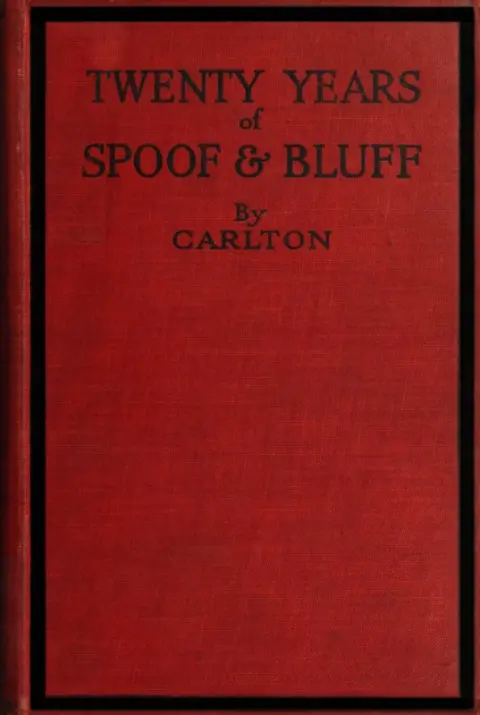
"Twenty Years of Spoof and Bluff" by Carlton is a memoir written in the early 20th century. The book narrates the fascinating life of the author, who recounts his journey from being a young telegraph messenger boy to becoming a skilled performer in the entertainment world, filled with anecdotes and experiences from his career. Through a blend of humor and hardship, Carlton shares insights into the world of street performances and conjuring, recounting the challenges and triumphs he faced along the way. The opening of the memoir introduces readers to Carlton's early experiences, revealing his humble beginnings and the tough circumstances that led him to pursue a career in show business. He describes his initial attempts at public entertainment, including busking on the sands of Southend, where he faces challenges such as stage fright and the threat of rowdy competitors. As he learns the ropes of showmanship, Carlton's resourcefulness and determination allow him to navigate hardships, setting the stage for his remarkable transformation and the many adventures to come in the vibrant world of entertainment.
Introduction adapted from the source catalogue; source summaries may be automatically generated.
Free to read · English · 88,213 words · No account needed
MAKE TIME FOR A GOOD BOOK
On by default. Untick to stop anonymous reading totals. Each page counts after 10 seconds in view. How this works.
Anonymous counting is on unless you have switched it off.
Tommy thought this an excellent idea, and went off there and then and
got his cards printed.
“Where shall I go first?” he asked me later on in the day.
“Doesn’t matter!” I replied off-handedly. “Why not try the Oxford? Come to-morrow night, and bring half a dozen pals with you.”
“Right,” replied Tommy, beaming with pleasurable anticipation, “I will.”
And he did.
Meanwhile I had seen Mr. Blythe Pratt, the Manager, and told him about the joke; with the result that when Tommy appeared, with six rather nondescript-looking friends, he was received with every courtesy, and given a private box for the evening.
Of course he was delighted. Vistas of unlimited free entertainments loomed before his excited imagination.
“Where shall I go to-morrow night?” he asked.
“Oh,” I said. “Why not try the T----,” mentioning a Hall where there was, I knew, an unusually grumpy and quick-tempered manager.
He went. What exactly transpired there I never heard. But I can imagine
the scene.
Tommy was quite upset about it.
“Oh,” there must have been some mistake, I told him. “Try the Palace
to-night.”
And he actually did try it. But that finished it. The reception he met with there finally cured him of all further desire in the direction of cadging for free seats.
By the way, here is a funny story that occurs to me as I write.
Although it is not generally known to the public, it is, nevertheless, a fact that Houdini, the world-famous “Handcuff King,” and Hardeen, his rival in the business, are brothers.
They are, however, on the best of terms with one another personally, being rivals only professionally. Once it happened that Houdini had a week’s engagement at Leeds at the same time that Hardeen was appearing at Bradford.
Houdini arrived in the former town very late at night, and desiring to see his brother on an urgent matter of business he went over to Bradford, arriving there about two o’clock in the morning, when, of course, everybody had gone to bed.
However, Houdini made the best of his way to where his brother lodged, and after he had been knocking and hammering at the door for about twenty minutes, “loud enough,” as he expressed it, “to wake the dead,” the landlord put his head out of the window.
“Who are you? What do you want?” he asked rather irately.
“I’m Houdini, the handcuff king, and I want to see my brother, Mr. Hardeen, on important business,” was the reply. “Come down and open the door.”
The landlord grunted. Then--“Oh, you’re Houdini, are you? That there chap as can open any lock?”
Your reading position is saved on this browser. Take it to another device with a library code. Reading pages adapt to text, rather than matching a printed edition.
BEHIND THE BOOK
This eBook is for the use of anyone anywhere in the United States and most other parts of the world at no cost and with almost no restrictions whatsoever. You may copy it, give it away or re-use it under the terms of the Project Gutenberg License included with this eBook or online at www.gutenberg.org. If you are not located in the United States, you will have to check the laws of the country where you are located before using this eBook. Read the source licence.
The original source file, including credits and licence, is retained by this library. Request an original-format copy at no charge. Please include the book title and Project Gutenberg identifier #49547.
KEEP YOUR CURIOSITY GOING
John L. Ransom

Herman W. Mudgett

Harriet Monroe
Daniel Dulany Addison
Charles Lanman

Harold Rosher