THE CLASSIC COLLECTION✦An outlaw’s diary: the CommuneCLASSIC FREE BOOKS
An outlaw’s diary: the Commune
Cécile Tormay
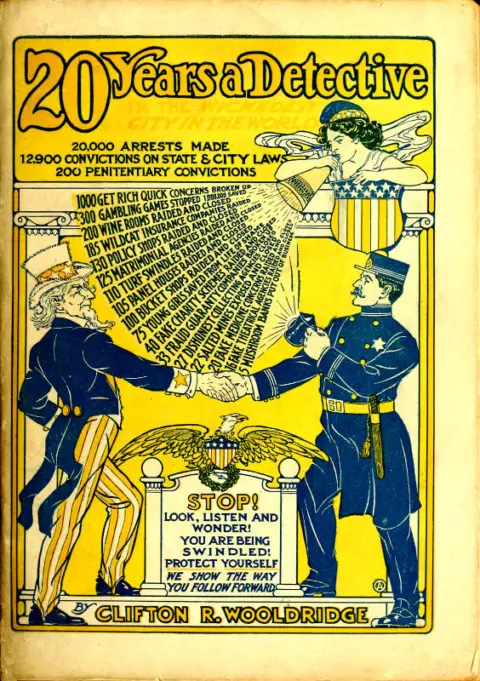
THE CLASSIC COLLECTION · 1908
"Twenty Years a Detective in the Wickedest City in the World" by Clifton R. Wooldridge is a true crime memoir written in the early 20th century. The book details the author’s extensive experiences and achievements as a detective in Chicago, focusing on exposing various forms of criminal activities and corruption, particularly those related to street crime, fraud, and graft. Wooldridge, hailed as "the incorruptible Sherlock Holmes of America," shares not only his statistics and arrests but also his insights into the darker corners of society and the methods used by criminals. The opening of the memoir reveals Wooldridge's commitment to fighting crime in a city notorious for its corruption. He discusses his heroic endeavors, encompassing 20,000 arrests, various operations against fraudulent schemes, and his battle against the pervasive influence of the "grafter." Through a detailed account of his methodology and interactions in the field, he illustrates the cunning tactics used by criminals, while also asserting his integrity and dedication to serving justice. The preface sets the tone for a captivating journey into the world of crime and the moral complexities that come with law enforcement, showcasing Wooldridge's insights as he reflects on both societal vulnerabilities and the personal risks he faced during his two-decade career.
Introduction adapted from the source catalogue; source summaries may be automatically generated.
Free to read · English · 161,642 words · No account needed
MAKE TIME FOR A GOOD BOOK
On by default. Untick to stop anonymous reading totals. Each page counts after 10 seconds in view. How this works.
Anonymous counting is on unless you have switched it off.
Mr. Sullivan owned the entire equipments of the offices and dictated the policy and work to each manager, which had to be carried out to the letter. The following is a list of the branch offices and locations which were operated by Mr. Sullivan:
The Sullivan letterhead gives branch offices in the following cities: Altoona, Pa., Arcola, Ill.; Aurora, Ill.; Avoca, Ia.; Boston, Mass.; Buda, Ill.; Burlington, Ia.; Cambridge, Ill.; Chicago, Ill.; Cleveland, O.; Davenport, Ia.: Decatur, Ill.; Des Moines, Ia.; Detroit, Mich.; Earlville, Ill.; Effingham, Ill.; Elkhart, Ind.; Fairfield, Ind.; Fostoria, O.; Fort Madison, Ia.: Galesburg, Ill.; Geneseo, Ill.; Gibson City, Ill.; Goshen, Ind.; Grand Rapids, Mich.; Greenville, Ill.; Grinnell, Ia.; Iowa City, Ia.; Ivesdale, Ill.; Johnstown, Pa.; Kalamazoo, Mich.; Keokuk, Ia.; Kewanee, Ill.; Lancaster, Pa.; Mansfield, Ill.; Mattoon, Ill.; Michigan City, Ind.; Milwaukee, Wis.; Monmouth, Ill.; Monticello, Ill.; Morris, Ill.; Mount Pleasant, Ia.; New Castle, Pa.; New York, N. Y.; Niles, O.; Omaha, Neb.; Peoria, Ill.; Pittsburg, Pa.; Plano, Ill.; Princeton, Ill.; Racine, Wis.; Roberts, Ill.; Saybrook, Ill.; South Bend, Ind.; Sheffield, Ill.; St. Louis, Mo.; Tolono, Ill.; Tiffin, O.; Toledo, O.; Tuscola, Ill.; Waukegan, Ill.; Wyanet, Ill.
Chicago--225 Dearborn street, National Life Building, 16 Imperial Building, 51 Dexter Building, 84 Adams street, South Chicago--9138 Commercial avenue.
Mr. Sullivan had his correspondents and solicitors in all of the leading stock, bond, grain and cotton markets of most of the foreign countries. On May 23, 1903, he was doing a business of from $300,000 to $500,000 per year. His weekly expenses ran from $15,000 to $20,000.
Mr. Sullivan advertised extensively in the leading newspapers throughout the United States and in foreign countries. Many of his advertisements would cover an entire page. These advertisements brought him many inquiries from persons either through curiosity or desire to invest, saying nothing of the cash customers secured.
Mr. Sullivan made special effort to buy or acquire every mailing list to be found in the entire country which had been used by other fraudulent and get-rich-quick concerns.
It is said that he had secured over 20,000 names, which he had on his mailing list. These men were bombarded from day to day with his literature and his red-letters, giving the forecast of the market. These letters were very ingeniously gotten up by himself and a clairvoyant fortune teller named Madame Dunbar.
His methods were absolutely devoid of even a pretense of sound
business ethics, sensationalism and red ink being his only stock in
trade.
The class of literature and telegrams he sent broadcast and regardless of expense is well illustrated by the following:
Telegram sent January 1, 1903, to hundreds of persons throughout the
country:
Your reading position is saved on this browser. Take it to another device with a library code. Reading pages adapt to text, rather than matching a printed edition.
BEHIND THE BOOK
This eBook is for the use of anyone anywhere in the United States and most other parts of the world at no cost and with almost no restrictions whatsoever. You may copy it, give it away or re-use it under the terms of the Project Gutenberg License included with this eBook or online at www.gutenberg.org. If you are not located in the United States, you will have to check the laws of the country where you are located before using this eBook. Read the source licence.
The original source file, including credits and licence, is retained by this library. Request an original-format copy at no charge. Please include the book title and Project Gutenberg identifier #47445.
KEEP YOUR CURIOSITY GOING
Cécile Tormay

Moritz Busch
John L. Ransom
Frances Wright
Cécile Tormay

Mabel Potter Daggett