THE CLASSIC COLLECTION✦An outlaw’s diary: the CommuneCLASSIC FREE BOOKS
An outlaw’s diary: the Commune
Cécile Tormay
THE CLASSIC COLLECTION · 1923
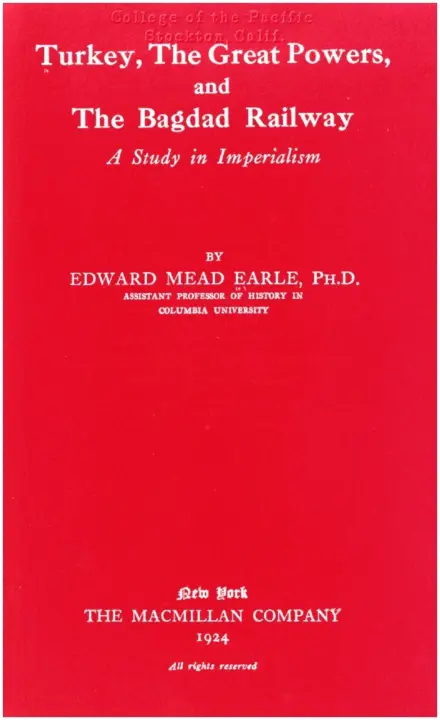
"Turkey, the Great Powers, and the Bagdad Railway: A Study in Imperialism" by Edward Mead Earle is a historical account written in the early 20th century. The book explores the intricate dynamics of imperialism as they relate to the rise of the Bagdad Railway project and its implications on Turkey and its global significance. Through meticulous analysis, it examines how various great powers engaged with the Ottoman Empire’s resources and strategic position. The opening of the book details the historical context leading to the significance of the Bagdad Railway, introducing it as an essential link reviving ancient trade routes during the 19th century. Earle outlines the broader implications of rail development on the economic and political stability of Turkey, emphasizing both the hopes tied to modernization and the inherent dangers posed by international rivalries. The narrative sets the stage for a deeper discussion on how this railway project emerged in a landscape fraught with imperial aspirations and the challenges the Ottoman Empire faced in asserting its sovereignty amidst foreign interests. Overall, the initial chapters lay a foundation for understanding the complexities that surrounded the construction of the Bagdad Railway as a symbol of both progress and contention in modern imperialism.
Introduction adapted from the source catalogue; source summaries may be automatically generated.
Free to read · English · 109,189 words · No account needed
MAKE TIME FOR A GOOD BOOK
On by default. Untick to stop anonymous reading totals. Each page counts after 10 seconds in view. How this works.
Anonymous counting is on unless you have switched it off.
[28] Compiled from the Statistisches Jahrbuch für das deutsche Reich, 1900–1914, as corrected for 1900–1905 according to the Statistisches Handbuch für das deutsche Reich, Volume 2, pp. 506–510. A remarkable increase of German exports to Turkey—an increase of 50%—is to be noted in the year 1904, during which the first section of the Bagdad Railway was constructed. Undoubtedly this increase is to be partially accounted for by the purchase in Germany of materials for right of way as well as rolling stock for the railway. This factor should not be over-estimated, however, as a glance at the following tables will show that imports into Turkey from other European countries during the same year likewise showed increases, without exception. The general falling off in trade during 1908 may be attributed, in part, at any rate, to the Young Turk Revolution of that year.
[29] Compiled from Diplomatic and Consular Reports, Nos. 2950 (1902), 3533 (1905), 4188 (1908), and 4835 (1910–1911).
[30] Supra, p. 36.
[31] Diplomatic and Consular Reports, No. 3533 (1905), p. 27; Turkey
in Europe, pp. 86–87.
[32] Mesopotamia, pp. 99–101; Schaefer, op. cit., p. 22. Regarding British interests in the Persian Gulf, cf., a detailed statement by Lord Lansdowne to the House of Lords, May 5, 1903. Parliamentary Debates, House of Lords, fourth series, Volume 121 (1903), pp. 1347–1348.
[33] “Bagdad: Handelsbericht des kaiserlichen Konsulats für das Jahr 1908–1909,” in Deutsches Handels-Archiv, 1910, part 2, pp. 27–35; also, “Bericht über den Handel in Basra und Bagdad für das Jahr 1910,” ibid., 1912, part 2, pp. 263–270; Mesopotamia, p. 108.
[34] Cf. supra, pp. 59–60; Report of the Bagdad Railway Company, 1906, p. 4, 1908, pp. 7–8; Diplomatic and Consular Reports, No. 3533 (1905), p. 29. The Mersina-Adana line was formally incorporated in the Bagdad system in 1908. Cf. Deuxième convention additionelle à la convention du chemin de fer de Bagdad (Constantinople, 1910).
[35] Parliamentary Debates, House of Commons, fifth series, Volume 22
(1911), pp. 1284–1285.
[36] Quatrième convention additionelle à la convention du 5 Mars, 1903, relative au chemin de fer de Bagdad (Constantinople, 1911). H. F. B. Lynch (of the firm of Lynch Brothers), “The Bagdad Railway: the New Conventions,” in the Fortnightly Review, new series, Volume 89 (1911), pp. 773–780. Mr. Lynch explains that his summary of the Alexandretta port concessions is based upon an authentic article appearing in La Turquie, a Constantinople newspaper, of March 21, 1911. Diplomatic and Consular Reports, No. 4835 (1911), p. 16; The Times (London), March 23, 1911.
[37] Stenographische Berichte, XII. Legislaturperiode, 2 Session, Volume 266 (1911), pp. 5984c et seq.; Troisième convention additionelle à la convention du 5 Mars, 1903, relative au chemin de fer de Bagdad (Constantinople, 1911); Parliamentary Debates, House of Commons, fifth series, Volume 23 (1911), pp. 582–583, statement by Sir Edward Grey.
[38] See speeches of Herr Scheidemann and Herr Bassermann before the Reichstag, March 30, 1911. Stenographische Berichte, XII. Legislaturperiode, 2 Session, Volume 266 (1911), pp. 5980 et seq.
[39] Parliamentary Debates, House of Lords, fifth series, Volume 23
(1911), p. 589.
[40] D. Chatir, “L’État actuel du chemin de fer de Bagdad,” in Questions diplomatiques et coloniales, Volume 36 (1913), pp. 279–281; Report of the Bagdad Railway Company, 1910, p. 4, 1911, p. 4, 1913, pp. 3–5, 1914, pp. 6–8.
Your reading position is saved on this browser. Take it to another device with a library code. Reading pages adapt to text, rather than matching a printed edition.
BEHIND THE BOOK
This eBook is for the use of anyone anywhere in the United States and most other parts of the world at no cost and with almost no restrictions whatsoever. You may copy it, give it away or re-use it under the terms of the Project Gutenberg License included with this eBook or online at www.gutenberg.org. If you are not located in the United States, you will have to check the laws of the country where you are located before using this eBook. Read the source licence.
The original source file, including credits and licence, is retained by this library. Request an original-format copy at no charge. Please include the book title and Project Gutenberg identifier #66221.
KEEP YOUR CURIOSITY GOING
Cécile Tormay

Moritz Busch
John L. Ransom
Frances Wright
Cécile Tormay

Mabel Potter Daggett