THE CLASSIC COLLECTION✦An outlaw’s diary: the CommuneCLASSIC FREE BOOKS
An outlaw’s diary: the Commune
Cécile Tormay
THE CLASSIC COLLECTION · 1923
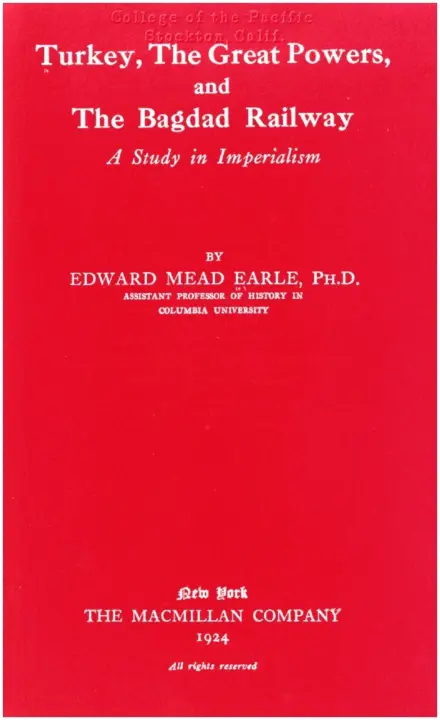
"Turkey, the Great Powers, and the Bagdad Railway: A Study in Imperialism" by Edward Mead Earle is a historical account written in the early 20th century. The book explores the intricate dynamics of imperialism as they relate to the rise of the Bagdad Railway project and its implications on Turkey and its global significance. Through meticulous analysis, it examines how various great powers engaged with the Ottoman Empire’s resources and strategic position. The opening of the book details the historical context leading to the significance of the Bagdad Railway, introducing it as an essential link reviving ancient trade routes during the 19th century. Earle outlines the broader implications of rail development on the economic and political stability of Turkey, emphasizing both the hopes tied to modernization and the inherent dangers posed by international rivalries. The narrative sets the stage for a deeper discussion on how this railway project emerged in a landscape fraught with imperial aspirations and the challenges the Ottoman Empire faced in asserting its sovereignty amidst foreign interests. Overall, the initial chapters lay a foundation for understanding the complexities that surrounded the construction of the Bagdad Railway as a symbol of both progress and contention in modern imperialism.
Introduction adapted from the source catalogue; source summaries may be automatically generated.
Free to read · English · 109,189 words · No account needed
MAKE TIME FOR A GOOD BOOK
On by default. Untick to stop anonymous reading totals. Each page counts after 10 seconds in view. How this works.
Anonymous counting is on unless you have switched it off.
Nevertheless, the rapid expansion of German financial interests in the Near East and the established policy of the German banks to encourage and assist export trade were factors in a remarkable development of German trade in the Ottoman Empire, as will be indicated by the following table:[28]
EXPORTS FROM IMPORTS TO
TURKEY TO TURKEY FROM
YEAR GERMANY—MARKS GERMANY—MARKS
1900 30,400,000 34,400,000
1901 30,000,000 37,500,000
1902 36,500,000 43,300,000
1903 37,700,000 50,200,000
1904 43,500,000 75,300,000
1905 51,600,000 71,000,000
1906 55,000,000 68,200,000
1907 55,100,000 81,500,000
1908 47,600,000 64,000,000
1909 57,300,000 78,900,000
1910 67,400,000 104,900,000
1911 70,100,000 112,800,000
This table eloquently describes the nature of the advance of German economic interests in Turkey. It does not, however, tell the whole story. Was this advance the result of a general increase of prosperity in the Ottoman Empire in which the Germans shared in common with other traders? Or was the increase in German trade out of proportion to the progress of other nationals—perhaps at the expense of the French and British? The following tables will help answer these questions:[29]
EXPORTS FROM TURKEY TO UNITED TO AUSTRIA KINGDOM TO FRANCE TO ITALY HUNGARY YEAR MARKS MARKS MARKS MARKS
1900 118,760,000 86,220,000 22,520,000 35,220,000 1901 122,000,000 26,120,000 31,540,000 1902 130,520,000 83,040,000 28,980,000 35,580,000 1903 127,400,000 81,200,000 38,120,000 39,900,000 1904 122,760,000 73,120,000 31,300,000 39,120,000 1905 118,960,000 80,780,000 42,240,000 37,640,000 1906 129,440,000 91,600,000 45,100,000 39,300,000 1907 136,600,000 95,320,000 50,480,000 34,640,000 1908 109,220,000 70,760,000 44,580,000 34,360,000 1909 109,320,000 79,000,000 59,080,000 36,600,000 1910 100,660,000 77,000,000 48,000,000 43,340,000
IMPORTS TO TURKEY FROM FROM UNITED FROM AUSTRIA KINGDOM FRANCE FROM ITALY HUNGARY YEAR MARKS MARKS MARKS MARKS
1900 102,920,000 29,800,000 29,720,000 53,440,000 1901 128,220,000 37,880,000 43,800,000 57,100,000 1902 123,980,000 37,200,000 40,400,000 61,380,000 1903 114,020,000 36,640,000 45,360,000 65,120,000 1904 151,960,000 40,880,000 53,280,000 77,600,000 1905 139,300,000 42,420,000 57,200,000 76,660,000 1906 167,040,000 47,300,000 70,900,000 92,620,000 1907 147,380,000 46,380,000 63,040,000 89,920,000 1908 145,260,000 51,600,000 58,700,000 69,240,000 1909 156,280,000 54,600,000 67,740,000 77,040,000 1910 177,160,000 58,400,000 94,000,000 107,300,000
Certain important conclusions may be drawn from these statistics:
1. British trade continued during the decade 1900–1910 to dominate the Near Eastern market. With total imports and exports in the latter year of over 277,000,000 marks it was in no immediate danger of being outstripped by its nearest rivals—a German trade of about 172,000,000 marks and an Austro-Hungarian trade of about 150,000,000 marks.
2. France, whose Near Eastern trade in 1900 had proudly held a position second only to that of the United Kingdom, was being obliged to accept a less prominent place in the economic life of the Ottoman Empire. During the first ten years of the new century French merchants obviously were being outmaneuvered by Germans, Austro-Hungarians, and Italians. In spite of a total increase of 17% in exports and imports between France and Turkey it was apparent that French trade was not keeping the pace; during the same period Austro-Hungarian trade showed an increased valuation of 81%, German trade of 166%.
3. Although it continued to dominate the Near Eastern market, British commerce, likewise, was losing ground. Between 1900 and 1910 it showed an increase of only 25% as compared with the Italian record of 172% during the same period. During the decade British exports, although showing an increased valuation, fell off from 35% to 22–1/2% of the total import trade of Turkey; for the same period German exports achieved not only an absolute gain of almost eighty million marks, but also a relative increase from 2–1/2% to 11–1/2% of the whole.
Your reading position is saved on this browser. Take it to another device with a library code. Reading pages adapt to text, rather than matching a printed edition.
BEHIND THE BOOK
This eBook is for the use of anyone anywhere in the United States and most other parts of the world at no cost and with almost no restrictions whatsoever. You may copy it, give it away or re-use it under the terms of the Project Gutenberg License included with this eBook or online at www.gutenberg.org. If you are not located in the United States, you will have to check the laws of the country where you are located before using this eBook. Read the source licence.
The original source file, including credits and licence, is retained by this library. Request an original-format copy at no charge. Please include the book title and Project Gutenberg identifier #66221.
KEEP YOUR CURIOSITY GOING
Cécile Tormay

Moritz Busch
John L. Ransom
Frances Wright
Cécile Tormay

Mabel Potter Daggett